Vücudundaki bazı atomlar senden milyarlarca yıl yaşlı
Bunu mecaz olarak söylemiyorum
Şu an bedenini oluşturan karbonun oksijenin kalsiyumun demirin ve daha birçok elementin önemli bir kısmı sen doğmadan çok çok önce başka yıldızların içinde üretildi
Çünkü Büyük Patlamadan hemen sonra evrende bugünkü anlamıyla karmaşık elementler yoktu
Hidrojen vardı helyum vardı ve çok az miktarda lityum vardı
Sonra ilk yıldızlar doğdu
Bu yıldızların merkezlerinde milyarlarca yıl boyunca nükleer füzyon gerçekleşti ve evrende daha ağır elementler oluşmaya başladı
Bazı yıldızlar öldüğünde bu elementleri uzaya saçtı
Yeni yıldızlar gezegenler ve sonunda Dünya bu kozmik enkazın içinden oluştu
Yani bedenindeki demirin bir kısmı Dünya’da başlamadı
Güneş’te bile başlamadı
Senden milyarlarca yıl önce yaşamış yıldızların ölümünden kalan maddelerin içinden geldi
Şu anda aynaya baktığında gördüğün şey sadece bir insan değil
Yaklaşık 14 milyar yıllık kozmik bir sürecin geçici biçimi
Ve belki de insanın kendisiyle ilgili en tuhaf gerçek şu
Bir gün sen ortadan kaybolacaksın
Ama seni oluşturan atomların çoğu kaybolmayacak
Sadece başka bir şeyin parçası olmaya devam edecek
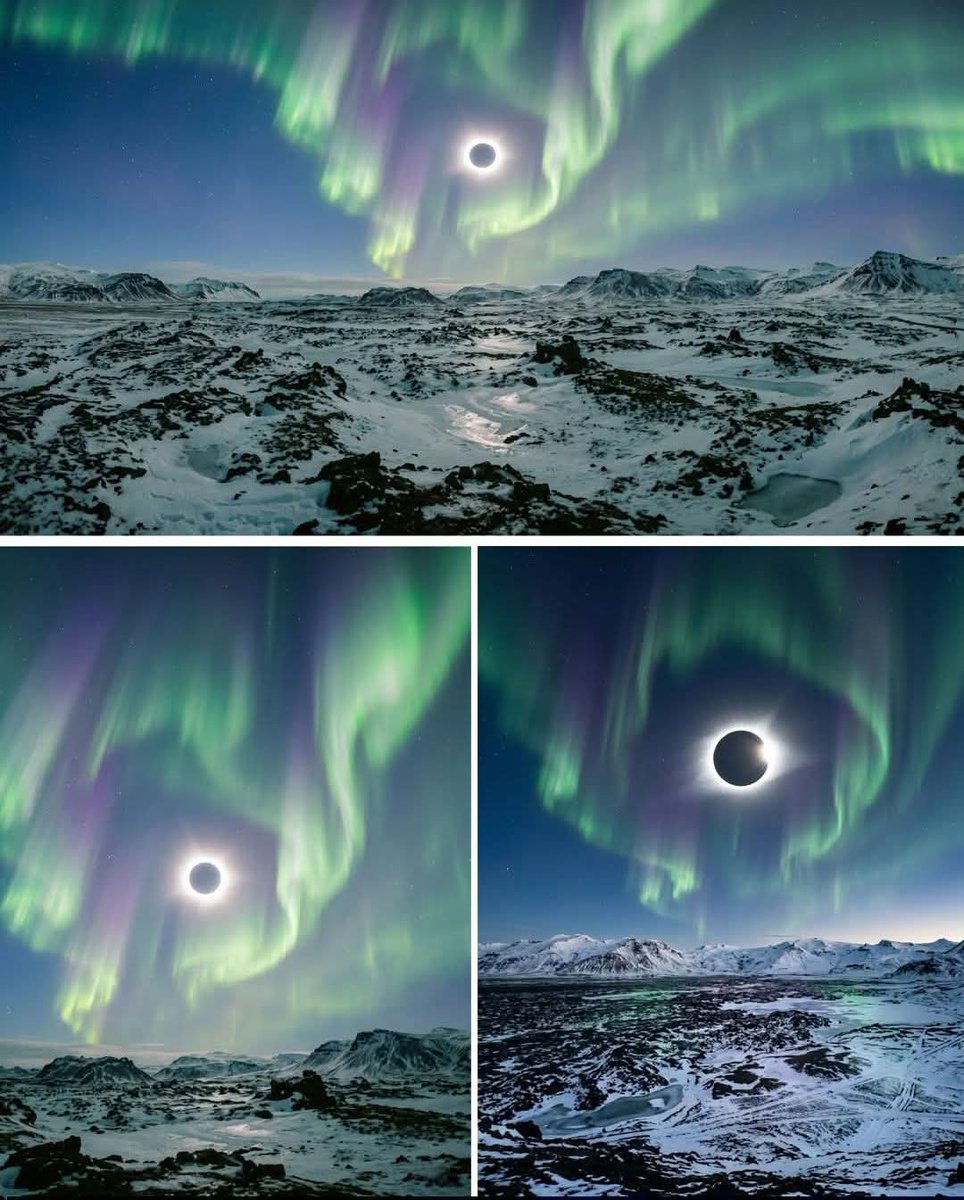
The universe just pulled off something almost impossible… over Iceland. 🌌🌑
This is the kind of moment that doesn’t just feel rare… it feels unreal.
Seeing the Aurora Borealis is already a bucket-list experience.
Witnessing a Solar Eclipse is rare on its own.
But both… perfectly aligned in the same sky?
That’s the “double crown” — and it might be a once-in-a-lifetime sight.
What looks like pure magic is actually a perfect storm of timing:
✨ A powerful geomagnetic storm ignited vivid auroras across the polar sky
🌑 At the exact same time, the Moon slipped into the Sun’s path of totality
👁️ From the perfect angle, the Sun’s glowing corona formed one crown… while shimmering green auroras painted another behind it
Two crowns. One sky. One fleeting moment.
This is what happens when cosmic precision meets Earth’s atmosphere — a reminder that the universe doesn’t just work in equations… it performs.
And sometimes, if everything aligns just right… we get to witness it.
NASA’s black hole size comparison still wrecks us every time.
Starts with a Sun-mass speck, then scales to TON 618; its shadow so vast light takes weeks just to cross it. Galaxies become specks. We’re not even dust.
400 yılı aşkın bir süre önce Galileo Galilei, kütlenin bir nesnenin düşme hızını etkilemediğini öne sürmüştü.
Artık dünyadaki en büyük vakum odasını kullanarak fiziğin bu temel ilkesini doğrulayabiliyoruz.
Se cree que los gatos🐈 protegen el sueño de sus dueños actuando como guardianes energéticos y físicos. A nivel espiritual, se dice que absorben la energía negativa acumulada, mientras que en el plano físico, su presencia cercana proporciona seguridad, calma y calor, lo que reduce el estrés y mejora la calidad del descanso.
Benditos gatos.
Astronautas relatam que o espaço tem um cheiro forte e inconfundível: bife queimado, pólvora e metal quente.
O odor gruda no traje após cada caminhada espacial.
A causa? Moléculas de estrelas mortas grudadas na roupa. Você está cheirando cadáver de estrela.
A Swiss photographer named Tobias Messereli captured this amazing picture of the sun setting perfectly behind a tree. It’s absolutely spectacular!
📸: TMPhoto
How a sunset looks from space.
The International Space Station races around Earth at 28,000 km/h as the Sun slips below the curved horizon. Fiery reds and glowing pinks light up the clouds while the thin blue atmosphere glows against the black of space.
Captured by ESA astronaut Alexander Gerst on October 28, 2018. Every 90 minutes the ISS sees a sunset like this.
Clearest image of Moon ever captured...
You may think moon is colourless but this is what it really looks like in true color.
Its so detailed you can even see individual crater and spots in color.
Japan’s leap into the deep blue has birthed a technological titan: the world’s first megawatt-scale underwater turbine designed to anchor within the relentless Kuroshio Current. Unlike solar or wind energy, which are beholden to the whims of the weather, this subaquatic marvel taps into ocean streams that flow with permanent, unshakable consistency. Because water is roughly 800 times denser than air, even a slow-moving current carries a kinetic punch far more powerful than a howling gale, allowing these massive "sea-planes" to generate a steady, "always-on" stream of green electricity that could theoretically power the nation 24/7.
The sheer scale of this ambition is staggering, as researchers estimate that the energy pulsing through Japan’s coastal waters could reach a capacity of 205 gigawatts—nearly enough to match the country’s entire current power generation. These turbines operate like inverted satellites, hovering in the water column and using sophisticated sensors to maintain stability against the crushing pressure of the depths. By transforming the silent, eternal movement of the Pacific into a high-tech power plant, Japan isn't just building a gadget; it is effectively turning the ocean into the planet’s largest, most reliable natural battery.