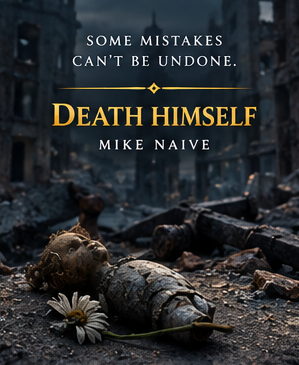
If you want to read a blasphemous book about death narrated by Death Himself, you’ll have to wait until January.
Available to pre-order now.
https://t.co/eOgxZohDU7
If you want to read a blasphemous book about death narrated by Death Himself, you’ll have to wait until January.
Available to pre-order now.
https://t.co/eOgxZohDU7
Apparently people are folding their grocery bags into tiny perfect triangles now. I thought we all agreed the proper storage method was to nominate the strongest grocery bag and stuff 63 other bags inside it, like our mothers and grandmothers before us.
I’m about to use 4,000 gallons of water and enough electricity to power a small city for a month by asking grok what the difference is between a lake and a pond
On 2nd September 2010, an 89 year old woman died alone in her flat in Torquay, England.
To most people around her, Eileen Nearne appeared to be simply a quiet elderly woman living an unremarkable life.
Then they began going through her belongings.
They found medals. They found wartime documents.
And an extraordinary story began to emerge.
Nearly seven decades earlier, Eileen had been a British secret agent operating behind enemy lines in Nazi occupied France. She was just 23 years old when she was sent into France in 1944 as an agent of Britain's Special Operations Executive.
Her job was incredibly dangerous.
Eileen worked as a clandestine wireless operator, transmitting secret messages between resistance networks in France and London.
Every time she switched on her radio, she risked discovery. German direction finding teams hunted illegal transmitters, and wireless operators could be captured if they remained on air for too long.
Eventually, they found her.
In July 1944, German security forces raided the house from which Eileen was transmitting. She was arrested and interrogated. Her captors wanted to know who she was working for and what she knew.
Eileen refused to reveal the truth. Instead, she maintained a cover story, claiming she was an innocent Frenchwoman who had been sending messages for a businessman.
She was tortured. She still did not give them the information they wanted. Eileen was eventually sent to Ravensbrück, the notorious concentration camp for women, and later transferred to another camp where she endured forced labour.
Then, as Nazi Germany collapsed in 1945, she escaped during a prisoner transfer. After everything she had survived, Eileen made her way through Germany while hiding from enemy forces until she finally reached safety.
She returned home after the war.
And then she largely disappeared from public view.
For decades, many of the people living around her had little idea what the quiet woman in their neighbourhood had once done.
When Eileen died on September 2, 2010, there was initially concern that she might receive a simple council arranged funeral because no close relatives were immediately known.
Then her wartime possessions were discovered.
The forgotten elderly woman had been anything but ordinary.
She had been parachuted into occupied France.
She had transmitted secret messages while the Gestapo hunted people like her.
She had been captured.
She had survived interrogation, imprisonment and a concentration camp.
And she had escaped.
Eileen Nearne had carried one of Britain's most dangerous wartime jobs when she was only 23 years old. Most of the world only learned the full extent of her remarkable story after she was gone.
Today, we remember Eileen Nearne.
1921–2010
R.I.P.