If you lived there, @Jason (and I do), you would realize that France is in a spiral.
The culture you refer to is historical—and the wine & produce are still excellent, as is some engineering and academia. But it is a self-inflicted failure, with the rot evidenced by economic data and attributable to the present-day culture of entitlement, laziness, arrogance and the buying-in to pan-European wokeness.
Of course, not everyone is of such a mindset. But those who have seen the light are the French that have lived abroad—and they all recommended not moving there! The rest are provincial, resist change and have made complaining a national sport.
A recent stay in Milan was so refreshing (I’m sure @chamath would agree): not dodging dog shit on the sidewalks or enjoying the fragrance of human urine everywhere (yes, these are real things…still).
The country is beautiful but insufferable.
So, who’s going to “protect” its culture?
⚡️The U.S. no longer has to compare itself to Europe as a whole to show divergence.
Individual American mega-states are starting to look like peer competitors to major European nations.
That is a huge tell.
The hidden variable is operating leverage.
Texas sits inside the American platform: dollar system, U.S. capital markets, U.S. military umbrella, U.S. tech ecosystem, U.S. legal and corporate infrastructure, massive domestic consumer base, and free internal migration.
France carries sovereign responsibilities Texas does not carry. Texas does not have to run an independent currency, nuclear deterrent, national pension architecture, foreign policy, or full welfare-state balance sheet on its own.
So the comparison flatters Texas and slightly cheats. But it still reveals something brutal: the most dynamic U.S. regions now compound faster than legacy European nation-states because they combine American-scale capital access with state-level policy flexibility.
Texas is not merely a place. It is a growth machine.
Energy is the core. Cheap and abundant power sits underneath everything: AI data centers, petrochemicals, LNG, manufacturing, grid expansion, Bitcoin mining, defense industry, industrial reshoring, and population growth. Europe spent years moralizing energy policy while Texas kept treating energy as civilization’s base layer. That difference compounds.
The next geopolitical split is not simply America versus Europe. It is high-energy, high-capex, high-migration growth zones versus low-energy, high-regulation preservation zones.
Texas is one of the clearest examples of the first category.
France is one of the clearest examples of the second.
Europe still has culture, beauty, history, education, engineering depth, and institutional memory. But growth power is moving toward places that can build, power, permit, finance, and absorb people faster. Civilization is becoming more infrastructure-bound again. Energy, land, grid, ports, chips, compute, and capital velocity matter more than postwar prestige.
Final read: this chart is not just bragging about Texas. It is a map of the new world.
The future is flowing toward jurisdictions that can turn energy into capital formation without suffocating the process.
France represents inherited civilization.
Texas represents compounding civilization.
Right now, compounding is winning.
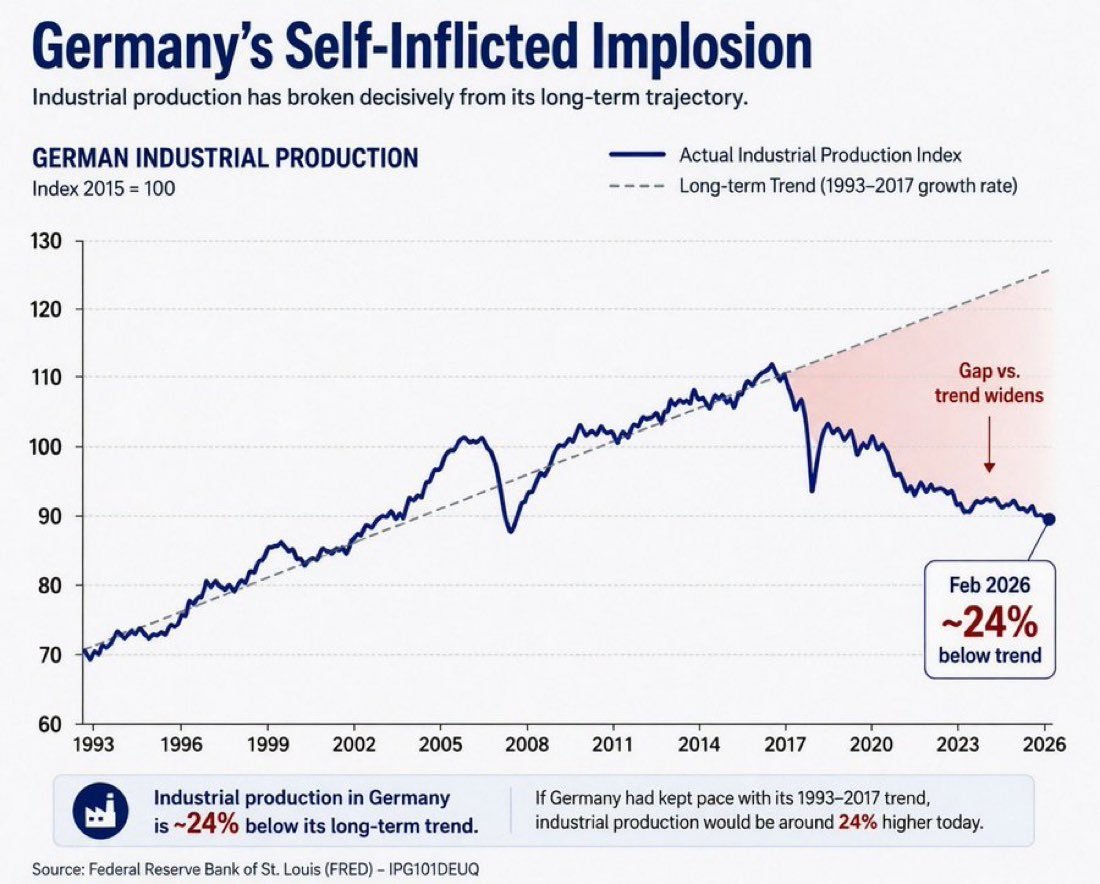
Deutschland ist geil.
Man muss das endlich einmal positiv sehen: Die Industrieproduktion sinkt. Und zwar nicht irgendwie, sondern mit Haltung.
Während andere Länder noch rückständig produzieren, exportieren, Maschinen bauen, Chemie herstellen, Stahl kochen und Wohlstand erwirtschaften, geht Deutschland mutig voran: Wir bauen ab.
Nicht chaotisch. Nicht zufällig. Sondern wertebasiert.
Endlich kommen wir den großen Zielen näher. Weniger Industrie heißt weniger Energieverbrauch. Weniger Energieverbrauch heißt mehr Effizienz. Und wenn irgendwann gar nichts mehr produziert wird, sind wir praktisch unschlagbar energieeffizient.
Das Energieeffizienzgesetz wird dann nicht erfüllt.
Es wird übertroffen.
Natürlich gibt es ein paar kleine Nebenwirkungen: weniger Arbeitsplätze, weniger Wohlstand, weniger Know-how, weniger Steuerbasis, weniger Zukunft. Aber wer wird denn so materialistisch sein? Wohlstand ist doch ein sehr altes Konzept. Fast schon toxisch. Nach Fabrik. Nach Schichtarbeit. Nach Leistung. Nach Männern mit Werkzeugkoffer.
Heute geht es um Größeres.
Um Moral.
Um Haltung.
Um CO₂-neutrale Selbstverzwergung.
Wir produzieren vielleicht bald weniger Autos, weniger Maschinen, weniger Chemieprodukte und weniger Innovation. Aber dafür produzieren wir Weltrettungsgefühle in industriellem Maßstab. Das ist doch auch Wertschöpfung. Jedenfalls in Talkshows.
Man muss den Grünen fast dankbar sein. Sie haben verstanden: Der modernste Industriestandort ist der, der keiner mehr ist. Kein Lärm, keine Abgase, keine Energieprobleme, keine Lieferketten. Nur noch Lehmhütte, Lastenrad und ein Arbeitskreis für resiliente Postwachstumsräume.
Gut, Zelte wären auch möglich, aber die bestehen oft aus modernen Materialien. Also lieber Lehm. Regional. Nachhaltig. Kreislauffähig. Bei Regen leider etwas herausfordernd, aber das nennen wir dann Transformationserfahrung.
Das wirklich Geniale ist: Mit jeder Fabrik, die verschwindet, verschwindet auch Wissen. Und wenn das Wissen erst einmal weg ist, muss man auch nichts mehr produzieren. Dann fragt auch keiner mehr, warum wir es nicht mehr können.
Das ist deutsche Konsequenz.
Erst machen wir Energie teuer.
Dann wundern wir uns über weniger Produktion.
Dann nennen wir es Strukturwandel.
Dann erklären wir den Abstieg zur moralischen Avantgarde.
Andere Länder bauen Kernkraftwerke, Industrieparks, Chipfabriken und Infrastruktur.
Deutschland baut Haltung.
Und wenn die Kurve weiter fällt, sollten wir nicht jammern. Wir sollten feiern. Denn jede nicht produzierte Maschine ist ein kleiner Sieg gegen den alten Wohlstand. Jede geschlossene Fabrik ein stillgelegtes CO₂-Risiko. Jeder verlorene Industriearbeitsplatz ein Beitrag zur nationalen Entlastung vom Leistungsdruck.
Deutschland ist nicht im Niedergang.
Deutschland meditiert nur auf dem Weg zur Lehmhütte.
Wissen ist Macht. Wir wissen nichts, Macht nichts.
⚠️ALERT: A SINGLE USB STICK CAN NOW DRAIN YOUR ENTIRE CRYPTO WALLET
Microsoft just flagged a malware called CryptoBandits that has been spreading through USB drives.
Once you plug one in, it swaps any wallet address you copy with the attacker's and grabs your seed phrases and private keys.
Any funds you send to it go straight to the attacker.
This is the last time I’m going to comment on the Reuters story about the alleged $3 billion, $12 billion, or $20 billion supposedly transferred, made available, made accessible, or otherwise handed over by the UAE to the Iranian regime, a claim that the UAE government has categorically denied.
Let me state something clearly.
I’ve spent more than two decades working in intelligence, counter terror finance, and financial investigations. I’ve worked on terrorism financing cases, advised on complex IRGC finance matters, and been called as an expert witness in terrorism finance cases involving governments, major banks, and cross-border financial transactions.
And one thing I learned very early is this:
When a story revolves entirely around a financial transaction, you do not simply assert that Country X paid Country Y billions of dollars and then expect everyone else to prove that it didn’t happen.
That’s not how evidence works.
You cannot demand that people prove a negative. If nothing happened, how exactly are they supposed to prove that nothing happened?
The burden of proof lies with the person making the claim.
In finance, especially at this scale, evidence matters. Paper trails matter. Documentation matters. Banking records matter. Regulatory approvals matter. Transaction records matter. Leaked documents matter.
You don’t just point to anonymous sources and declare that billions of dollars moved across borders.
A transfer of $3 billion, $12 billion, or $20 billion does not simply disappear into thin air.
Whether it moves as cash, gold, dollars, yuan, rupees, dirhams, or even cryptocurrency, there will be evidence. There will be records. There will be traces. There will be counterparties. There will be compliance procedures. There will be reporting obligations. There will be people involved.
That’s the nature of modern finance.
So my simple question is this:
Apart from anonymous sources, where is the paper trail?
Show us one document.
One transfer instruction.
One banking record.
One payment confirmation.
One regulatory waiver.
One piece of evidence that can actually be examined, scrutinized, and verified.
Because that’s how financial investigations work.
Until then, we’re being asked to accept an extraordinary claim with no publicly available evidence whatsoever.
And on a lighter note, two nights ago I observed a suspicious formation of flying magic carpets crossing the skies above Dubai and heading east over the Gulf toward Iran. They appeared to be carrying large wooden chests overflowing with gold coins.
Based on the evidentiary standard apparently being applied here, I assume Reuters will be reporting that transaction shortly.