Statements alone will not prevent atrocities, just look at el Fasher.
If the United States wants to help stop the RSF’s atrocities and achieve peace, it will use its leverage to substantially increase pressure on the UAE to halt indispensable Emirati support to the RSF.
NEW | Somaliland President Abdirahman Mohamed Abdullahi (Irro) conducted the first official state visit to Israel by a Somaliland president from June 14 to 17, meeting with Israeli Prime Minister Benjamin Netanyahu to discuss furthering cooperation across all domains and inaugurating Somaliland’s embassy.
Israel had already cooperated with Somaliland on security matters for years but became the first state to recognize Somaliland as an independent state on December 26 and has since begun training Somaliland troops.
CNN also reported in June that Israel has established a covert base in Somaliland to support military operations against Iran, with pro-Turkish investigative outlet Middle East Eye separately reporting that Israel has deployed 50 troops to Somaliland. The Israeli Foreign Ministry denounced the latter claim as “fake news,” however, and Somaliland officials have denied the presence of an Israeli military base, although Irro and others have left open the possibility of Israel establishing a base in Somaliland.
The strengthening Israel-Somaliland relationship will likely intensify the middle power competition in the Red Sea involving Israel and the UAE, which also backs Somaliland, on one side and Federal Government of Somalia (FGS) supporters Turkey and Saudi Arabia on the other side.
Israel and the UAE have increasingly aligned in aggressively pursuing shared security interests since signing the Abraham Accords in 2020. Israel is likely looking to threaten the Yemeni Houthis, secure Red Sea shipping routes, and contain Turkish influence in the Red Sea and Indian Ocean, while the UAE has a significant stake in Somaliland’s port of Berbera, a relationship that has become more important since the FGS canceled bilateral agreements with UAE in January 2026.
Turkey views Israel’s relationship with Somaliland as a challenge to its favorable positioning in the Red Sea and has doubled down on Somalia as its anchor state in the Horn of Africa, operationalizing security and drilling agreements with the FGS that bolster Turkish presence in Somali waters. Saudi Arabia’s broader rivalry with the UAE has led Saudi Arabia to try to supplant Emirati influence in Somalia, as it signed a military pact with the Somalia soon after the FGS canceled bilateral agreements with the UAE.
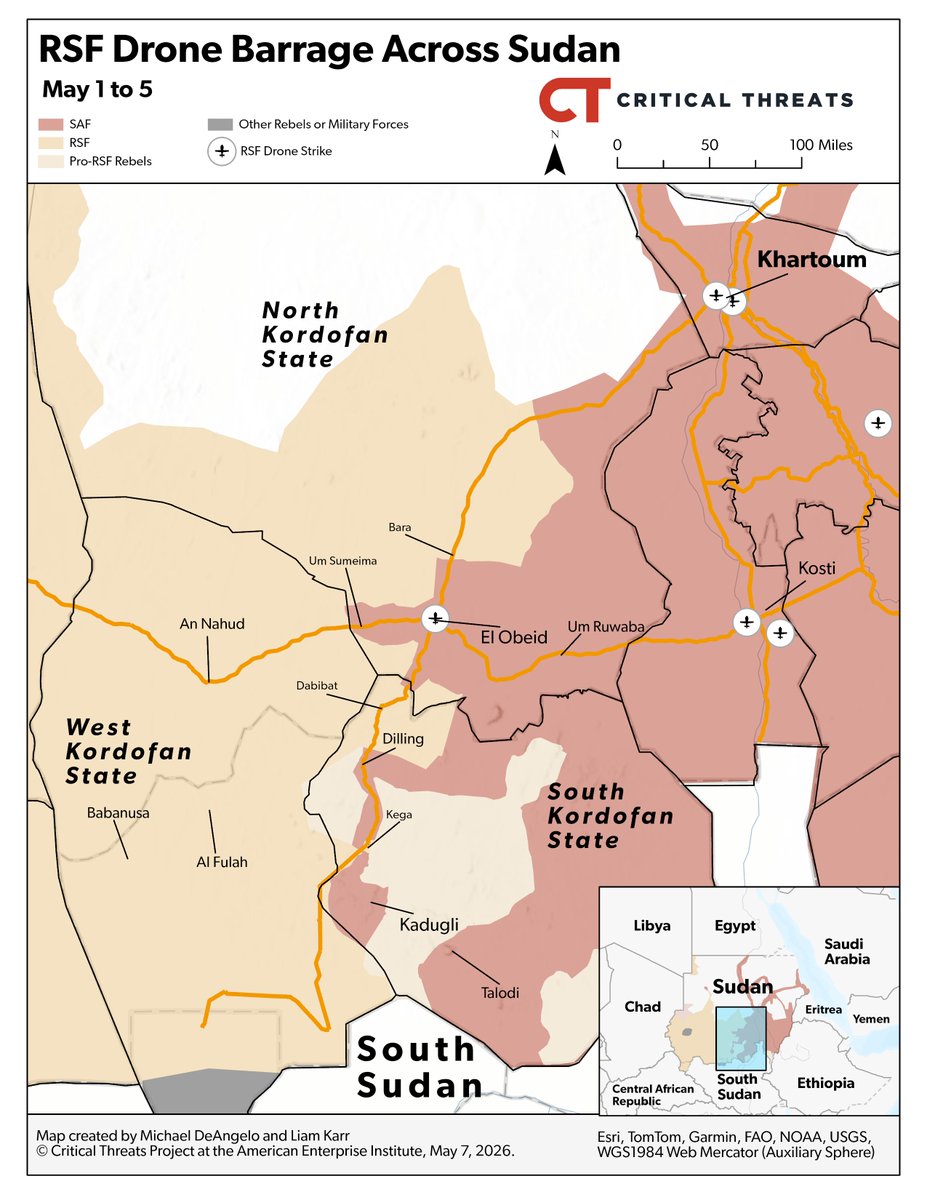
The RSF is setting conditions for an offensive on the SAF–controlled city of el Obeid in North Kordofan, which is a major operational objective for both sides, as it is key to control of central Sudan and breaking the current stalemate.
Emirati support received through neighboring countries continues to enable the RSF's war effort. 🧵⬇️
NEW | Federal Government of Somalia (FGS) forces clashed with opposition forces in Mogadishu, marking an escalation in their constitutional and electoral dispute.
Clashes between the two parties in Mogadishu will likely continue to intensify in the immediate term, although there is growing international pressure on both sides to compromise on their maximalist political positions. 🧵⬇️
Disruptions to Ethiopia's June 1 elections display the stark divisions between the federal government and ethno-nationalist rebel groups.
A major electoral win by the ruling Prosperity Party would not inherently ease tensions and could even set the stage for worsening conflict.
CTP’s long-standing assessment continues to stand amid the clashes between FGS and opposition forces in Mogadishu.
Absent a settlement between the FGS and SFC, the recent clashes could spiral into wider violence across Mogadishu and other states seen in past election cycles.
NEW | Over a dozen countries, including the United States, called for the Federal Government of Somalia (FGS) and the leading Somali Future Council (SFC) opposition coalition to return to dialogue amid an intensifying constitutional and electoral dispute.
The FGS’s attempts to consolidate political control across Somalia have put it on a collision course with the SFC and alienated even formerly pro-FGS Federal Member States. 🧵⬇️
NEW | Puntland state forces have intensified operations against IS Somalia Province (ISS) in response to an ISS resurgence.
ISS’s resilience underscores the necessity of continued counterterrorism pressure to disrupt the group’s function as a key node in the global IS network, although numerous other political and security challenges could limit counterterrorism resources and enable the group to reconstitute.🧵⬇️
NEW | Four Rapid Support Forces (RSF) commanders and forces loyal to the officers have defected to the Sudanese Armed Forces (SAF) since April 2026, withdrawing from front lines in central and western Sudan.
CTP Africa Analyst Michael DeAngelo discusses why this is important. ⬇️
Fano and the OLA have both announced road blockades in Amhara and Oromia since yesterday.
Regardless of the election results, unresolved tensions between the federal government and armed ethno-nationalist groups will continue to undermine the former’s ambitious agenda.
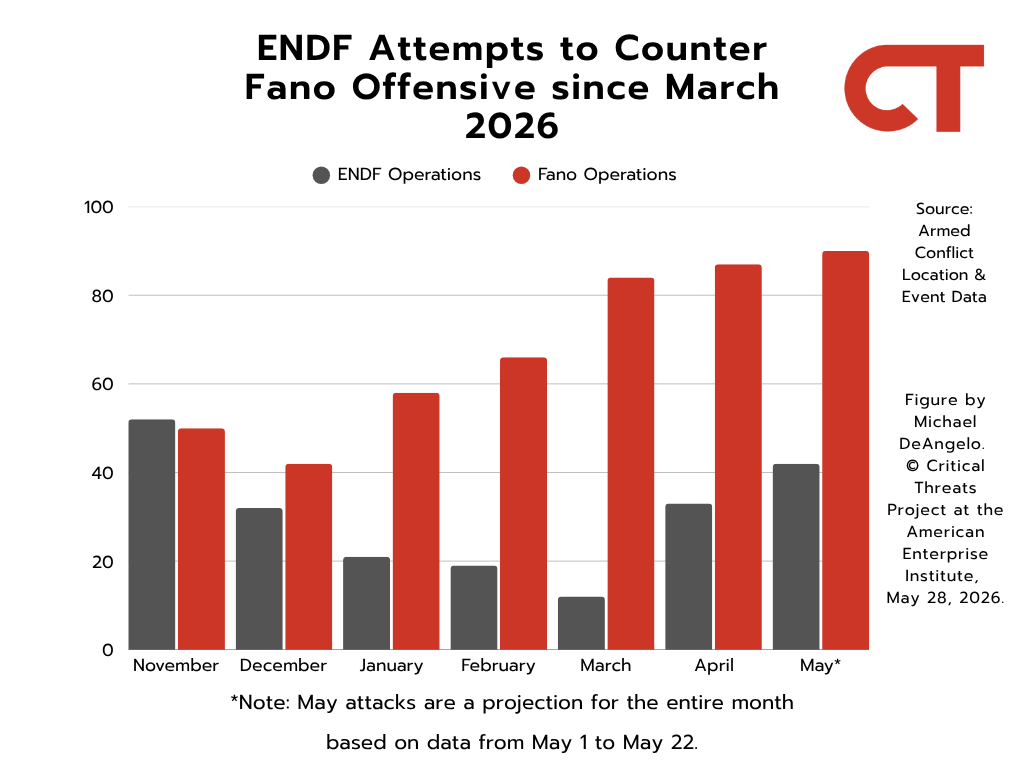
NEW | Amhara ethno-nationalist Fano militias have sustained offensives across northern Ethiopia’s Amhara region since March 2026, disrupting the federal government’s efforts to organize upcoming June 1 federal elections in affected areas.
Fano’s offensives could also be constraining any federal government plans to respond to the TPLF’s power grab in the neighboring Tigray region. 🧵⬇️
Several RSF commanders have defected to the SAF since April 2026, which could degrade the RSF’s combat effectiveness on key front lines in the Sudanese civil war.
The defections bolster the SAF’s wartime strategy, which has eschewed peace talks in favor of a military victory.🧵⬇️
NEW | Egypt and Eritrea signed an agreement to link their ports on the Red Sea, underscoring the two countries’ strengthening bilateral ties as they seek to contain Ethiopian influence in the Red Sea and Nile River Basin.
The agreement establishes a maritime transit route between Egypt and Eritrea and also involves Egyptian investment in Eritrean infrastructure, building on a reported 2025 deal for Egypt to invest in Eritrea’s port of Assab in exchange for naval access.
Egypt’s foreign minister met with Eritrean President Isiais Afwerki to finalize the agreement and stated that only coastal countries can determine security and governance in the Red Sea, ruling out a role for non-coastal countries like Ethiopia.
Ethiopia has defined access to the Red Sea—particularly via Assab—as a crucial component of its regional strategy, which has rankled Egypt and Eritrea and caused them to draw closer.
Egypt views the GERD and Ethiopia’s plans to build other dams on the Nile—another key piece of Ethiopia’s strategic ambitions—and quest for naval access as threats to its own natural resources and regional standing, while Eritrea sees Ethiopia’s desire access at Assab as an existential threat.
This discord over sea access is one of several fault lines drawing the attention of Middle East powers and fueling competition across the Horn of Africa and Red Sea.
While the Strait of Hormuz is justifiably garnering global attention, the United States and international community still cannot allow Somali piracy to metastasize.
Sustained Somali piracy while Hormuz is disrupted could tank the global economy and regional security.
NEW | As the Iran war cuts off the Strait of Hormuz, another crucial maritime trade corridor, the Red Sea, is facing a far older threat: piracy.
Somali pirates have launched a hijacking campaign against oil tankers and cargo ships since April, marking their highest level of activity since the peak of Somali piracy in 2011. These activities pose a major threat both to the global economy and to regional security, as they disrupt the oil and container trade and risk enabling al-Qaeda’s Somali affiliate, al-Shabaab, to increase its revenue and strengthen its ties with the Houthis.
It is thus imperative for the United States to work through local Somali and international partners to ensure that piracy cannot wreak even more havoc than it did over a decade ago.
Read more of CTP Africa Analyst @mikedeangelo25's Op-Ed, Another Crucial Maritime Chokepoint Is Under Threat, here: https://t.co/qRUzzfdJU9
Read the full analysis of Sudan-Ethiopia tensions, as well as the article about the reported drone strike, below.
https://t.co/qAyrn6c2OD
https://t.co/5mZ51RroxC
The SAF allegedly conducted a drone strike in western Ethiopia on Sudan’s Blue Nile state border two weeks ago.
Ethiopia’s support for the RSF remains a point of contention that could cause further escalation, although a Sudan-Ethiopia military confrontation is still unlikely.
Sudan has reportedly massed forces in a disputed area along the Sudan-Ethiopia border, which could escalate the unfolding regional proxy conflict between the two countries and raise the risk of direct military confrontation.
CTP Africa Analyst @mikedeangelo25 explains what this means and why this is significant. ⬇️
If the FLA-JNIM partnership in northern Mali proves sustainable, JNIM could turn even more of its attention to populated central and southern Mali, corroding a ruling junta that looks more unstable by the day.
@liam_karr and I talk about this and much more on a recent Space.
JNIM launched a historic offensive in northern Mali on April 25. Why does this matter so much? What are the implications for the United States? Tune in on Tuesday, 5/5 at 1000 EST to hear CTP's @liam_karr and @mikedeangelo25 break this down!
https://t.co/eUC6bZtfwy
NEW | The TPLF reinstated the pre-Tigray war regional government, effectively voiding the Pretoria peace agreement that ended the Tigray war and risking a potential military confrontation with the federal government.
The council then selected TPLF head Debretsion Gebremichael as president, who had previously deposed TIA head Getachew Reda during TPLF's first de facto coup of the TIA in March 2025.
The TPLF’s reinstatement creates a rival body to replace the Tigray Interim Administration (TIA), despite the Pretoria agreement mandating that the TIA govern until the federal government sponsors regional elections.
The TPLF’s move sets up a showdown with the federal government that could spiral into a military confrontation, as preexisting tensions have escalated into open hostilities in 2026, fueling a military standoff on Tigray’s regional border since February. The Ethiopian government responded to the reinstatement by flying fighter jets over Mekelle, the Tigray regional capital.
NEW | The RSF conducted drone strikes on key infrastructure in cities across central and eastern Sudan, undermining the SAF-led Sudanese government’s efforts to boost its legitimacy by restoring governance.
Sudan accused Ethiopia of facilitating some of the strikes and has massed forces in a disputed area along the Sudan-Ethiopia border, which could escalate the unfolding regional proxy conflict between the two countries and raises the risk of direct military confrontation, although both have capacity constraints that make this unlikely. 🧵👇
Somali pirates conducted the most hijackings in Somali waters in a 10-day period since the end of the peak of the Somali piracy crisis in 2012. CTP Africa Analyst @mikedeangelo25 explains what this means and why this is significant. ⬇️
NEW SAHEL MAP UPDATE | CTP has updated its interactive map showing Sahelian Salafi-jihadi areas of operation in West Africa following JNIM's April 25 offensive across Mali.
CTP will continue to update the map as the situation in Mali continues to develop.
Link below 🔗⬇️