Several years ago I was asked to write some basic slides on 'Solving economic models numerically' for 3rd year UG students including joint honours. I chose four simple examples which are analytically tractable and easy to program...
https://t.co/IJONY4b1f7
https://t.co/pXMvzxEs4c
When I was a first-year PhD student at Minnesota, I did poorly in my first macro sequence with Larry Jones because I failed to define the equilibrium carefully. Back then, I didn’t understand why that mattered. Working on equilibrium selection years later, now I do.
Jane Street pays $650,000 a year for quants. Stanford just released the exact RL-for-trading bible for free.
16 chapters. 0 to algo trader. Asset allocation, market making, American option exercise, full Python code & Colab notebooks.
Bookmark & give it a weekend.
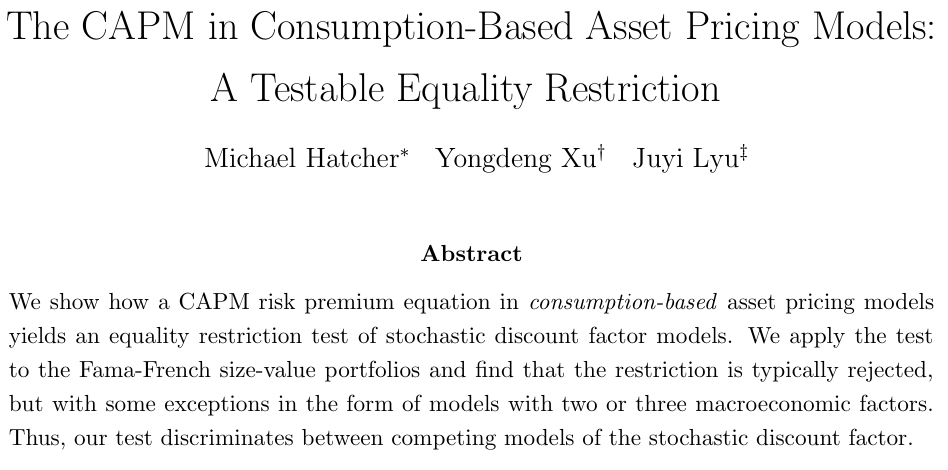
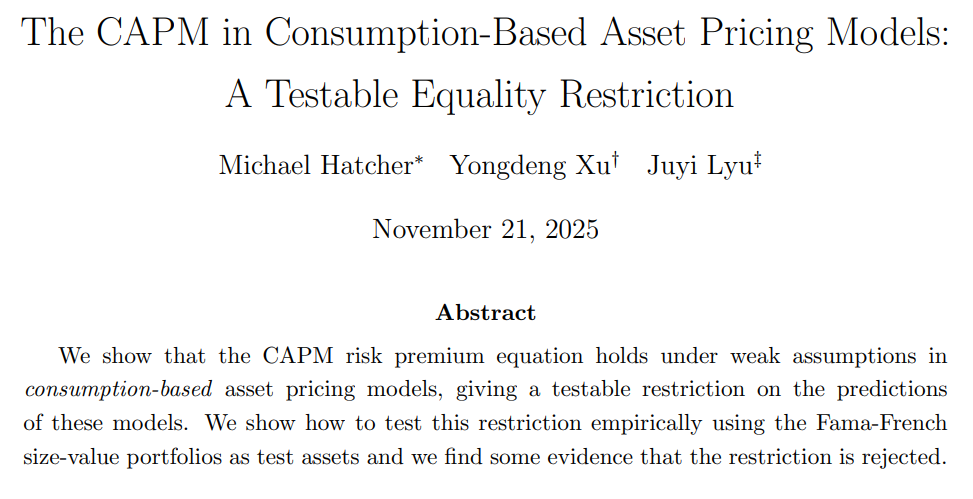
The CAPM in Consumption-Based Asset Pricing Models: A Testable Equality Restriction. This is an update of our paper (joint with Yongdeng Xu and Juyi Lyu) on testing the theoretical predictions of consumption-based asset pricing models using an equality restriction. Comments welcome.
Incredible volatility in the UK government bond market:
After finishing last week just below 5%, the yield on 10-year Gilts surged to over 5.10% before retracing all the way down to 4.82%!
#economy#uk#markets#bonds
@elerianm The sensitivity of UK bond prices to shifts in the balance of news from the Gulf is in itself an indicator of how vulnerable the UK fiscal position is. The current govt has made the situation a lot worse by ramping up public spending way beyond the amounts of increased taxation.
Thank you @UoS_Economics for the invitation. It was a pleasure to spend time with such a great group of macroeconomists and to learn about the research that is taking place at The University of Southampton. @MikeHatcherEcon
The rules-based international order is undergoing a 'rupture, not a transition', Canada’s Prime Minister Mark Carney said on Tuesday in a speech that did not mention US President Donald Trump by name, but won a standing ovation at the World Economic Forum https://t.co/nE0A9UKApV
This speech *is* one for the history books. But that’s less a compliment, than a coda.
Carney has given us the words to mark the end of the ‘rules-based order’…by acknowledging it never really existed.
It was a collective illusion. That now is over.
We all know the facts about capital and labor shares: the share of GDP paid to capital was stable around one third for 50 years but has risen a bit in the past 25 years. 1/N
New paper on consumption-based asset pricing models.
We show that the CAPM risk premium equation holds under weak assumptions in such models, so the CAPM has been hiding in the C-CAPM all along!
The 'beta' in C-CAPM is microfounded and can easily be estimated, allowing an empirical test of consumption-based asset pricing models, that is, does beta = beta_CAPM?
As an illustration we test the equality restriction using the Fama-French portfolios. Link below.