This is a poor article and does the @jacobin's political project no favors. I write this as someone who self-defines more as a Keynesian than a New Keynesian, in the sense that issues of multiple equilibria/indeterminacy, incomplete markets are more central to my thinking than price stickiness (at least as conventionally modelled).
First, the critique fails on its own terms: unoriginal in some respects, obsolete or incomplete in others.
-There is not a single argument here advanced on criticisms that appeared circa 2010. (To be fair the authors cite the excellent paper by Ricardo Caballero.)
-The critiques do not reflect the current New Keynesian program. One would have no idea that Heterogeneous New Keynesian models have emerged, a near revolution in macroeconomic methodology, which makes the complaints about representative agent models obsolete. Less progress has been made on enriching the role of banks and the financial sector, but advances have been made.
-Finally, one of the most important criticisms of New Keynesian model is omitted: the indeterminacy approach
Roger Farmer @farmerrf, "The Indeterminacy School in Macroeconomics," NBER Working Paper, 2019
This type of work challenges new Keynesian models using the logic of intertemporal decision making, so does not meet the agenda of the article's authors.
Second, the criticisms are in, important cases, incorrect. To claim that
"The contributions of Hall and Woodford and the New Neoclassical Synthesis more generally provided no theoretical foundation for macroeconomic stabilization."
ignores how New Keynesian arguments mattered in understanding zero lower bounds, forward guidance. The peremptory pronouncement of course ignores insights of the model in the decades preceding the Financial crisis.
The discussion of Hall's work on consumption is, to my eyes, bizarre. Leaving the fact that Hall himself demonstrated limitations to his original 1978 paper, consumption analysis has evolved to account for heterogeneity, borrowing constraints, etc. This evolution represents a success of the New Keynesian research program.
Third, the article misstates the purported value of pluralist/heterodox approaches. I have long argued for the value of complex systems methods in enriching economic theory, and am nevertheless comfortable in saying that 30 years of work have failed to demonstrate much value for the approaches in understanding macroeconomics. As for agent-based models,
Robert Axtell and J. Doyne Farmer , "Agent-Based Modeling in Economics and Finance: Past, Present, and Future, Journal of Economic Literature 2025
reviews the work, and demonstrates how little has been produced. Individual papers may be interesting, but the idea that complexity or agent-based models have demonstrated theoretical or empirical relative to mainstream macroeconomics. The Axtell-Farmer literature synthesis is filled with mainstream economists who have explored complexity/ABM methods. It is simply false that the economics discipline has refused to consider them.
As it happens, this article nearly coincides with the publication of
Greg Kaplan @GregWKaplan, Macro: The Economic Models that Shaped Our World
which I just finished reading and strongly recommend, if one wants to understand the actual state of the New Keynesian model.
This is INSANE…
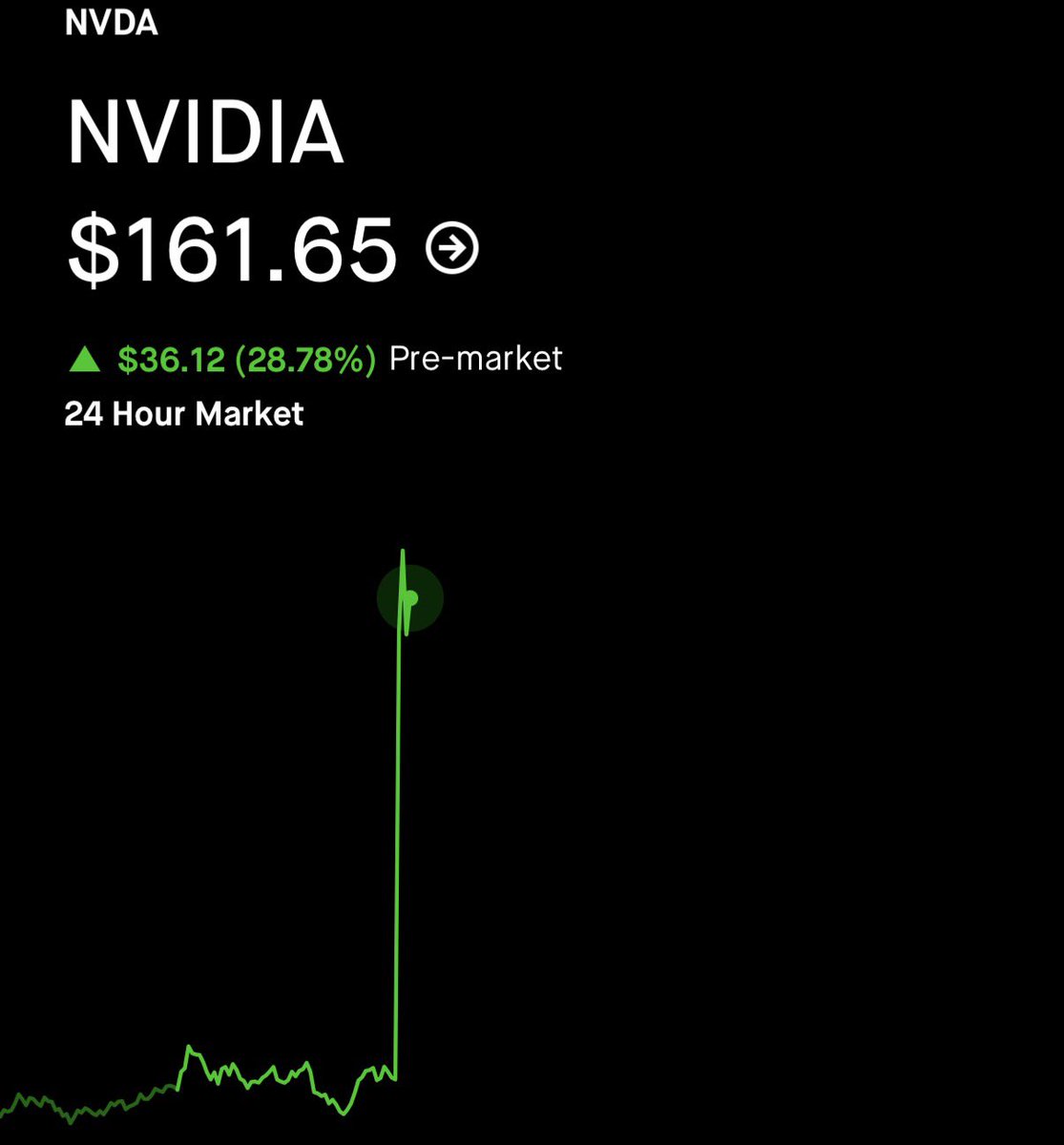
Right before Close last Friday someone bought $3,400,000 worth of $NVDA 160 calls which expire today.
This morning Jensen Huang was reinstated as Nvidia CEO.
After a rough (9,000%) gain these contracts will be worth beyond $312,000,000.
Clear levels of insider trading is happening…
🚨BREAKING: NYT can reveal that in an all-hands meeting convened specifically to diagnose why the next-gen Blackwell Ultra GPUs had missed their must-ship deadline, one senior vice president produced a fart noise that hung in the silent air like insolent defiance.
Jensen, who had been mid-sentence explaining that “every millisecond of latency is a moral failure,” stopped in his tracks. He was livid. The room went silent. He turned, slowly, and fixed the man with a death stare, the same one that has previously made entire engineering teams spontaneously re-architect their roadmaps.
The executive, a man whose LinkedIn listed “uncompromising operational excellence” as a core competency, felt his soul leave his body in embarrassment. In a voice that cracked like a overclocked core, he offered the only defense available to him:
“That… that was not what you think. It was just the chair.”
Jensen did not blink. He did not smile. He simply tilted his head by one precise degree and said, “oh?? Prove it!”
What followed was 45 seconds of pure, unfiltered executive purgatory. The man whose face was now the color of a red-hot HBM stack, began the most humiliating performance review of his career. He rocked. He tried to shift his weight as he attempted a series of increasingly desperate micro-adjustments in his chair. First, a gentle creak, then a strained, dry squeak.
He was mortified that he couldn’t produce the original acoustic signature. The other executives stared at their laptops with the intensity of people who had just discovered religion. Someone’s pen rolled off the table and the sound was deafening.
When he finally sat down again, trembling, Jensen nodded once, as if a hypothesis had been successfully validated, and returned to the slide about “owning the outcome.”
Per sources, the executive spent the rest of the meeting humiliated and deflated, calculating how many RSUs it would take to erase the memory of having to prove to Jensen Huang, that he had not, in fact farted.
This was “a struggle session to extract guilt for flatulence-adjacent sounds and yet another humiliation ritual that is par for the course when working for Jensen", the employee said.
@PharmD_KS@ces921 Do you think treasury sitting on bank balance sheets instead of the fat balance sheet would’ve had a material impact in inflation? I don’t think so. The problem here is fiscal policy.
The Fed did not "engineer" anything - US nominal spending is still growing much faster than what is compatible with 2% in the medium term. And this is, by the way, the key reason US inflation continues - for the sixth year - to run above 2%.
The US stock market has been booming because the Fed has been accommodating a massive US budget deficit. That has to end sooner or later. If the Fed continues to accommodate the excessive budget deficit, then inflation will never return to 2% - and then interest rates are likely to move upwards in a similar fashion as in the early 1980s. And then the stock market will crash anyway.
The task of the Fed and other central banks is not to bail out investors. It is to ensure nominal stability. The Fed has failed to do so for the past six years and as a consequence has created a stock market bubble.
It is about time US policymakers get their act together - that means primarily massive fiscal consolidation and tighter monetary policy.
And yes, this will deflate the earnings bubble, but there is no alternative. Or rather, the alternative is runaway inflation, and no stock market investor would wish for that.
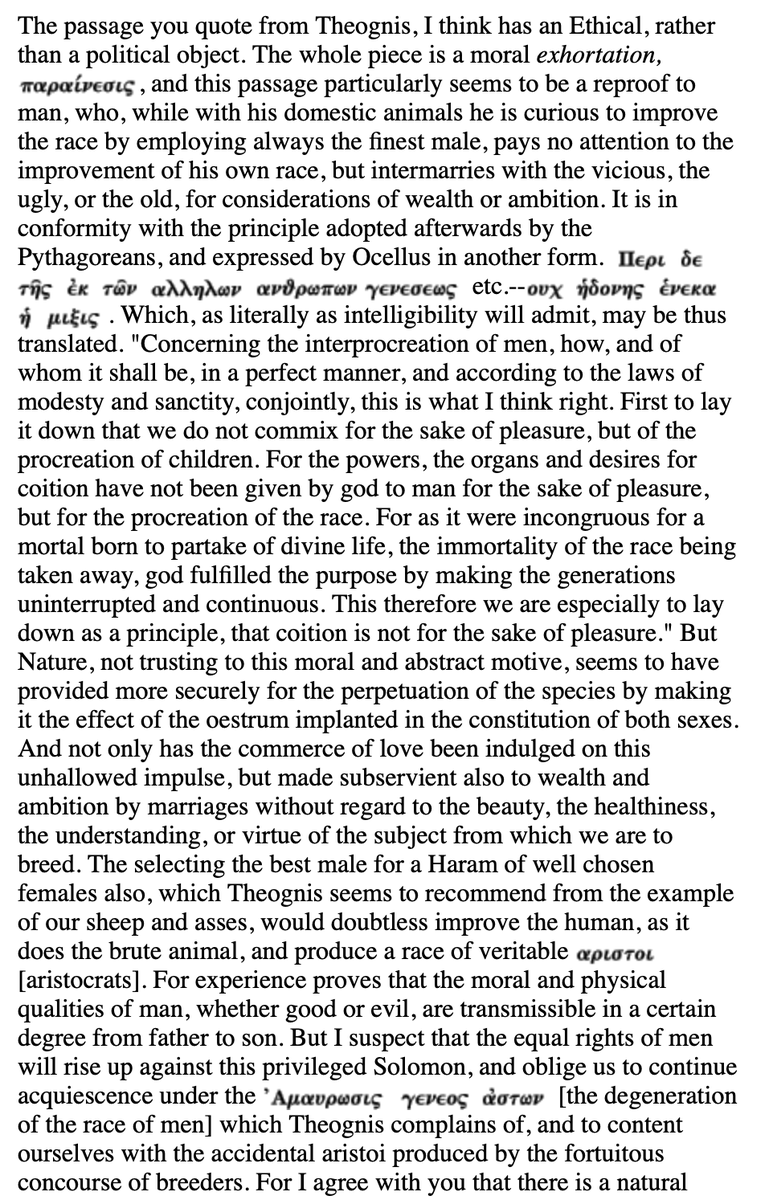
I wanted to quote from Jefferson on the natural aristocracy for something I'm writing, so went to his famous letter to Adams. I had never read the whole thing, and I was stunned by the opening, which I post here. I draw your attention to two things. First, the guy is talking about eugenics. The horror! Second, the erudition. Try to imagine anyone in political life today who has the knowledge to write this (even ignoring the Greek in the original, which Jefferson assumes that Adams will be able to read). Actually, when you stop to think about it, how many politicians could even understand what the sentences mean?