Some thing that I see my students commonly miss is that they don’t ask the client what they expect to get out of the treatment for that day. Setting the expectation (both for the client and clinician) allows for optimal achievement of the CLIENT’s goals and improved satisfaction.
Clients routinely ask me what “exercises” are best for “blank” condition/injury. My answer to nearly all of these questions is a question: How do you know it is “blank” condition? Quality exercise/rehab prescription is preceded by a quality diagnosis.
Most players don’t get hurt DOING weighted ball programs but rather get hurt from the effects of the weighted ball programs, mainly increased range of motion (external rotation). - ASMI Injuries in Baseball Course
“Therapeutic interventions to diminish inflammation have been explored with mixed success, likely because inflammation is a component of a healthy biological response that ushers in a healing cascade.” Andarawis-Puri et al 2015. Interesting thought on tendon health and healing.
4/5: Symmetry is making sure that as you grind you don’t lose the effectiveness of the movement. This usually requires offset loads (ie: single leg RDLs or single arm bench press) to make sure that the athlete is building/maintaining symmetry while grinding.
5/5: Ballistics is taking the movement and performing it at high speeds. (ie: KB Swing for the hinge) Athletes have to earn to be in this territory of training. Poor patterning, insufficient grinding, and/or asymmetry disqualify an athlete from ballistics.
3/5: Grinding is what I would consider building strength in a particular movement (ie: deadlift for the hinge or goblet squat for the squat). Apply load that requires the body to adapt (build/recruit more muscle) so that the body can lift a larger load later.
2/5: Patterning means teaching the specific movements (hinge, squat, push, pull, etc). Typically without load or with a load that contributes to the learning of the movement.
1/5: I have found the following teaching progression from Dan John highly effective when coaching/training athletes in a variety of lifts: Patterning-Grinding-Symmetry-Ballistics
“Prod it (your injured tissue), don’t push it. Go a little bit… little bit… little bit… little bit.” Dan John on training during an injury phase. This is why I (PTs) have a job. We are professional “prodders”knowing just how much to stress your injured tissue and in what ways.
“Cause enough pain free stress to sufficiently activate the involved muscles for the desired period of time without producing sufficient stress to cause fatigue.” Gary Reinl summed up therapeutic exercise (and most treatment) in one sentence. #physicaltherapy#physiotherapy
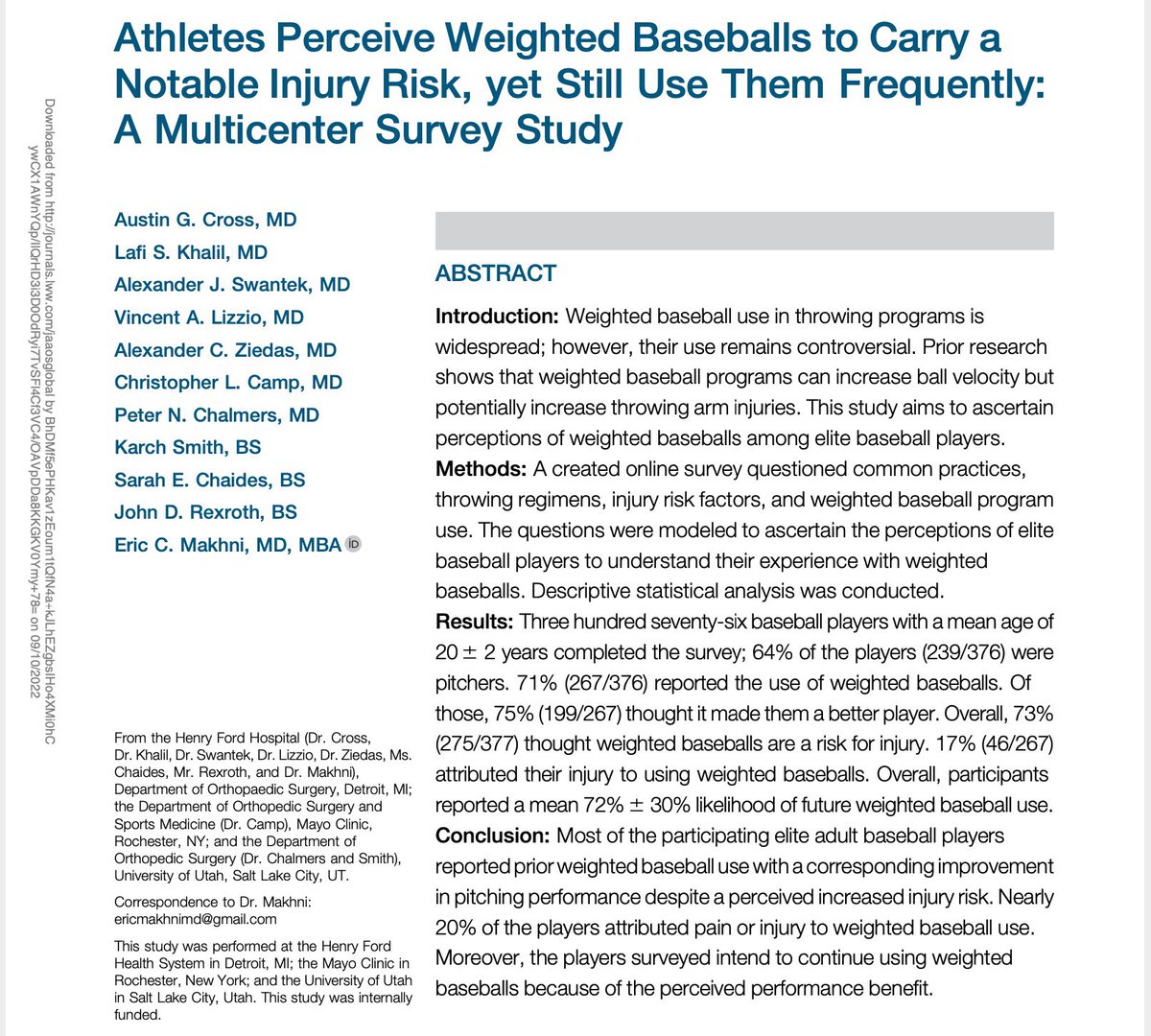
@ChrisCampMD@OfficialJAAOS@EricMakhniMD@Lafi_KhalilMD @mayoclinicsport @HenryFordHealth Was fortunate to help with this study in gathering the data from players. This perception is true and I found it very interesting/alarming as similar velocity gains can be seen from good strength and conditioning WITHOUT risk!
Survey of 376 college/pro baseball players on Weighted Balls. #’s to know👇
71% use WB
#1 reason: ⬆️ velo
75% say WB ⬆️ performance
73% say WB ⬆️ injury
17% link prior injury to WB
72% will use WB in future
Most see a risk, but are willing to take it
https://t.co/1mh96xa3s7
Without a standard of movement then everyone thinks they are excellent. Standards allow for proper assessment and prescription of movement and exercise to allow for continual advancements. Don’t know your standard? Find someone who does. #strengthcoach#physicaltherapist
Speed development (running, throwing, etc) may be more about taking away any “brakes” that don’t allow for top speed than developing more speed in the system.