It’s time to meet the next candidate in our job market candidate lineup, the great Christian Lundqvist!
Christian works in empirical microeconomics, with a focus on labor, especially unions and collective bargaining. In his Job Market Paper, “Workplace Influence on Union Membership,” he tracks workers who switch employers to study how workplace union density affects the decision to join a union.
Workers who move to a more union-dense workplace are more likely to unionize, even when the move stays within the same occupation, industry, municipality, and firm. Workers respond more to union density among peers than among non-peers, and little to local union wage premiums or to proxies for workplace instability. The pattern points to social norms, ahead of pay or insurance, as driving the decision to join a union or not.
Beyond his JMP, Christian is working on how childhood exposure shapes adult union membership, and on collective agreements in the Swedish labor market.
🚨 We’re hiring an Assistant/Associate Professor in Macro at the University of Amsterdam!
I absolutely love it here so far: great salary, a fantastic city, and, most importantly, wonderful colleagues.
Please spread the word, and DM me if you have any questions!
There are many thoughtful critiques of this line of work. This is not one of them. Sad to see @margrev engage in this. Only upside is that the post clearly illustrates the need to have humans in the loop in social science...at least for now :)
If you believe that mindless AI evaluations are legitimate then why would you spread the evaluation of Saez & @gabriel_zucman without first subjecting it to its own mindless AI evaluation?
I just did and it turns out the critic's errors all go in one direction.
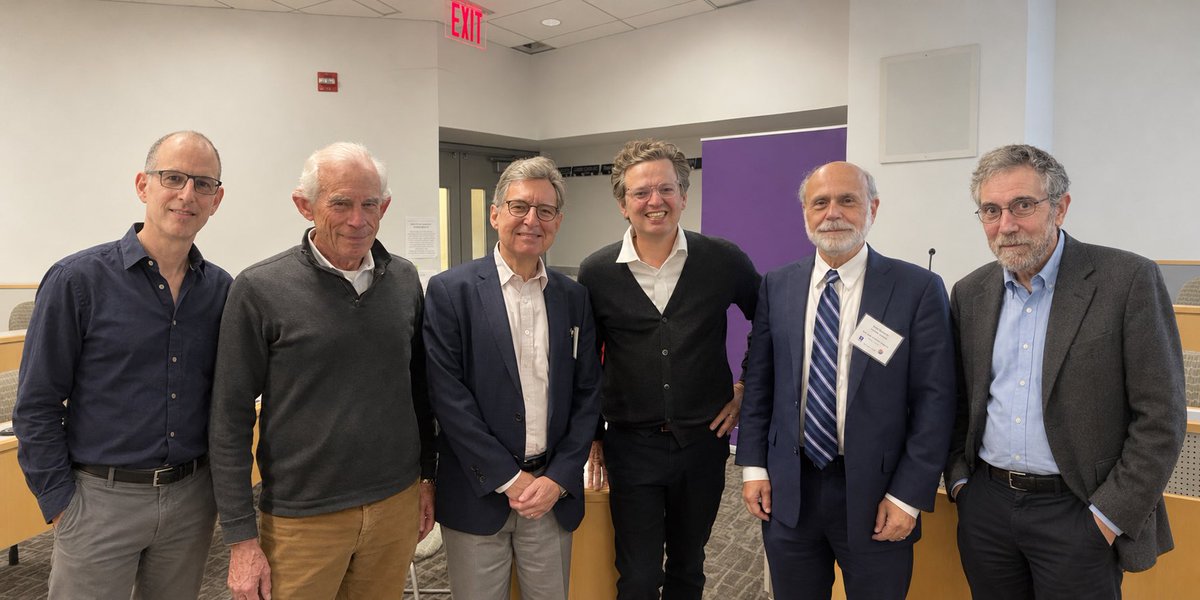
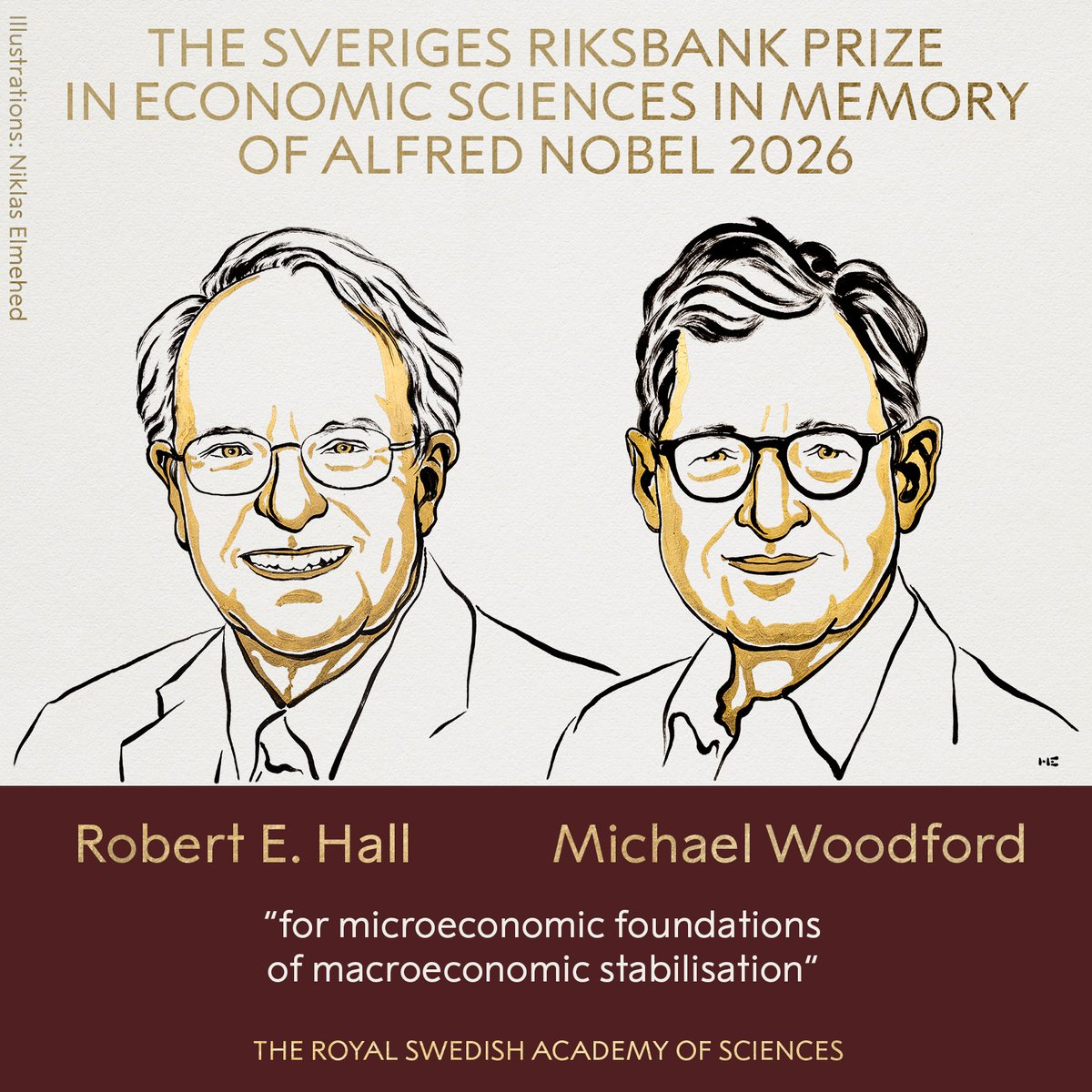
With Mike Woodford's Nobel Prize, this has been a week of extreme joy at his well-deserved recognition (and Bob Hall's, of course). Yet, I won't deny it, also a week of some self-reflection and personal crisis. You see, he was my main advisor at Princeton. Now, looking at my other advisors, one cannot help but wonder: What value added could I possibly have contributed to my own research agenda, formulated in the early 2000s at Princeton? As it turned out, the coming years would be eventful for my other three advisors: Krugman (Nobel 2008), Sims (Nobel 2011), Bernanke (Nobel 2022). With this sample of three establishing Granger causality (predictive, not causal, whatever the name suggests; Sims himself did much to bring the concept into macroeconomics), I confidently stated the inevitable conclusion in 2022 on Twitter (now X): considerable money could be won in betting markets by placing a bet on Woodford getting the Nobel Prize in the coming years. I am not a betting man, but I hope somebody made money.
Yet, there is a twist to the story. How does one define one's PhD committee? The way I have defined it is the people you worked the most with, who wrote you letters of recommendation when you went on the job market, and who then signed off on your thesis later. At Princeton, there was a rather liberal policy on when the actual formal defense took place. At that time, your main advisor dragged in whoever happened to be around to listen to you talk for 30 minutes or so. I don't remember who was actually around for the formalities, except Mike and, hard to forget, Chris Sims.
Characteristically, Chris sent me an email the night before telling me that he thought Markov perfect equilibrium made no sense, which generated a lively exchange. Those who did not know Chris might have thought this was inconsiderate, as if he were trying to block my defense. It was quite the opposite. Chris was just the quintessential scholar. He was reading the thesis and just wanted to talk about it.
But back to this week's reflections. I would be remiss not to mention that there was another, perhaps unexpected by those familiar with monetary economics, utility player at Princeton during my time. And this utility player actually happened to be one of the people I spoke the most with, for I was closest to him in age, TA'd his grad classes for him and, memorably, a Money and Banking class where he taught the entire class using a microfounded IS-LM model based upon a two-generation OLG model. I still remember the puzzlement on one of the students' faces as he asked me in a TA class: So prices are fixed for ... 30 years? And he DID write a letter for me (bringing the total of this group to five!). So, fellow economists, prepare your bets. Given my research agenda in monetary economics, he may seem to be coming a bit out of left field. Then again, he is one of those economists who could advise anyone on anything. The utility player was none other than the George J. Stigler Distinguished Service Professor in Economics and the College at the University of Chicago: Robert Shimer. He's much younger than the others, so it may take some time. But you heard it here first: Prepare your bets!
PS. Picture taken at a conference in honor of Mark Gertler recently. Paul and Rob added, courtesy of AI, ex post.
As I imagine is also true for many other macroeconomists here, this prize feels personal to me.
Hall and Woodford have laid the foundations for an enormously fruitful body of research, one that encompasses my own research agenda on consumption, fluctuations and stabilization policy. My papers would not have existed were it not for their contributions.
So well deserved. Congratulations!!
New paper! 📄
If you get a job at a better paying firm, your take home pay goes up. How much more do you spend?
It matters because the answer tells us whether gaps in pay between firms translate into gaps in living standards. 1/9
Finally we formalise these results in a quantitative search model with savings. Frictions govern the pass-through of fixed firm pay differences into consumption.
In the model, firm consumption effects track firms' contribution to welfare inequality closely. 8/9
TLDR: whether wages go ⬆️ a lot as the K-share ⬆️ depends almost entirely on Pi:=cost of doing the newly automated tasks with L vs w AI. If you write Y=K^aL^{1-a} you're implicitly assuming Pi is huge, like 10x-35x 🤖 No surprise u'll find huge wages gains. Pls, report your Pi‼️