@CynthiaAwolesi@trigottista lol you need to preach that to the people still supporting this government because it’s there tribesmen in power, I’m happy it’s affecting everyone until we are ready to unite or possibly go our separate ways.
@CynthiaAwolesi@trigottista lol we no won unite again, we will support APC until country scatter then everyone will come to the conclusion that one Nigeria is not going to work. Una Dey do like say bad governance affects only igbos lol
FROM WHAT WE BUILT TO WHAT WE LOST: LESSONS FROM NIGERIA’S HISTORY
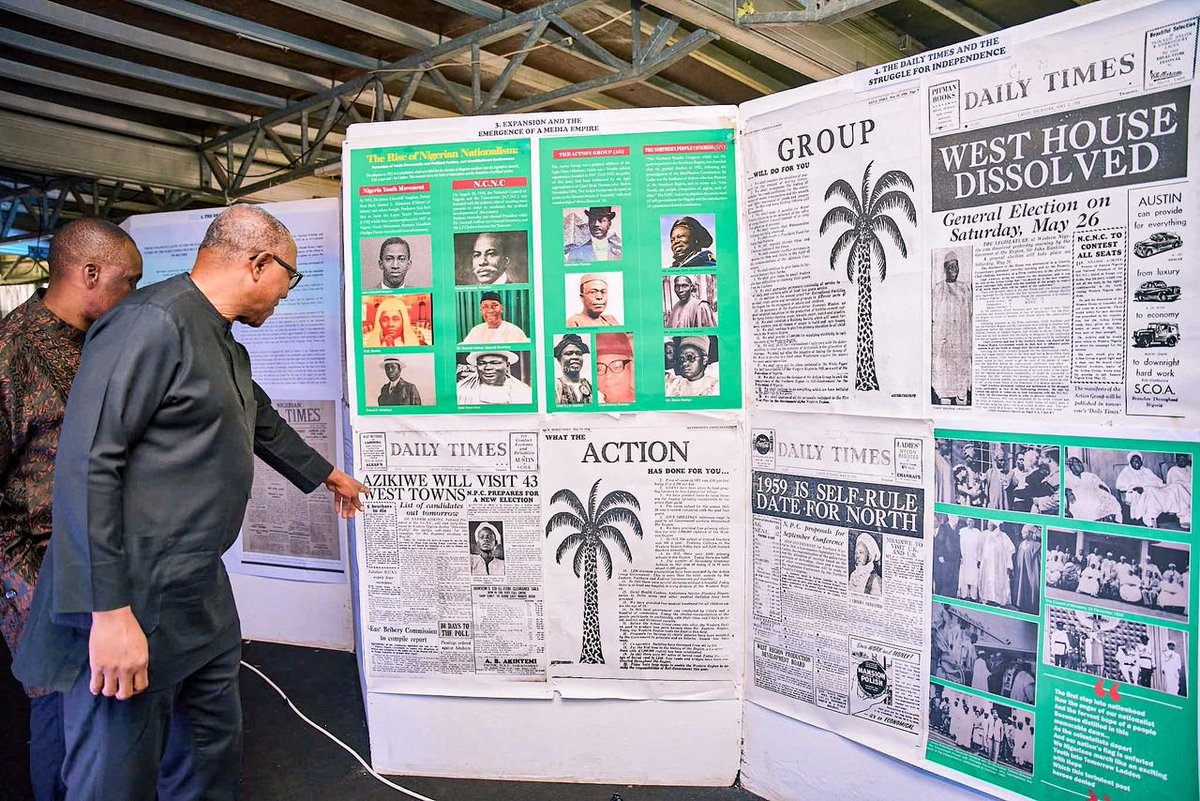
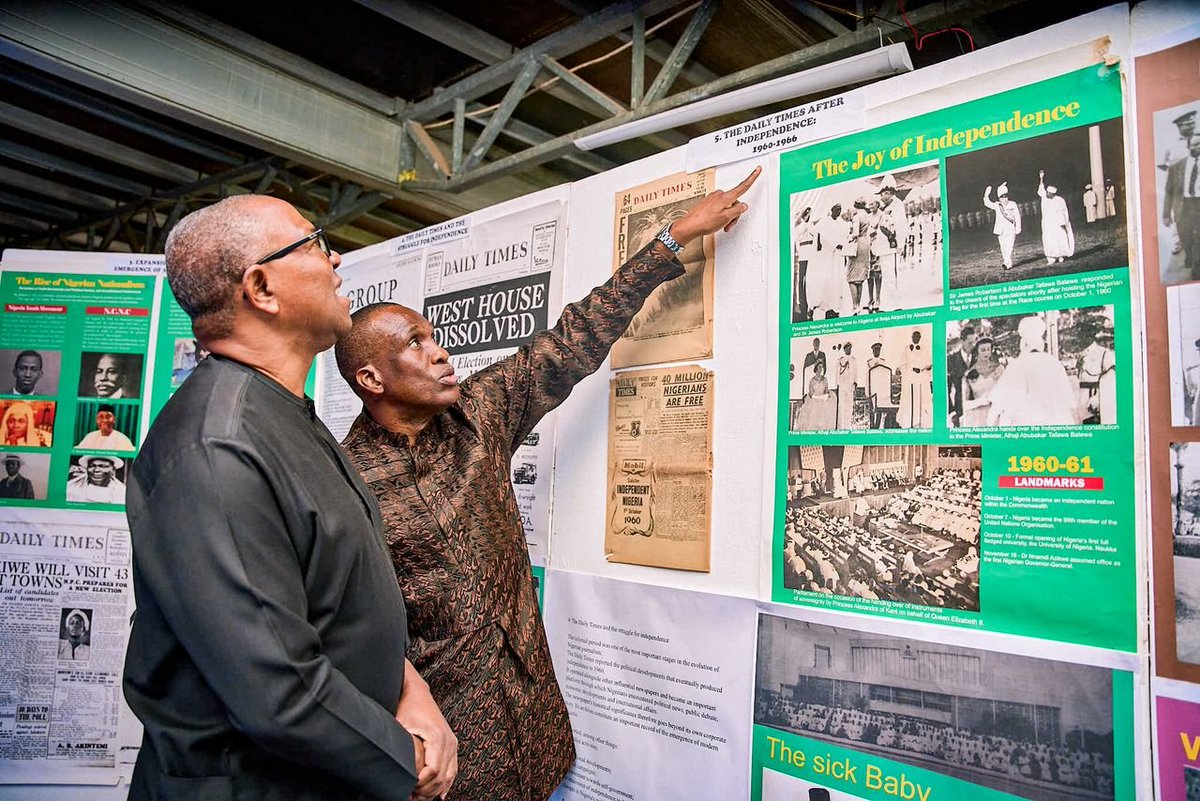
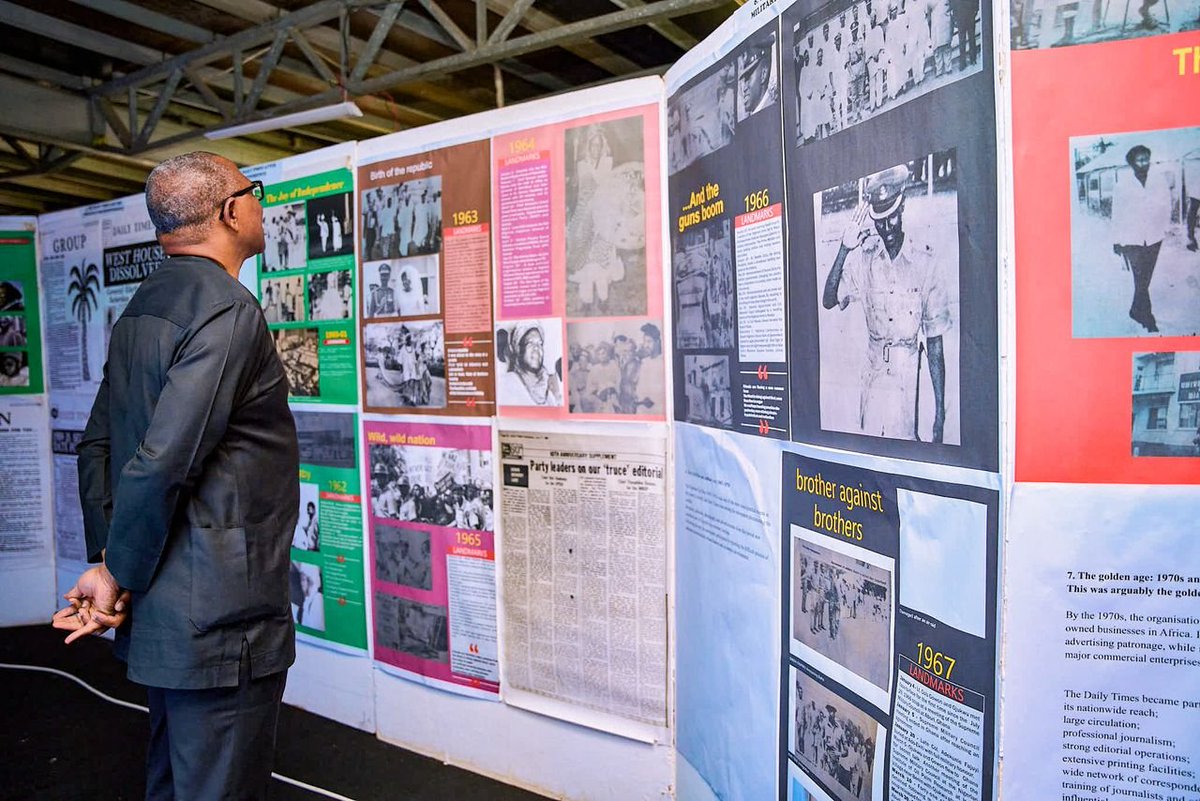
Today, I attended the Daily Times Newspaper’s 100th anniversary celebration in Abuja. The occasion brought back fond memories of my younger days, when I would visit the newspaper stand at 57 Old Market Road, Onitsha, opposite the General Post Office, simply to read the front pages of the newspapers.
I was particularly interested in stories about governance, our economy, and Nigeria’s development. Those early encounters with newspapers helped shape my interest in understanding our country and the choices that have shaped our journey as a nation.
At the exhibition, I took time to go through some of the old publications. What I saw was both fascinating and deeply sobering.
One of the most striking things I came across was an advertisement for the Nigerian Shipping Line. In 1959, it had 6 ships; by 1960, it had 8; and by 1961, it had grown to 10 ships.
Today, more than six decades later, the Nigerian Shipping Line has no ships.
I also read about Nigerian Airways, which began operations in 1958 and, by 1980, had grown into one of Africa’s leading airlines, with a fleet of over 30 aircraft and direct flights to London, New York, Rome, Paris, Amsterdam, and other international destinations. At one point, it even operated a Boeing 747, one of the largest aircraft of its time.
Sadly, Nigerian Airways eventually ceased operations in 2003.
The comparison with Emirates is particularly instructive. Nigerian Airways had already developed a substantial fleet before Emirates commenced operations in 1985 with just two leased aircraft. Today, Emirates operates a fleet of more than 250 aircraft, while the Nigerian national airline of that era no longer exists.
These are not merely stories from old newspapers. They are reminders of what Nigeria once built, what our people were capable of achieving, and, most importantly, what we failed to sustain.
The tragedy is not that these institutions belonged to a different era. The tragedy is that a country blessed with enormous human and material resources allowed many of its once-promising institutions to decline and disappear through years of poor leadership, mismanagement, corruption, and weak accountability.
Even more painful is the fact that while many of our institutions have weakened or disappeared, corruption seems to have remained one of the few things that has continued to grow.
We must ask ourselves: Why did institutions that once worked begin to fail? Why have countries that started behind us overtaken us? Why have we repeatedly failed to preserve the institutions and investments created by previous generations? The answers must guide the choices we make today.
I commend Mr. Fidelis Anosike and his team for keeping the Daily Times legacy alive and, importantly, preserving an important part of Nigeria’s history for present and future generations.
A nation that forgets its history risks repeating its mistakes. We must remember where we came from, honestly examine what went wrong, learn from both our successes and failures, and build institutions that can outlive individual leaders and political administrations. Nigeria is not condemned to decline.
We can rebuild our institutions. We can restore confidence in government. We can create an economy that produces rather than merely consumes. We can build enterprises that compete globally. And we can create a country where the next generation inherits stronger institutions, greater opportunities, and a better quality of life than the generation before it.
The Nigeria we desire is possible. But it requires leadership anchored on competence, accountability, prudence, integrity, and service. We must stop celebrating what Nigeria used to be and start rebuilding what Nigeria can become.
The journey to rebuild Nigeria must begin now.
A New Nigeria is POssible. -PO
I want to be fair to @PeterPsquare . He is not wrong that French opens doors Igbo does not. He is not wrong that parents get to decide how they raise their own children. But I guess he underestimates the fact that he is not just any parent. P-Square is a name millions of Igbo people grew up admiring, their success made them proud to be who they are. People all over the world sang their songs using Igbo words. So when a voice like that says Igbo is not worth passing on, it does not land like one man’s private choice. It gives permission for a belief a lot of people were already quietly carrying, that English and French, in short anything foreign, sits above Igbo, that their native language is something to graduate out of rather than something to hold onto.
I am not Igbo. I am Swiss. But my husband made it clear from the beginning that our children would speak Igbo, and I have never once seen that as a burden or a complication. Our children speak Swiss German, English, and Igbo at home, German at school, and now French as well, since that is part of their school curriculum too. Five languages, and none of them fighting each other for space. That is the part people forget when they frame this as a choice. Children do not need to pick one language to be strong in. They can navigate several at once, easily.
It is adults who turn language into a competition. Children just absorb what is spoken to them and grow fluent in all of it.
A language is not only a tool for getting ahead. It is also a rooting tool, the place where love, memory, and belonging live. It is the specific way a grandmother scolds you and forgives you in the same breath. It is a joke that only works in the original. Lose the language, and you do not just lose a skill. You lose a room in your own house, one you can still visit as a guest but never quite live in again. That is what worries me most in this conversation. A child who cannot speak their father’s or mother’s language will, at some point, stand in that homeland and feel like a stranger. Not unwelcome, not unloved, just outside something that was supposed to be theirs by birth.
One day, my sons will be handed a kola nut, and in that moment, no one should have to do it for them. They should know how to receive it, how to speak over it, how to break it themselves, not pass it along to someone else because they never learned the words or the meaning behind them. That is such a small moment, and yet it says everything. It is the difference between being someone’s guest and being someone’s own.
So when I hear “Igbo is useless,” what I actually hear is a wound that has not healed.
From the outside, I have watched how often English or French get treated as the languages worth keeping, while Igbo gets treated as the one you can afford to let go of. That preference did not come from nowhere. It is a colonial hierarchy that convinced generations of people that closeness to their own culture was a limitation rather than a foundation. I don’t say this to shame anyone, least of all a man raising his own family the best way he knows how. I say it because the people who shape how we see ourselves carry a weight beyond their own households, whether they asked for it or not.
My hope is simple. That we stop treating our children’s languages as a competition with only one winner. That we let them have both the world and their roots, and trust that they are capable of holding both without ever having to choose.
The wait is over.
We have 2 golds: Chimdiebube Onwubiko and Don Anele Munachimso.
We are the best in the world!
Egejurum Onyedikachi’s name was omitted. He should have a gold.
Lokoja Judgment: An Unnecessary Serious Setback for Nigerian Democracy
Today was an exceptionally busy day. I left Lagos in the early hours for Emekuku, where I visited the School of Nursing Sciences, an institution I have consistently supported over the years. It was gratifying to inspect projects funded through my previous interventions, including the school’s computer laboratory. Such investments reaffirm my belief that education remains one of the strongest foundations for national development.
From there, I attended the 80th birthday celebration of the Emeritus Archbishop of Owerri, Most Rev. Dr Anthony Obinna, whose commitment to justice, peace, and the common good has inspired many, before proceeding to Madonna University for another engagement.
It was at Madonna University that I received the court news of the Lokoja court rulings through my brother, Senator Rabiu Musa Kwankwaso.
Every Nigerian committed to the country’s progress should be deeply concerned. This judgment represents another setback for our democracy and the institutions upon which our future depends.
It is regrettable that some who claim to champion democracy now appear determined to weaken the very institutions that sustain it. In doing so, they are undermining public confidence and endangering the future of millions of Nigerians.
The legislature and the judiciary are increasingly being drawn into this pattern of institutional decline. Democracy cannot thrive where institutions lose their independence and credibility.
Those who seek to weaken Nigeria’s democratic foundations will not ultimately prevail. When a similar situation recently affected the ADC, I condemned it without hesitation. I do so again today because my position has always been guided by principle.
My concern is not about who becomes President. My concern is that Nigeria works. Our politics must move beyond the quest for power and focus instead on building a united nation founded on justice, strong institutions, the rule of law, and equal opportunity. That is the Nigeria we owe ourselves and the one we must leave for future generations.
I therefore urge all well-meaning Nigerians to rise above partisan interests and defend our democracy. The survival of our institutions is inseparable from the survival of our nation. It's when we work together that a new Nigeria of our dream is made POssible. -PO
A Nation Losing Its HUMANITY.
Some events shatter a society so deeply that words are no longer enough to express the shock; the brutal killing of a teacher and the horrific rape and murder of an elderly woman are among such tragedies. These are not isolated incidents but signs of deeper moral and social decay.
How did we get here? How did we reach a point where teachers are hunted and killed, and the elderly—custodians of memory and wisdom—suffer such dehumanising violence?
This is more than a security crisis; it is a failure of collective humanity. We have become desensitised, consuming tragedy briefly and moving on, allowing indifference to normalise the unacceptable.
To the families affected, I share in your grief. But grief alone is not enough.
We must demand accountability and urgent systemic change. If such atrocities no longer move us to action, then we risk losing our shared humanity. -PO
State visits by Leaders are not tourism, and diplomacy is not a fashion parade. Every foreign trip undertaken by a government must deliver measurable benefits to the people, including investments, technology transfer, trade agreements, factory expansion, industrial partnerships, and job creation.
During President Trump’s recent visit to China, the American delegation reportedly included a few top government officials, and many of the biggest figures in global business and technology:
Consequently, huge trade deals worth several billion dollars including about 200 Boeing orders were achieved.
The list of the entourage included
1. Donald J. Trump – President of the United States
2. Marco Rubio – Secretary of State
3. Pete Hegseth – Secretary of Defence
4. Elon Musk – CEO, Tesla & SpaceX
5. Jensen Huang – CEO, Nvidia
6. Tim Cook – CEO, Apple
7. Larry Fink – CEO, BlackRock
8. Stephen Schwarzman – CEO, Blackstone
9. Kelly Ortberg – CEO, Boeing
10. Brian Sikes – CEO, Cargill
11. Jane Fraser – CEO, Citigroup
12. Larry Culp – CEO, General Electric
13. David Solomon – CEO, Goldman Sachs
14. Sanjay Mehrotra – CEO, Micron Technology
15.Cristiano Amon – CEO, Qualcomm
16. Dina P. McCormick – President of Meta
17. Ryan McInerney – CEO, Visa
18. Michael Miebach – President, Mastercard
19. Jim Anderson – CEO, Coherent
20. Jacob Thaysen – CEO, Illumina
That is how serious nations approach diplomacy, by aligning foreign policy with economic expansion, industrial growth, innovation, and national productivity.
I hope that lessons can be learned from these recent visits comparing them with the President of Nigeria’s recent state visit to the United Kingdom.
A large entourage of politicians, aides, and government officials travelled, yet Nigerians are still asking a simple question: what exactly did Nigeria bring home?
Which factories are coming to Nigeria?
What power, technology, manufacturing, agricultural, or industrial agreements were secured?
How many direct jobs will this visit create for Nigerian youths?
What investments were attracted?
What measurable economic outcomes can the ordinary Nigerian point to?
The delegation reportedly included:
1. President Bola Tinubu
2. Senator (Mrs) Tinubu
3.12 governors
4.9 ministers
5.7 members of the National Assembly
6. Over 20 senior State House staff
7. Over 30 security personnel
8. Over 10 domestic staff
9. Several supporters and associates
It is not enough to ride horses, wear matching uniforms, attend royal banquets, and release glossy photographs. Symbolism without substance cannot feed hungry citizens.
Today, Nigeria is in decline, battling serious insecurity, food insecurity, unemployment, a weakened naira, declining industrial productivity, and worsening poverty.
At a time when millions of Nigerians struggle daily to afford food and survive economic hardship, every kobo spent on foreign trips must produce tangible national value: investments, factories, jobs, exports, infrastructure, and economic opportunities.
Nigeria needs leadership that is focused less on optics and more on productivity; less on ceremony and more on measurable economic results.
A New Nigeria is POssible. -PO
@Dark9nnt21@PEshiogiem4181@whyce_4x@Biglemon100@AjeboDanny Do everything you can to leave that shithole bro, life is already ahead of you living in Nigeria, more than 90% tins we pray 4 has been solved abroad. Can’t wait 4 for u to join on dis side.
@FestusNolly@AjeboDanny God doesn’t give wealth or even interfere in human affairs, they struggle you are currently facing is due to your environment and country, we have many rich atheists even china is an atheist country and it’s doing very well. Better wake up.
@Joshman167@Davetrades001@Jaykeenayo@Nina75509045264@AjeboDanny A Muslim will call on Allah.if u had a working country,u wouldn’t even b worried abt being kidnapped.most of d things una dy call on ur Jesus 4 has been solved in developd countries.bro if u r kidnappd by wicked bandit,u will be killed,u r nt special n nt d ist 2 cal on him
@PEshiogiem4181@Dark9nnt21@whyce_4x@Biglemon100@AjeboDanny Bro the world has moved on from religion, it has served its purpose 4 them, if not 4 Christianity do u think Africa will forgive slave trade n d evils committed bk den? Na y dem tell us 2 forgiv n we hav mansions in heaven bt dm dy build dia’s on earth 😂ur reward is in heaven 😂
@PEshiogiem4181@Dark9nnt21@whyce_4x@Biglemon100@AjeboDanny China is even an atheist country and it’s doing better dan ur religious country lol, una religious leaders wey dy fly private jet n keep quiet against bad governance 🤣 bro d greatest religion 4 me is loving ur neighbor as yourself and you don’t need religion 4 dat, just ur brain
@PEshiogiem4181@Dark9nnt21@whyce_4x@Biglemon100@AjeboDanny The purpose of the bible was to install fear, create submission n unforeseen belief, remove accountability etc, dat is y d bible will tell if som1 slaps u 77 times that u should turn d othr cheek 4 dem to continue🤣y u hv 2 pray for everytin dat u hav already bin givn brain 4.
@PEshiogiem4181@Dark9nnt21@whyce_4x@Biglemon100@AjeboDanny lol exactly what I said, I might b afraid😂 na fear dem use hold una, na person write bible, the used it to concur us, so what happens to our forefathers befr Christianity came?d all went to hell?all othr religion ppl r all going to ur hell? 🤣
@MRDAN131448@PRICE_ACTION_NG@AjeboDanny Go and watch the platform and you will understand, there is enough for everyone if some people are not greedy, everything u asked is due human greed and wanting more. Some of the diseases we have r man made.
@PEshiogiem4181@Dark9nnt21@whyce_4x@Biglemon100@AjeboDanny If you were born in China there is 90% chance u won’t b a Christian, if ur parents were Muslim, there is 85% chance that u will b one too. So do you think you are going to heaven? If I’m to ask u? R u following exactly what ur bible says?