You never find out who's on the other side of your Pact swap. You don't need to.
Their collateral is locked before your trade moves. Deliver or forfeit, enforced by code.
A stranger you'll never meet, and it changes nothing about your safety.
I’ve been in the most frustrating phase as a trader.
Price dip a bit I’m like,
“is this a real drop or just a bear trap?”
Wait for confirmation… it bounces back up.
Price starts going up I think, “is this the start of a bull run or just a bull trap?”
I enter small… it dumps instantly.🤦♂️
And the worst part?
Opening social media.
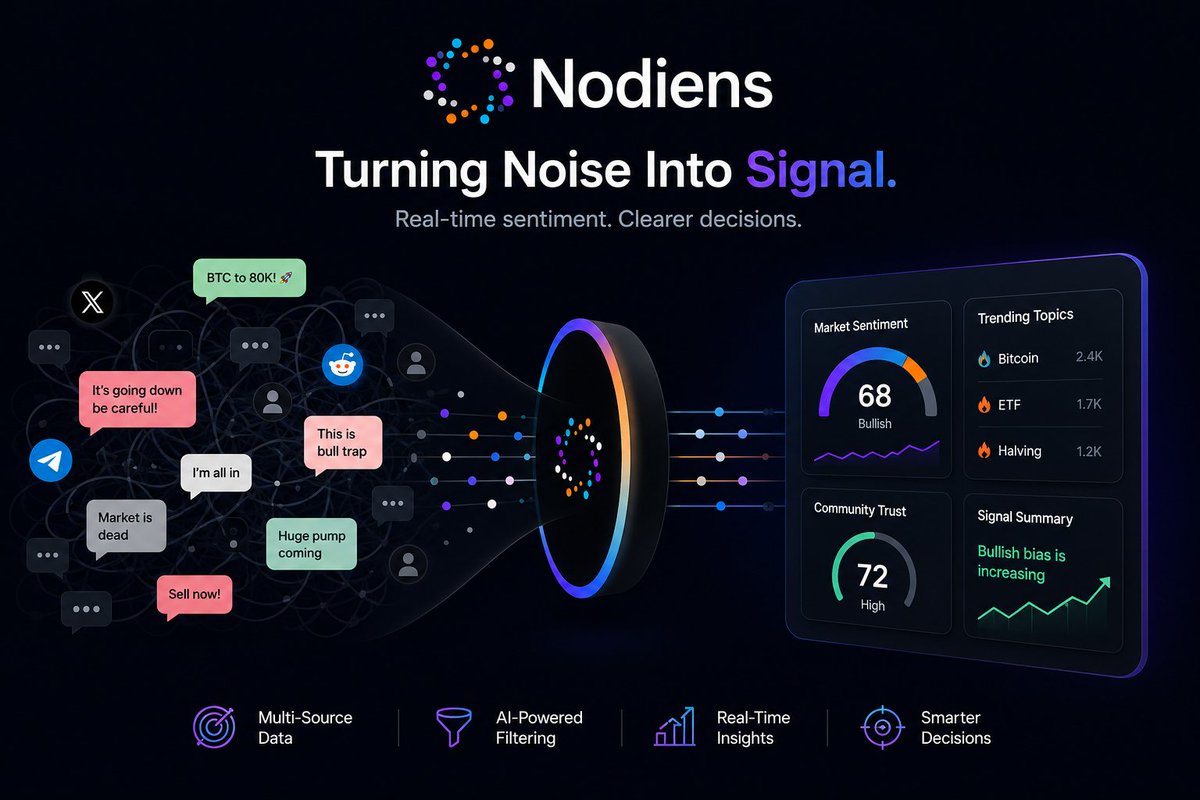
Timeline is pure chaos.
Someone says:
“BTC heading to 80k 🚀”
Scroll a bit:
“Crash coming, be ready.”
Everyone sounds confident.
But all in different directions.
That’s when it hit me:
the problem isn’t the market.
The problem is NOISE.
Too many opinions.
Too little signal.
And this is what most traders don’t realize:
as long as you keep consuming noise,
your decisions will always be random.
That’s where it started to make sense,
with @nodiens
noise can actually be filtered into something usable.
Not just reading opinions.
But seeing the collective direction of the market in real time.
Where sentiment is leaning.
Where trust is building.
What’s hype vs real conviction.
This isn’t about being right all the time.
It’s about:
having an edge.
Because in a market like this,
the winners aren’t the smartest ones,
but the ones who can see the signal clearly.
So maybe the real question isn’t:
“where is the market going?”
But:
where are your decisions coming from?
Turning noise.
Into signal.
And from there,
Nodiens can be one of the solutions
to help traders decide:
is this the moment to enter…
or just another trap.
Price is the tip of the iceberg. A pump can be misleading.
Underneath: liquidity, volume, volatility, market behavior. That's where the truth of a project lives.
Financial Intelligence on Nodiens shows you the whole iceberg, so you can tell real momentum from temporary hype.
🔍 What @nodiens Actually Does
Every day, crypto conversations happen everywhere.
Twitter, Telegram, Reddit, millions of messages, opinions, hype, fear, and misinformation.
The problem isn’t access to data.
It’s that everything is fragmented and noisy.
Most people try to keep up manually:
scrolling feeds, jumping between apps, chasing trends.
But by the time something is obvious,
it’s already too late.
That’s where Nodiens comes in.
Instead of showing you raw data,
Nodiens aggregates conversations from platforms like Twitter, Telegram, and Reddit into one unified stream — then filters out spam, manipulation, and irrelevant noise.
What you get isn’t chaos anymore.
It’s structured, readable signals.
Signals about:
• where attention is moving
• how sentiment is shifting
• which narratives are gaining traction
• and what the market is starting to care about
All of this is processed from millions of data points across social platforms and market activity, turning scattered information into clear, decision-ready intelligence.
So instead of reacting to hype,
you can track the build-up behind it.
Instead of consuming noise,
you start understanding direction.
That’s the real difference:
Most people see information.
Nodiens turns it into intelligence.
And in a market driven by narratives,
the ability to filter noise into signal
is where the real edge is.
#Nodiens #CryptoSignals #Crypto
Season Update: Indonesia Pool 🇮🇩
$1,000 USDC from this season's reward pool is reserved exclusively for Beacon runners on Indonesian IPs.
Your share is based on uptime, so the more consistently your Beacon runs, the bigger your cut.
Eligibility is tied to genuine connections in Indonesia.
Full mechanics drop this week.
If you're in Indonesia, get your Beacon running now.
Need to download the Beacon?
Get it running in 2 minutes: https://t.co/YY4D4tiE8r
Every project has two stories.
The market's: price, volume, liquidity.
The crowd's: who's talking, who's building, who's staying.
Nodiens turns each into a score, built from hundreds of signals.
Two numbers. Full picture. Faster research.
Live AMA with OpenX Network tomorrow, Tuesday July 28 at 15:00 UTC.
Our Head of Marketing @Sarut0biSasuke joins @AshtonH to talk decentralized AI and DePIN from the operator side: what it takes to run a network with hundreds of agents live in production, community nodes supplying the data, and every query settled in USDC over x402.
Bring questions about running a Beacon, building on the Go SDK, or where the agent economy goes next.
We'll take them live.
WE HAVE RAISED 10M
at a $100 million valuation
our partner NextGenIVF Group Limited, a NASDAQ listed company had exercised the option to increase their stake to 10%.
this is an additional 4m investment into us!!!
the pre-a round is now closed, where we are now moving onto our series A fundraising.
k25 is building the largest livestream x esports platform, where we incorporate prediction market mechanisms
good things are coming.
follow our socials and join our community to receive first hand news
Most Layer 1 blockchain focus on optimizing within the same constraints: faster block times, lower fees, or higher throughput.
@RetiumChain takes a different direction.
Instead of improving the existing model, it rethinks how the system is structured at a fundamental level.
At the core of this shift is its architecture.
Traditional blockchains are linear systems. Transactions are grouped into blocks, and blocks are processed sequentially. This introduces an inherent bottleneck, because the system depends on global ordering before anything can be finalized.
Retium replaces this with a mesh-based architecture, often referred to as PrimeMesh.
Instead of relying on a single chain of blocks, nodes communicate across multiple paths in a network graph.
This is not just a performance upgrade.
It changes the execution model itself — from a sequential pipeline into distributed coordination.
In practical terms, computation no longer has to wait its turn in a queue.
It can happen in parallel, across different parts of the network, which opens the door to more realistic scalability.
This architectural shift is reinforced by how validation works.
Most systems today rely on either Proof of Work or Proof of Stake.
PoW secures the network through energy expenditure.
PoS does it through economic stake.
Retium introduces Proof of Math (PoM), where validation is tied to mathematical correctness.
Instead of asking who spent the most resources, the system asks a different question: can the computation be proven correct?
This reframes security.
It reduces wasted work compared to PoW, and avoids the capital concentration dynamics often seen in PoS systems.
Validation becomes deterministic, grounded in logic rather than probability or financial weight.
Another important design choice is validator specialization.
In most blockchains, validators are responsible for everything: executing transactions, verifying them, participating in consensus, and finalizing results.
Retium separates these responsibilities into distinct roles: execution, validation, coordination, and finality.
From a systems perspective, this looks much closer to modern distributed architecture than traditional blockchain design.
Each component focuses on a specific task, allowing workloads to run in parallel and scale more efficiently.
This modularity also shows up in how fees are handled.
In many chains, gas fees are heuristic. They estimate cost, but don’t always reflect the actual computational work involved.
Retium instead ties fees directly to logic complexity.
Simple operations remain inexpensive, while more complex computations are priced proportionally.
This creates a tighter alignment between resource usage and cost, which can lead to a more sustainable system over time.
On top of this, Retium introduces an additional layer: RAI (Retium AI Layer).
Rather than being part of consensus, this layer functions as an optimization system.
It monitors network conditions, helps distribute workloads, and extracts patterns from on-chain data.
If implemented effectively, this introduces a degree of adaptability.
The network is no longer purely deterministic in execution, but can adjust based on its own state.
From a developer standpoint, this changes how applications are built.
Instead of interacting with a rigid execution environment, developers work with a more structured and modular system.
This opens the possibility for applications that require deeper computation, more complex state transitions, and multi-layer coordination.
Use cases start to move beyond simple transfers or basic DeFi primitives, toward systems that more closely resemble real computational platforms.
At a high level, most blockchains today function as transaction processors.
Retium is closer to a distributed computation and verification system.
If this model proves viable at scale, it doesn’t just improve existing infrastructure — it challenges the assumptions behind how blockchains are designed in the first place.
Retium offers a different perspective on what these systems can become.
If you’re interested in understanding how this works in more detail, it’s worth taking the time to explore it directly:
https://t.co/hrH5k8hjyq
11/
If implemented well,
this turns blockchain into something more adaptive.
Not just deterministic execution,
but a system that can respond to its own conditions.
10/
RAI (Retium AI Layer)
Retium introduces an AI layer on top of the network.
Not as a gimmick, but as an optimization layer:
monitors network state
helps distribute workload
extracts insights from on-chain data