McDonald's uses an AI bot called "Olivia" for hiring. A pair of hackers found they could access every conversation job applicants had with it—including all the personal info they shared—by exploiting security flaws as basic as using the password "123456". https://t.co/55WueJz3Of
Hijo único de una familia judía americana, a Jim Simons los números le fascinaron desde que era un niño. Su padre trabajaba como ejecutivo y pudo facilitar que su hijo acabara estudiando matemáticas en el MIT. En apenas tres años, Simons se doctoró y, con 26 años, fichó por la Agencia de Seguridad Nacional.
Su trabajo consistía en desencriptar las comunicaciones rusas en plena Guerra Fría.
Announcing AlphaFold 3: our state-of-the-art AI model for predicting the structure and interactions of all life’s molecules. 🧬
Here’s how we built it with @IsomorphicLabs and what it means for biology. 🧵 https://t.co/gjw6Ip4F2M
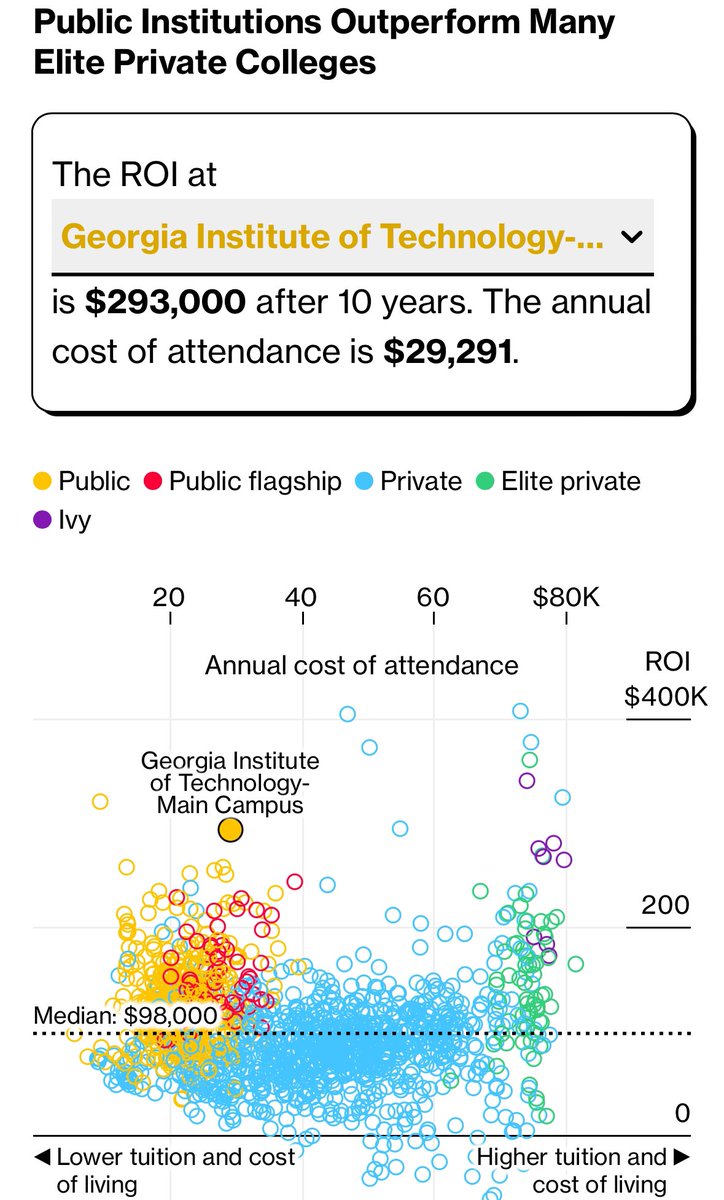
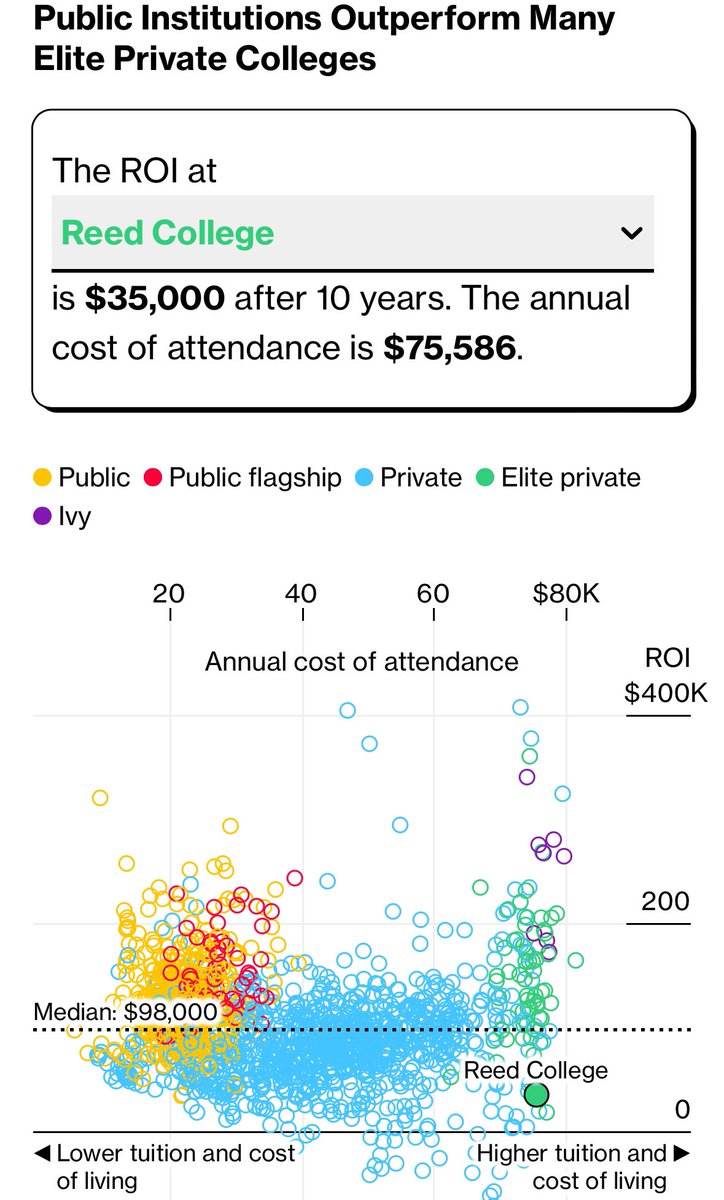
Bloomberg analysis shows Georgia Tech is basically the best value in higher ed. In the other quadrant is your Reed/Oberlin-type places: https://t.co/pnQJ3bT3HW
* Language is low bandwidth: less than 12 bytes/second. A person can read 270 words/minutes, or 4.5 words/second, which is 12 bytes/s (assuming 2 bytes per token and 0.75 words per token). A modern LLM is typically trained with 1x10^13 two-byte tokens, which is 2x10^13 bytes. This would take about 100,000 years for a person to read (at 12 hours a day).
* Vision is much higher bandwidth: about 20MB/s. Each of the two optical nerves has 1 million nerve fibers, each carrying about 10 bytes per second. A 4 year-old child has been awake a total 16,000 hours, which translates into 1x10^15 bytes.
In other words:
- The data bandwidth of visual perception is roughly 16 million times higher than the data bandwidth of written (or spoken) language.
- In a mere 4 years, a child has seen 50 times more data than the biggest LLMs trained on all the text publicly available on the internet.
This tells us three things:
1. Yes, text is redundant, and visual signals in the optical nerves are even more redundant (despite being 100x compressed versions of the photoreceptor outputs in the retina). But redundancy in data is *precisely* what we need for Self-Supervised Learning to capture the structure of the data. The more redundancy, the better for SSL.
2. Most of human knowledge (and almost all of animal knowledge) comes from our sensory experience of the physical world. Language is the icing on the cake. We need the cake to support the icing.
3. There is *absolutely no way in hell* we will ever reach human-level AI without getting machines to learn from high-bandwidth sensory inputs, such as vision.
Yes, humans can get smart without vision, even pretty smart without vision and audition. But not without touch. Touch is pretty high bandwidth, too.