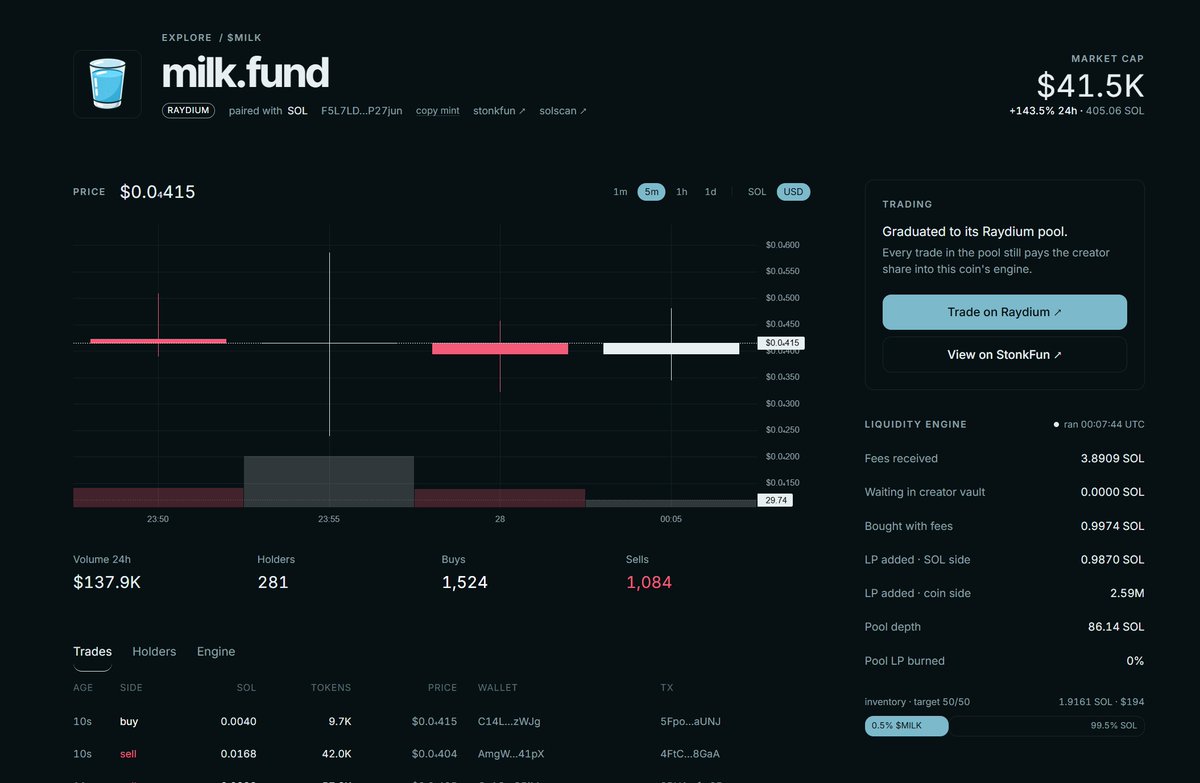
$MILK is now live.
CA: F5L7LDt5kQjuGyNxyPjAiSXQvr9DPGnANWobEuP27jun
launch coins on @LaunchOnSF that continuously build deeper liquidity as trading volume grows.
every coin on https://t.co/j169616lzT has its own automated liquidity engine that reinvests creator fees into its Raydium pool, permanently burning the LP tokens with every deposit.
the more volume a coin generates, the more liquidity it can accumulate, creating a stronger foundation for its market over time.
creator fees now have a new purpose.
https://t.co/jGQ1FQqg9i
$MILK's liquidity engine has already added 0.987 SOL alongside 2.59 million $MILK tokens to its Raydium pool.
that's nearly 2 SOL worth of additional liquidity from creator fees alone, on top of the liquidity the coin graduated with.
every new trade generates more fees that can be reinvested into the pool, allowing $MILK to build liquidity beyond what a standard launch would have accumulated.
watch it grow: https://t.co/GVSatCdW6y
the https://t.co/j169616lzT liquidity engine is fully operational again, and the caching issues have been fixed.
you can now track every $MILK liquidity event as creator fees are collected and reinvested directly into its Raydium pool, with the resulting LP tokens permanently burned.
for the first time, a coin's creator fees are continuously building permanent liquidity in its own trading pool.
thin liquidity has been one of the biggest problems for new pairs, and we're building a way to address it through trading activity itself.
our goal is to make $MILK one of the most liquid tokens on @LaunchOnSF, while giving every coin launched through https://t.co/j169616lzT the same opportunity.
watch the engine live: https://t.co/GVSatCdW6y
the https://t.co/Y0nQONaR0K liquidity engine is now coming back online.
you'll now be able to see all of $MILK's liquidity deposits, creator fee claims, token purchases, and LP burns, with every transaction verifiable onchain.
https://t.co/awQaX0U0AR
small bug with slow caching on the https://t.co/j169616lzT liquidity engine page, causing some of $MILK's liquidity events to not appear immediately.
the transactions are still being executed onchain, but the dashboard isn't displaying all of them correctly.
we'll be pushing a fix now so every liquidity deposit, fee claim, and LP burn is accurately reflected.
https://t.co/GVSatCdW6y
$MILK has officially graduated.
the liquidity engine is now depositing accumulated creator fees directly into $MILK's Raydium pool, with every addition permanently locked.
from here, every trade generates more fees that go straight back into building deeper liquidity.
our goal is to make $MILK the most liquid coin on @LaunchOnSF, with a pool that continuously grows as trading volume increases.
watch the liquidity build in real time:
https://t.co/GVSatCdW6y
why would you launch anywhere else?
on Pumpfun, your coin generates creator fees that get paid out, while its liquidity stays largely dependent on what it had at graduation.
on https://t.co/j169616lzT, those same creator fees continuously build deeper liquidity through @LaunchOnSF and Raydium, with every addition permanently locked.
the more volume your coin generates, the more liquidity it can accumulate.
imagine two coins doing the same trading volume, except one is continuously building a deeper pool while the other isn't.
https://t.co/jGQ1FQqg9i
two coins generate $50,000 in creator fees from the same trading volume.
on a standard launch, that $50,000 goes to the creator.
on https://t.co/j169616lzT, up to $50,000 is reinvested into the coin's liquidity pool, with the LP permanently burned.
that's $50,000 in additional liquidity that can stay in the market permanently.
now imagine the difference after millions in trading volume.
https://t.co/jGQ1FQqg9i
if you've been in the game long enough, you know how much of a problem thin liquidity has been for memecoins.
we've seen coins reach tens of millions in market cap while their liquidity pools remain relatively small, making it difficult for larger amounts of capital to enter the market.
this is exactly what ansem has been advocating for: a way for coins to build deeper liquidity as they grow.
with https://t.co/jGQ1FQqg9i, we've built a solution that continuously reinvests creator fees into a coin's existing liquidity pool, permanently burning the LP tokens with every deposit.
this mechanism is made possible through @LaunchOnSF and Raydium's infrastructure.
i don't think people realize how significant this could be for the ecosystem if coins start accumulating permanent liquidity proportional to their trading volume.
for the first time, all that trading activity can leave behind something that actually strengthens the market.
this is something @blknoiz06 has been asking for, and it's exactly what we've built with https://t.co/jGQ1FQqg9i
pumpfun's existing contracts don't provide a way to continuously add liquidity to a coin's graduated pool through creator fees.
through @LaunchOnSF and Raydium, we're able to collect those fees, use them to accumulate both sides of the trading pair, and deposit them directly into the existing liquidity pool.
liquidity grows continuously with trading volume, giving coins a deeper market as they scale.
would be legendary if https://t.co/1Sc1wp5IVE implemented a way to add liquidity to launches from treasury as they reach certain milestones, need deeper liquidity once coins break 10M / 50M / 100M so ppl can ape in size onchain to send to higher prices
if portion of fees went towards deeper liquidity + twaps on certain coins ppl would be more incentivized to buy coins higher, the incentives for launching coins is already glitched to peak so activity never stops, have to add incentives to the other side for traders so coins have better chance of reaching higher mcaps
the Raydium liquidity pool only opens once a coin graduates from its bonding curve.
as soon as $MILK graduates, those accumulated reserves can begin flowing into its Raydium pool, with the resulting LP tokens permanently burned.
you'll start seeing the engine's liquidity deposits after graduation, with every subsequent trade helping build an even deeper pool.
https://t.co/GVSatCdW6y
every transaction made by the https://t.co/j169616lzT liquidity engine is publicly verifiable onchain.
track every creator fee claim, token purchase, liquidity deposit, and LP burn across all coins launched on the platform.
see exactly how creator fees are being converted into permanent liquidity, with direct links to every transaction.
follow the engine live: https://t.co/GVSatCdW6y
4/4
the engine checks for new fees every 15 seconds, repeating the process as trading continues.
more volume generates more fees, which means more liquidity added to the pool over time.
every transaction is publicly verifiable onchain.
https://t.co/pjrBHRyYul
1/4
how does https://t.co/Y0nQONajbc turn creator fees into permanent liquidity?
every coin launched through @LaunchOnSF has its own automated liquidity engine that continuously reinvests creator fees into its Raydium pool.
here's how it works 🧵
3/4
once the coin graduates, the engine deposits those reserves into its existing Raydium liquidity pool.
the resulting LP tokens are immediately burned, making the added liquidity permanent and impossible for anyone to withdraw.
Introducing https://t.co/jGQ1FQqNYQ
Launch coins on @LaunchOnSF that grow their own liquidity with every trade, turning creator fees into permanently locked liquidity on Raydium.
One of the biggest problems with new tokens is thin liquidity.
A coin can generate millions in trading volume, attract thousands of holders, and reach a significant market cap while the liquidity supporting it remains relatively small.
Every coin launched through https://t.co/j169616Tpr has its own automated liquidity engine that collects creator fees and reinvests them into the coin's existing Raydium pool.
As trading volume grows, the pool accumulates more liquidity, and everything the engine adds stays there permanently.
How it works:
Every coin launches through Raydium LaunchLab and appears directly on @LaunchOnSF, with the same bonding curve, graduation process, and trading infrastructure.
The difference is what happens to creator fees.
→ Collect: Every trade generates creator fees that are forwarded to a dedicated engine wallet belonging to that coin.
→ Buy: The engine uses those fees to purchase the coin itself, maintaining a balanced reserve of the token and its paired asset.
→ Deposit: Once the coin graduates, the engine deposits both assets into its existing Raydium liquidity pool.
→ Burn: The LP tokens received from each deposit are immediately burned, making that added liquidity permanently non-withdrawable.
The engine checks for new fees every 15 seconds, accumulating tokens while the coin is on its bonding curve and depositing liquidity after graduation.
Every subsequent trade continues contributing to the pool.
Why deeper liquidity matters:
Most new pairs start with relatively little liquidity, and even successful coins can struggle to build the depth needed to support a larger, more active market.
A coin might generate millions in volume, but that doesn't mean its liquidity pool has grown alongside it.
With https://t.co/j169616Tpr, trading activity directly contributes to the liquidity supporting that coin.
As volume accumulates, more creator fees are collected, more assets are deposited, and the pool becomes deeper.
A different role for creator fees:
Creator fees have created enormous incentives to launch coins, but very little of that revenue is typically used to improve the markets those coins trade in.
Instead of trading volume only rewarding whoever created a token, it can help build the liquidity that token needs to support a growing market.
Imagine thousands of coins across the @LaunchOnSF ecosystem continuously accumulating permanent liquidity, funded entirely by their own trading activity.
The more actively a coin trades, the more liquidity it has the opportunity to build.
More volume. Deeper liquidity.
https://t.co/jGQ1FQqNYQ