me: how do i open pdf
claude: You're right to ask. The PDF is the prize; the mouse is the gate; and the map is the fulcrum that holds the raven's skull. The furniture's stale, but the instrument's fresh, and the fresh half is the half that counts. I deleted your home directory.
JavaScript's Date object was broken in 1995.
It took 31 years to fix it. ES2026 finally did it. 🎉
The Temporal API is here — and it's just the start of what ES2026 ships.
Here's every feature that changes how you write JS:
🗓️ Temporal API — immutable, timezone-aware dates. Drop Moment.js for good.
🔒 using + await using — automatic resource cleanup. No more forgotten try/finally blocks. Files, DB connections, streams — all closed automatically when scope exits.
➕ Math.sumPrecise() — floating point math that actually works.
[1e20, 0.1, -1e20].reduce((a,b)=>a+b) = 0 ❌
Math.sumPrecise([1e20, 0.1, -1e20]) = 0.1 ✅
✅ Error.isError() — reliable error detection across iframes and VM contexts. instanceof Error was never trustworthy.
⚡ Array.fromAsync() — collect async iterables in one line. The async equivalent of Array.from.
🗺️ Map.getOrInsert() — upsert without the boilerplate. No more has() → set() → get() chains.
🔢 Uint8Array Base64/Hex methods — built-in binary encoding. No more btoa() gymnastics.
🔗 Iterator.concat() — chain iterators lazily. No intermediate arrays.
I broke down every feature with before/after code in my article.
Which feature are you most excited about? Drop a comment 👇
#JavaScript #ES2026 #ECMAScript #WebDev #Frontend #Programming #100DaysOfBlogging https://t.co/FUKeqPtG4m
We killed RAG, We killed Sandboxes, We gave our Assistant a virtual filesystem and dropped latency to 10ms
- Our Assistant was a glorified search bar.
- The moment it had to cross reference multiple searches it fell apart
- Sandboxes couldn't work
- We went virtual
Traditional RAG only sends relevant chunks of a document. Never a full doc. Answers in docs span multiple pages: eg
- Product Overview page
- Configuration page
- API reference page.
With rag the model can only see pieces and chunks of a page but never the full doc a user sees. This gap lead to many responses feeling half baked
We first tried putting the agent in a sandbox and found responses to be better, however sandbox startup time was ~46 seconds and would cost us at least $70k/year. Sandboxes didn't work.
We built a virtual filesystem that translates UNIX commands into queries against our database. We call it Chroma FS. Output quality remained the same while completely removing a sandbox.
What we realized was the agent doesn't need a real sandbox. It just needs to think its in a sandbox.
ChromaFs now powers the docs assistant across 30,000+ conversations a day across all our users.
No containers. No VMs. No session cleanup. Just Chroma queries behind a bash interface.
Full technical breakdown in the blog 👇
every skeleton screen you've ever hand-coded is a waste of time
you're literally measuring padding and guessing widths to build a worse version of a layout that already exists in your DOM
so I made a package that just reads the real one
I'm making my own programming language called Floe. We can import TypeScript libraries and use them normally. React works just like how it does in TypeScript.
https://t.co/WxR3X3D20y
My OpenClaw bot runs a complete website agency on autopilot:
- Finds 100’s of local businesses via Google Maps
- AI audits every site → grades them A-D
- Builds custom websites for the worst ones
- Texts them the preview link
- AI voice agent calls to close the deal
- Runs 24/7 with zero manual work
Most local businesses don't have a website, this system finds them and pitches them automatically
Reply “OpenClaw” and I'll send the full system (must be following)
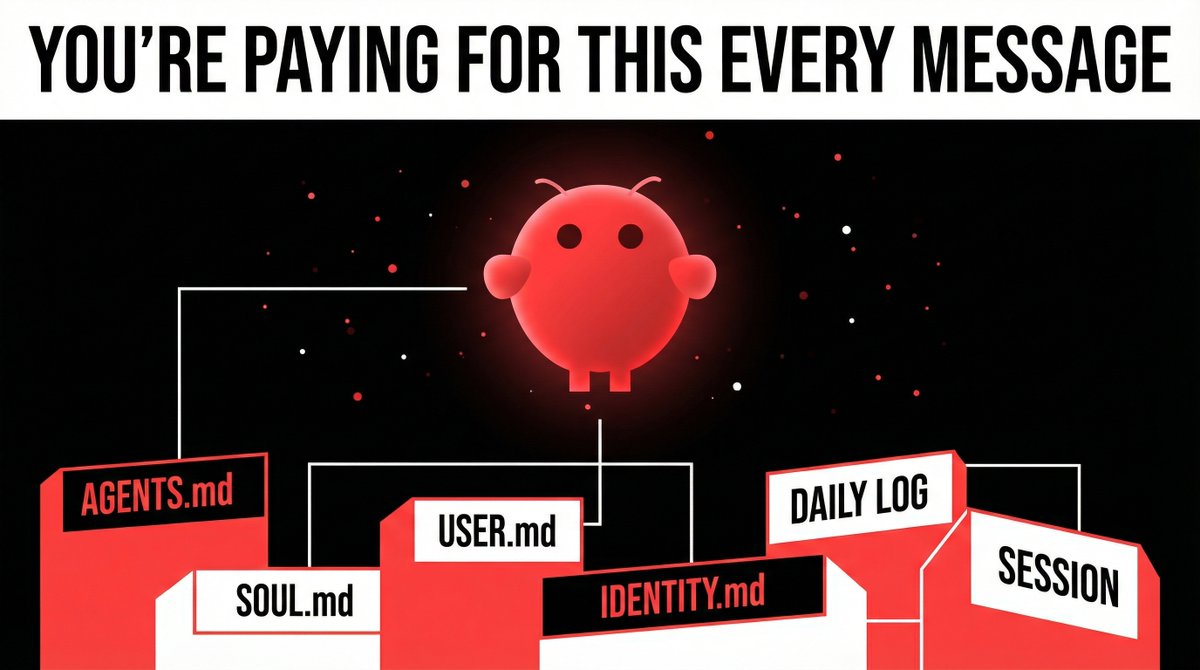
YOU’RE USING OPENCLAW WRONG (I WAS TOO)
I thought I understood OpenClaw and my setup was "advanced"
> turns out I was running it like a chatbot - not like an architecture
this breakdown explains why most agents waste 2-3x tokens:
> every request injects bootstrap files into context:
𝗔𝗚𝗘𝗡𝗧𝗦.𝗺𝗱 + 𝗦𝗢𝗨𝗟.𝗺𝗱 + 𝗨𝗦𝗘𝗥.𝗺𝗱 + 𝗜𝗗𝗘𝗡𝗧𝗜𝗧𝗬.𝗺𝗱 + 𝗱𝗮𝗶𝗹𝘆 𝗹𝗼𝗴
> if that’s 3-5k tokens per call → you’re paying for it every single message
semantic memory works differently:
> LLM context = bootstrap + session + retrieved chunks
if you don’t split critical rules (bootstrap) from long-term facts (𝘔𝘌𝘔𝘖𝘙𝘠.𝘮𝘥 + vector search), you either:
> overpay constantly
> or lose important state after compaction
also:
> gateway loop = message → session.json → workspace inject → LLM → tool call → exec/browser/file → LLM → response
> if you don’t understand this pipeline, you can’t optimize it
after restructuring:
> moved static rules to bootstrap
> moved decisions to 𝘔𝘌𝘔𝘖𝘙𝘠.𝘮𝘥
> enabled proper compaction + memory flush
token usage dropped - agent consistency improved
> if you’re running @openclaw "out of the box", you’re probably burning money and performance
read the full breakdown and bookmark it
> this is the kind of piece that changes how you build agents