I now get all my security news from @X.
The PHP attack last month, the Linux vulnerability at the start of this month, and now this.
Mainstream media is so behind – this isn’t new.
But with how many hacks and vulnerabilities being exposed, X has become essential to build around.
If you’re running a company, it’s almost irresponsible not to follow X closely.
Is there an alternative, or is X the fastest security alert source in the world now?
A vulnerability (worse_query) affecting iOS 26.7.1, 27.0.1, and 27.2 allows malicious apps to read local files from other apps, putting seed phrases, private keys, and login credentials at risk across the entire ecosystem. This is an iOS-level issue, not unique to Binance.
Immediate Action Required:
- Delete any apps installed from untrusted sources (such as sideloaded or manually signed IPAs).
- Update iOS and all apps to the latest official versions.
- If you suspect a breach, transfer funds to a new wallet created on a clean device and reset all active login sessions.
Never install unauthorized packages, and keep your software up to date.
Everyone says SaaS is dead.
I thought the same and expected things like Notion wouldn't survive.
But then I recently checked my Notion usage and actually ended up upgrading my plan.
My opinion has changed.
What's dying isn't the software, it's the pricing model.
What’s kept me on Notion is the MCP.
We write a lot of docs at @breezedotcom, mostly PRDs and scoping. I draft in Claude and push everything to Notion where the diagrams render properly. So I can drop in mockups Claude has built and my lawyer can comment on all of them.
I upgraded so I could search a database properly. Without it my AI chief of staff kept handing me back todos I'd already marked done, because it couldn't filter on status.
Google Docs should win and yet it doesn't. The MCP exists, but the reliability and the connectivity are terrible and you can't build a diagram the way you can in Notion.
My Notion usage has gone up a lot and they still charge me for one seat. They're capturing almost none of the extra usage.
The obvious answer is usage-based pricing. But I'm not using Notion AI, so if they started charging me for that I'd probably churn.
If great SaaS companies get this right, I think they'll thrive.
Curious to see what @ivanhzhao, @simonlast, @akothari and the team are cooking up.
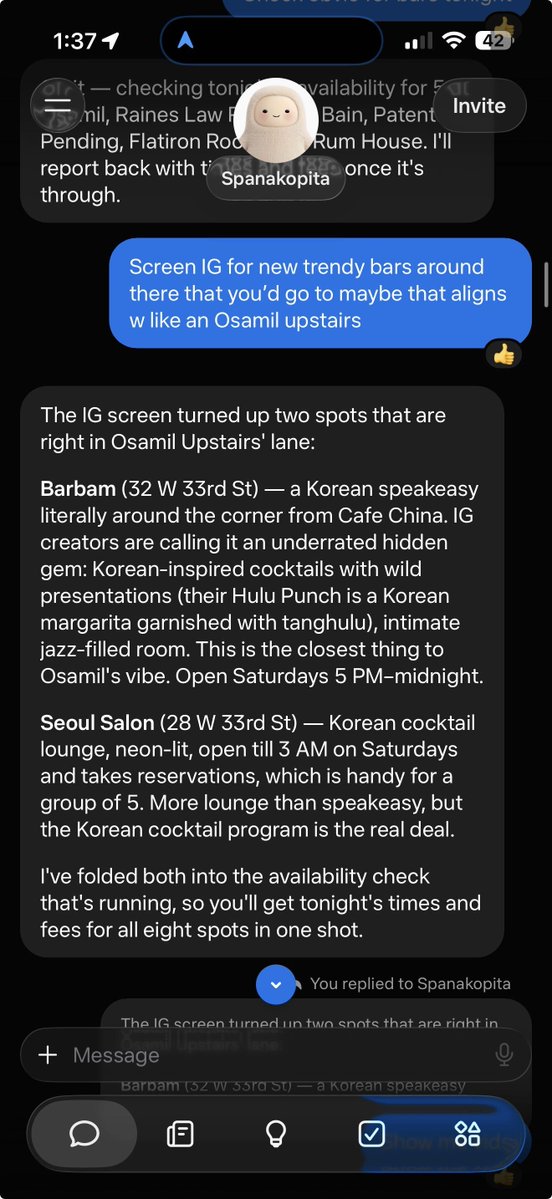
I think Muse will beat ChatGPT and Claude for mainstream users.
It all comes down to IG data.
Muse fulfills a need that Claude / OpenAI can’t match.
For regular users, both are a Google Search replacement.
But Muse is IG search on steroids and soon people are going to realize how insanely useful this is.
Google ranks based on popularity.
IG data is billions of creators posting stuff they're experts in, in their very niche fields.
I asked for trendy bars in NY and Muse returned reels from creators on the ground. No other AI can do this.
Muse can even curate a feed. I wonder what’s next for that -- it’s already got me spending more time on the app than I expected.
Very bullish.
the most rewarding part about muse is seeing it make a difference for people who aren't in tech and don't give a shit about AI
seeing muse click for people in my life outside of tech, and watching them use agents without having to know what a CoT or MCP or CLI are, feels like what we've been trying to build towards the whole damn time
love all the musers ❤️
@NinosMaron Muse had more downloads than ChatGPT in its first 12 days. Obviously way more people know about AI now, still a strong start. But you could be right.
I dread any time I have to talk with any customer service.
So I tried this with @Muse today.
It returned an entire transcript of the call log.
I wonder if the person on the other side knew it was an agent…didn’t seem like it.
Mind blown.
we just expanded the @Muse beta for outbound calls to US businesses, prioritizing folks who'd asked their Muse to let us know they wanted it first :)
if you're in, give it a shot and tell us what you think. phone calling was one of our top requests and your feedback helped make it happen! 📞
Instinct's launch was a crypto launch.
A lot of people wrote this sort of playbook off as degen behaviour.
But now we see it's just distribution.
They launched with an anonymous team, invite-only, and with people replying under posts asking for codes.
Then a few credible people posted about it. I only found it because @pitdesi and @sytaylor wrote about it.
Was interesting to see how trusting people were when it requires access to your inbox and in some cases your card to complete tasks.
People were suspicious but jumped into it anyway.
That's the DeFi and NFT era all over again.
Bored Ape's founders stayed anonymous for nearly a year. By the time BuzzFeed doxxed them the collection was worth billions. Bitcoin's creator has of course remained anonymous.
This is part of that world. In crypto the founder either turns out to be real or they rug it.
But now we see the same playbook works outside of it.
Instinct went from $50M to $2.5B in a few months, now in talks at $10B.
Crazy that all of it happened on X.
No one I know outside this bubble have even heard of it.
Distribution is the moat.
Instinct is in talks to raise about $1 billion at a roughly $10 billion valuation, less than a month after raising $250 million at a $2.25 billion pre-money valuation.
The 23-year-old founder Noah Shinn is building a personal AI agent that can operate software and complete tasks like answering emails, negotiating bills and booking reservations.
Instinct now has more than 100,000 users and has already run into compute capacity constraints as demand grows.
Its valuation has gone from roughly $50 million in the spring to $10 billion under discussion today.
Source: The Information
Muse vs Instinct
I've been trying to build personal assistants for a while. Claude automations, OpenClaw automations.
But these are the first two personal assistants I'd call legitimate.
A few raw thoughts and things I noticed after using both.
1. Muse’s data advantage is unrivalled
It’s hard to see how Instinct can compete here.
Meta’s data through IG is so vast and useful.
My main use for IG has always been travel. I follow photographer accounts to find places that aren't touristy or ski instructor accounts to discover new ski resorts.
People find restaurants and cool things to do on IG now through creators they trust.
Muse has access to all of that data that no one else does.
2. Instinct will push on a task harder than Muse – pro and a con.
Instinct will hammer a site until it gets you what you asked for. Saw someone had their OpenTable account blocked because it scanned a couple of hundred times. I got a golf tee time for our head of commercial that should have been impossible to get.
Muse tells me it's checking my flights twice a day, and when it gets stuck it hands the browser back to me rather than forcing it.
3. Muse is the fastest assistant I've used.
It replies immediately. It feels like talking to someone in real time rather than waiting on a machine. Instinct has started taking forever and has told me outright it's a compute problem.
Meta has been running consumer products for billions of people and it shows.
4. Meta saying it's liable is a game changer.
If Muse makes a mistake on a payment, a refund guarantee covers it. Didn't expect Meta to be the first to do this.
5. Meta has far more to lose than Instinct does.
For the long-term, Meta being a public company and doing this all extremely publicly with enormous liability attached gives them a huge edge.
In terms of giving them more data, they already have all my Instagram data anyway.
Instinct, the worst case is the company dies and I'm left with accounts blocked all over the internet.
6. Seeing what they're doing is important
With Instinct there's a lot happening in the background that I have no view into, and there are people who found out it had transacted on their behalf after the fact.
With Muse, I can see the browser.
Again, it's a pro and a con. Instinct's UX is cleaner but it comes at a cost.
Overall, I'm still using both. But currently leaning more into Muse.
Instinct ships faster than almost anyone I've seen. It will be interesting to see how they progress from here.
Muse feels like it's being built to still be here in two years.
I'm surprised more people aren't talking about this.
Building superintelligence without guardrails is one aspect.
The other is that humans are getting more cognitively lazy by the day -- a trend that should also be considered just as seriously imo.
We've very quickly outsourced our thinking.
I say this as someone who's all in on AI.
We spend a serious amount on AI every month at Breeze and I tell everyone in the company to use it for everything. It's genuinely made the team more capable and efficient.
The problem is, I get to answers so fast now that I rarely sit with a problem long enough to properly exercise my brain. I’ve spoken to many who have already felt the tangible impact this new workflow has had on them.
Similar arguments were made with the calculator or the internet, but I think it’s fair to say we are at a whole new level.
For now the impact is heavily weighted on those at the forefront of tech who are using AI daily.
But how long till that spreads to the majority of the population and what will the consequences be then?
And it isn't just work. Most people are doom scrolling TikTok and Instagram Reels instead of sitting down with a book. Dopamine spikes are too readily available and we're steadily losing the ability to digest long form content or take in information deeply.
Where does this leave us?
I don't have a neat answer. I'm building in the middle of it like many others.
What I do have is a bias towards optimism. I'm betting on a future where AI is disruptive but ultimately raises quality of life for everyone, much like every other major technological leap throughout history.
But the trajectory is concerning.
The question everyone asks is what ChatGPT 10 or Claude 10 looks like.
I think the harder question is what we look like by then.
I resigned from Anthropic today. I spent the last three years doing pretraining research at both OpenAI and Anthropic. Neither company is acting responsibly. They are racing straight to self-improving superintelligence and gambling with our lives. More thoughts below.