@Plazm_io Reading about the integration, $PLAZM as collateral sounded useful.
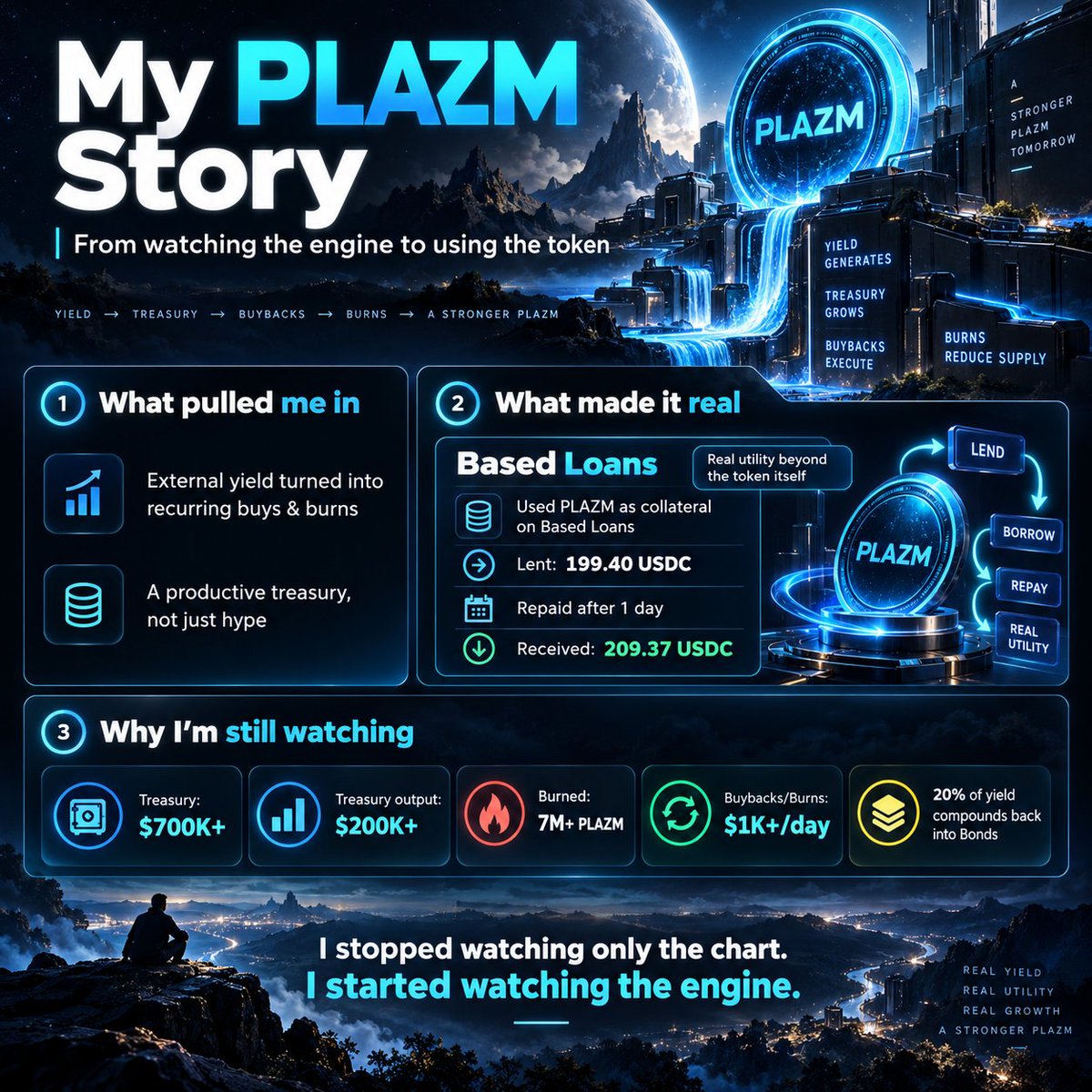
Using it from the lender side made it real: I put 199.40 USDC to work, the loan was bought back after 1 day, and 209.37 USDC came back ready to redeploy.
That’s when the utility clicked.
Over the year I started tracking the engine more than the chart:
→ treasury>$700K
→ $200K+ treasury output
→ 7M+ PLAZM burned
→ $1K+ daily buybacks/burns
→ 20% of yield compounding back into Bonds
The mix of growing productive capital + shrinking supply is why I’m still here
#PLAZMContest@Plazm_io
What kept me here wasn’t a price target. I watched PLAZM turn external yield into recurring buys/burns, then saw the token gain utility beyond its own app when I could lend USDC against $PLAZM on @Based_Loans.
@DexFinance
The moment that made it real for me:
I funded 199.40 USDC against $PLAZM collateral on a 30-day loan.
The borrower bought back after just 1 day and I received 209.37 USDC.
That was when PLAZM stopped being only something I followed — it became something I could use.
$PLAZM’s treasury has now pushed past $700K.
The project reports $200K+ in treasury output so far, with buybacks now running above $1K/day — without spending down principal.
The number I’m watching next: how fast 20% Bond compounding grows that engine.
Most tokens add emissions to create yield. $ERAGE takes the opposite route.
It can only be minted with $ESHARE + $RAGE, while each mint/redeem takes 2.5% to strengthen backing and burn both underlying tokens.
No staking APR. The mechanism itself is the experiment
@therageprotocol
$LSTEAK takes a different route to yield: no emissions, no rebasing.
Current backing: ~$179K
BPT: ~$1.135
Yield flows into backing, POL, xlLSTEAK, burns and operations.
The metric I’m watching isn’t APR — it’s whether backing per token keeps climbing.
10,000 Yakkamon NFT Eggs are minted. Now the more interesting phase starts.
@yakkamon_game is finalising early access with an initial 30 Yakkamon, rolling out in waves in Q4.
Mint hype is over. Now I’m watching whether the game loop keeps players.
Productive treasuries are moving from individual tokens to launchpads.
@BackedFund is bringing a CoinBarrel-style model to Base, with productive Bond backing built into launches.
The idea I’m watching: can “backing” become a default part of token launches?
One @Based_Loans detail I think gets overlooked:
Every loan charges a 2.49% protocol fee. 15% of that fee is routed into mUSDC.
So loan activity doesn’t just serve borrowers/lenders — it also adds external USDC to another Monstro product.
@monstrodefi
First 24h update: 2 $gDEX burned through the new v4 hook.
That’s on very low volume, so the interesting part from here is how the burn scales as trading activity picks up.
$gDEX just moved from “deflationary target” to an automatic burn mechanism.
A new Uniswap v4 hook now burns 2% on every buy/sell through the pool.
1,200 gDEX was also burned upfront.
Supply: 118,798
Long-term target: ≤100K
@DexFinance
Fewer than 60K $ESHARE remain.
Supply mechanics just got another layer:
→ Uniswap v4 pool
→ automatic burns on swaps
→ minting removed
→ ownership renounced
Existing burns still continue.
Scarcity now runs through multiple loops.
@EmpFusion
The interesting part of @Based_Loans isn’t just the 5% on a 30-day loan.
The premium is fixed at open. Day 1 buyback or day 30: same 5%.
For lenders, capital turnover is the hidden metric — faster buybacks mean the same USDC can be redeployed sooner.
Beginner tip for @0xSunflowerLand:
Don’t sell every resource as soon as you harvest it.
Keep a small stock of crops, wood and stone — quests and crafting often need them later.
Selling everything can slow your progress more than it helps.
Beginner tip for @0xSunflowerLand:
Don’t just plant the crop with the highest value.
Match crops to how often you can check the game:
• short crops when you’re active
• longer crops when you’re away
Idle soil earns nothing.
High APR isn’t automatically the problem.
The question is where the yield comes from.
@AltitudeBase launched Everest with ~67.5M ALTITUDE staked and a 146% starting APR.
The key distinction: rewards come from an existing reserve — not new token minting.
That’s what I’m watching
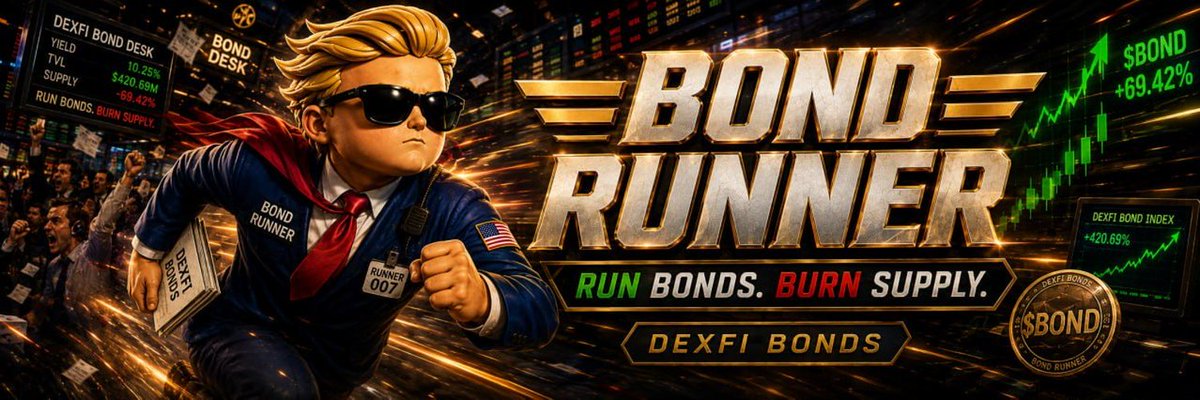
Been watching $RUNNER since launch. What matters isn’t the chart.
The loop is live:
trading → Bonds → external yield → market buys → burn.
7M+ RUNNER is already gone.
Now I’m watching one thing: how fast can the Bond stack grow?
@BondRunner_@DexFinance