📢Our February issue is now live! Highlights include a method for automated algorithm discovery, a Comment on the opportunities in organic redox flow battery research, and a Perspective on computational drug development.
👉https://t.co/5bQEETFusf
This position is subject to our new postdoctoral pay plan, which starts at 70K with incentives for mentored teaching and fellowships: https://t.co/koYpkdCbIn
Our new work on (1) mapping genetic interactions in E. coli with titratable CRISPRi and then (2) using these data to build predictive gene expression -> growth rate models is out now in Cell Systems! https://t.co/rReHliM3lL Congrats to @CmbUtsw student and lead author Ryan Otto!
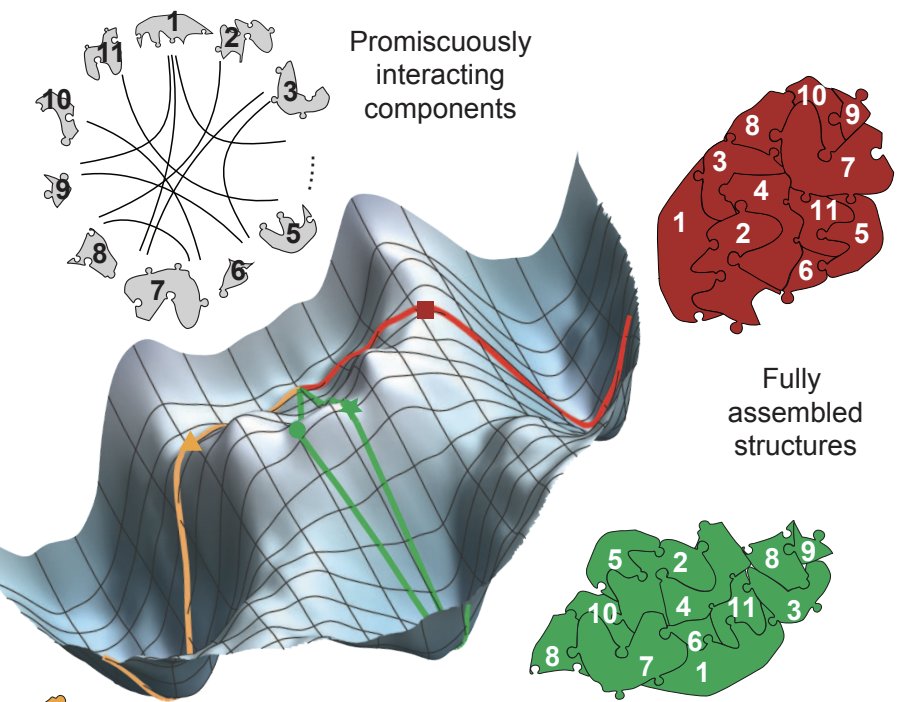
Can the intrinsic physics of multicomponent systems show neural network like computation?
Out now:
https://t.co/RNJS50MWtl
Led by Constantine Evans w/ Jackson O'Brien, Erik Winfree.
U Chicago summary: https://t.co/jgcH0GyGu9
Our deep distilling paper is out! It shows how far we can get training neural networks using modular symbolic reasoning, providing an alternative path to global loss minimization. It was such a fun and inspiring process working with @PaulJBlazek and @kvenkatesh75!
📢@PaulJBlazek and @MiloLinLab (@LHBioinf_UTSW) introduce an approach for automated algorithm discovery from data. The uncovered algorithms perform as well as or outperform human-designed algorithms in the discussed use cases. https://t.co/AcxKP9bX6m
👉https://t.co/OIaWGxupoO
New paper out on using non-equilibrium circuit theory developed in our lab to show how the maximum efficiency of molecular machines depends on the chemical energy gradients inside cells:
https://t.co/UP0UursGsO
Very excited to announce the launch of our new Biosynthetic Pathway Design Collaborative! My lab will be teaming up with @s_h_saunders, @MiloLinLab and @infphilo to build computational and experimental tools for biosynthesis https://t.co/EJ5Iz3d67m
@LHBioinf_UTSW
We're hiring - looking for a new postdoctoral fellow to join our collaborative efforts in synth biology! This postdoc with work with mself, @s_h_saunders, @infphilo and @MiloLinLab to advance new ideas in the computational design and experimental construction of biosynth systems.
Where do #gasvesicles live in a mammalian cell?
The cytoplasm, as we can see w/bioorthogonal labeling w/FlAsH!
Congrats to Erik Schrunk, co-sr auth @di_wu_ & co on a fractional labeling method that may also be useful for other protein nanostructures.
https://t.co/r9tJH5XQBN
Come join us! We have two postdoc openings: one in biosynth pathway design/optimization, and another to examine how E. coli responds to transient perturbations in essential gene abundance. For details: https://t.co/6EkGZ5hLwf Please RT 🙏!
It was long suspected that protein aggregates generically favor an ordered structure (e.g. amyloid) rather than a disordered amorphous phase. Our new work showing why this should be true regardless of sequence:
https://t.co/atUNZT6xSs
🚨The BIG News🚨
Delighted to share that the Bowman lab will move to @Penn this summer, where I will serve as a Penn Integrates Knowledge (PIK) Professor with a joint appointment in the Perelman School of Medicine and the School of Engineering! @BB_UPenn@pennbioeng
It is #mitoawarenessweek! Learn how researchers in the @MishraLab
are mapping out how our mitochondria are embedded into normal cellular function to understand how mitochondrial diseases occur. Their work could lead to new clinical tools and therapeutic options. #mitoawareness
Working on prediction, annotation, evolution or design of protein function? Incorporating computational function prediction into your experimental workflows? Submit an abstract to ISMB - Function! https://t.co/abv6psjmP2 In Madison, WI this July #ISMB2022@iscb@iddux
Super excited (and honored) to be this years junior faculty prize winner for the Biopolymers in vivo subgroup!! Can't wait to see everyone in a few hours. #bps2022@LHBioinf_UTSW