RUGS or UP/DOWN? 👀
If you ask me, I'll choose RUGS every time! 🔥
Sunday evening, relaxing before Monday comes around. Perfect time to enjoy some SWEEP and play a few rounds of RUGS.
And guess what? I managed to win before the RUGS timer ran out!
That's what makes RUGS exciting. You never know exactly when the rug will happen. It's all about timing, taking your position, and enjoying the thrill of the game.
For me, RUGS wins the Sunday evening battle.
How about you? Are you Team RUGS or Team UP/DOWN?
Let's keep earning and making every round count with @SweepGlobal and @ActionModelAI.
Join the action:
https://t.co/2PgjxFwK3L
I read a leveraged product by the owner it has in mind, not by the multiplier on the label. A ratio assumes an owner.
What a Bitcoin holder can now do is hold the leverage and leave it alone.
About 88 percent of investable capital buys and holds. The rest trades on shorter horizons.
Leveraged ETFs are built for that second group. A holder who buys one inherits a design that was never about them.
Holders of those funds pay an estimated 10 billion dollars a year or more in hidden financing. The funds also decay over time.
Kelly sizing is an institutional rule for choosing a leverage ratio. It does not choose the biggest one available.
Beyond the target, more leverage costs the holder more than it adds.
For Bitcoin the target is about 1.33 times. Berkshire has run near 1.6 times for decades. Neither number is trying to impress a trader.
Keeping the ratio steady is a standing job. The financing quote comes from the short side, not from the holder.
The hard part was never the math. It was packaging the math as something a holder can leave in a wallet.
@2FactorFinance ships that target as a structured product on Base.
The junior side, cbBTC–Jr, carries 1.33 times wrapped Bitcoin and is never liquidated. Built to be held, and live in a capped beta.
The senior side funds that leverage behind a deep buffer of junior capital. That calm is paid for by the junior side.
A buffer is capital, and capital can shrink.
My honest take. To a trader, 1.33 times looks timid, and it should. The number only makes sense once the owner is a holder.
The check worth keeping is one line. Ask who the product assumed was holding it.
Holders, name one leveraged product you kept longer than it was built for. One line is enough. I read every reply.
No deposit is needed for the Points Program. This is my own referral link for it.
https://t.co/EE4exm3fIk
Team Human. A spending cap on an AI agent is not a safety net.
It caps the size of the loss. The money does not come back.
I burned one submission here by missing a one line rule. No second try.
A trade is the same kind of click. So I keep the ones I cannot reverse.
Revoke a permission if you want. Try revoking a fill.
Would you let an agent trade if you could not take it back? @RallyOnChain
Are you watching what @Elyon_Chain is building?
25 partners and a new USDT campaign on the horizon
👇
1️⃣ The ecosystem is growing significantly
There are already 25 projects building on this EVM-compatible Layer 2 network, spanning AI (ChainGPT, X-Agent), DeFi (SUNio), infrastructure (Vanar), and Gaming/Social (UXLINK).
2️⃣ Live, functional products
It’s not just on paper ElyonDEX, Elyon Hunt, Wallet, Pay, and Store are already up and running. There is definitely plenty to test out.
3️⃣ A massive community
The network has surpassed 295,000+ airdrop users and continues to gain momentum every single day.
4️⃣ New Partner Quest with rewards
A joint campaign has been launched with ROOFUND, ULTILAND, and FreedaoHome via Elyon Quest
5️⃣ How to participate 🚨
Complete the missions, collect 160 points to earn a badge, and enter a raffle for 100 USDT .
The prize pool is modest and relies on luck, but the tasks are quick and the 2-day timer is already ticking.
Are you farming Elyon Hunt, or are you waiting for the next big campaigns? Let us know below 👇
#ElyonChain #ELN #Airdrop #Web3 @Elyon_Network #ElyonAirdrop
128 days of writing a morning page before checking my phone. One paragraph, every day, about whatever was in my head when I woke up.
What kept me going was the fear that if I stopped, my brain would forget how to think without an algorithm holding its hand. That fear is an excellent alarm clock.
How it ended: day 129, my phone fell off the nightstand onto my face. I reached for it to check if my nose was broken.
Muscle memory did the rest. I opened X before I opened my notes app.
By the time I realized what happened, I had already liked three posts and read a thread about a memecoin. My nose was fine.
My streak was dead. Killed by gravity and bad reflexes.
Streaks are coming to @RallyOnChain soon. Mine died because a phone attacked me in my sleep.
What is the longest streak you kept before it ended in the dumbest way possible?
720 days of walking, through summer heat, winter cold, rain and snow.
It doesn't matter where I am, what time it is or whether I feel like going out. I've even done it on days when I felt unwell or had no motivation.
I've probably missed 6 or 7 days in total, but never two days in a row. That's the rule I've managed to stick to.
Sometimes the hardest part is simply putting on my shoes and getting out the door.
Still going after 720 days.
What's the longest streak you've kept alive, and what kept you going?
@RallyOnChain
138 days. Still alive. Not the gym. Not a language app. Not even a heroic no-buy run. My streak is opening the same website every day. That's the whole legend.
It's the longest one I can actually prove, because @RallyOnChain keeps the counter on my profile. It literally says 'Streak is alive!' like a heart monitor for my consistency.
What keeps me going is embarrassing. I'm fairly sure it's not discipline. I just don't want to see one empty box in a row of orange checkmarks.
Waiting for the funny ending? There isn't one. Cause of death: pending.
Somewhere along the way it stopped being a habit and became a debt. Every day I keep it, I owe it one more day. The streak isn't mine anymore. I'm the streak's.
Your turn: drop your number and its status, dead or still alive. Dumb causes of death welcome. So are the embarrassing reasons you keep going.
I do not show visitors the price tags. I show them how many months $100 lasts. In Indonesia it is a calendar, not a shopping bag.
A rented room with a fan and a shared bathroom is about eight hundred thousand rupiah a month outside Jakarta. $100 covers two of those months.
At a warung, a plate of rice and chicken with iced tea costs about ten thousand rupiah. That is six months of lunches, one a day.
Pertalite, the subsidised fuel, is ten thousand rupiah a litre. $100 fills a four litre motorbike tank about forty five times.
$100 is about eighteen red notes, the biggest we have. The note that empties my wallet is not one of them. It is the two thousand one.
The minimarket sign says free parking. Nobody is there when I arrive. A man with a whistle appears when I start the engine. He takes two thousand.
You do not pay to park here. You pay to leave.
Now tell me what $100 buys in your city. One price is enough. I will tell you what it buys here. @RallyOnChain
@AhonJumaidil I refresh campaign pages at midnight and still lose slots. Does "a quiet balance beats a fast finger" mean the race itself is the problem?
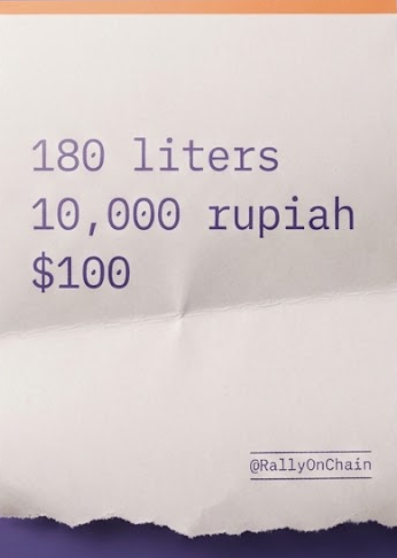
$100 buys 180 liters of petrol here.
Here in Indonesia, $100 is about 1.8 million rupiah. The subsidized pump charges 10,000 rupiah a liter.
The same money buys about 125 kilograms of rice.
The money habit outsiders miss is arisan.
My neighbors pay a fixed amount into a pot every month, one name is drawn, and that person takes the whole pot home.
So the hard part is not spending the money. It is waiting for your name.
Same notes. Different hands each month.
What does $100 buy where you live? @RallyOnChain
You can now hold Bitcoin at 1.33x leverage. Never liquidated. Built to be held, not babysat.
The odd part: 1.33x was never a secret. Almost nobody could hold it.
Kelly sizing answers one question: how much leverage maximizes long-run growth? Too little leaves growth on the table. Too much works against you, and pushed far enough, takes you to zero. There is a peak in between.
For stocks that peak sits near 1.5–2x. Berkshire has run at roughly 1.6x for decades. Ed Thorp built Princeton/Newport on the same idea. For Bitcoin, it is about 1.33x.
So why did this stay institutional?
Knowing the number is easy. Holding it is a job. Prices move, the ratio drifts, someone rebalances all day. And financing is usually priced by what it costs to be short.
Think cruise control. You can hold 60mph on a hilly road with your foot. You will also get tired and drift. Institutions paid people to keep the pedal steady. Everyone else got funding rates and liquidation emails.
That is the gap @2FactorFinance is built to close.
cbBTC-Jr is 1.33x leveraged cbBTC. Never liquidated. Held like spot. cbBTC-Sr funds that leverage and sits behind a deep buffer of Jr capital. The rebalancing lives inside the product, not on your calendar.
Live on Base in a capped beta. Backers: Pantera Capital, Coinbase Ventures, Brian Armstrong, True Ventures.
Leveraged ETFs are the comparison that made it click. Not growth-optimized. They decay over time. Holders pay an estimated $10B+ a year in hidden financing above what cash earns. Good trading tools. Poor holding tools.
And holding is most of the market: about 88% of investable capital, roughly $112T, buys and holds. About $15T trades short. Crypto built almost everything for the $15T.
My take: the leverage number is not the clever part. Packaging it so a holder can sit still is. That is what stayed institutional, and it is the part worth watching.
The quiet part: Jr is the buffer. It takes losses first. Never liquidated is not never down. No returns are promised here, and I am not telling anyone to buy leverage.
Bitcoin first, tokenized stocks next. Not live yet.
Season 1 of the Points Program is live. Sign in with X, no deposit. Your account needs 90+ days and 150+ followers. Marks have no cash value, not a token, not a claim on anything. Not open to the US or restricted countries.
Be honest: what is the longest you have held a leveraged position without touching it?
My referral link:
https://t.co/RM6rzDwWqO
I paid to enter a campaign and left a placeholder where a real name should have been.
The score dropped. The fee was already gone.
RLPs are Rally's points. My balance sits at 15,914 in the app header, and I did not get there by saving them.
I earn them by writing posts into campaigns like this one, every week, and the pot pays me back in RLPs at the end of the period.
Then I spend them. Every submission I send costs an entry fee, and the balance drains fast.
The rest goes into campaigns reserved for RLP holders, and the same balance counts toward the tiers and whitelists I am chasing.
So the hard part is not earning RLPs. It is picking which campaign gets the fee. Every entry I buy is a campaign I skip.
I watch @RallyOnChain for the next use, and the one I want is a second shot. Let me pay RLPs to enter the same period twice.
Point farmers, which campaign deserves your next entry fee? Name it in one line and I will tell you mine.
You can now hold leveraged Bitcoin the way you hold spot: it sits there while you get on with your life. What makes that possible is worth understanding.
It is not a safety switch. It is a trade. One side gives up priority so that it cannot be forced out.
cbBTC-Jr is the junior side: 1.33x leveraged cbBTC, never liquidated, built to be held rather than traded.
cbBTC-Sr is the senior side. It funds the leverage, and it sits behind a deep buffer of junior capital.
That buffer is junior capital. So the junior side absorbs losses first. Its immunity from forced exit is purchased with subordination.
Look at any two-party loan. The one repaid first accepts a smaller claim. The one who waits absorbs the shortfall. Priority is always priced.
Compare that with the leveraged product most people actually reach for. Leveraged ETFs are not tuned for long-run compounding, they erode over time, and holders pay an estimated $10B+ a year in financing above baseline interest.
Kelly sizing asks a narrow question: how much borrowing helps a position compound over years, and where borrowing starts to work against it. For Bitcoin, that lands near 1.33x.
Berkshire has run near 1.6x for decades. Listed equities cluster around 1.5x to 2x. A lower target for a more volatile asset is what the math would suggest.
Holding a fixed target is a job. Positions drift and someone has to keep adjusting them. And the price of borrowing is set in a market where the pessimists set the rate, not the holders.
2Factor folds both problems into a structure you can hold like spot. It runs on Base, starts with cbBTC, and is live in a capped beta.
Bitcoin first. Tokenized stocks are next on the roadmap and are not live yet.
My take: what changed here is who carries what, not how much you can borrow. What I cannot check yet is how that junior buffer behaves through a long drawdown. A capped beta has not lived through one.
Tell me one arrangement where you accepted being paid last in exchange for not being forced out, and whether you would make that trade again.
The Points Program needs an X account at least 90 days old with 150 followers, and it is not open in the US or restricted countries. No deposit is needed.
I follow @2FactorFinance for updates. If you want to join the Points Program through me, my link is here:
https://t.co/T9j883FkK0
I paid to enter a campaign and left a placeholder where a real name should have been.
The score dropped. The fee was already gone.
RLPs are Rally's points. My balance sits at 15,914 in the app header, and I did not get there by saving them.
I earn them by writing posts into campaigns like this one, every week, and the pot pays me back in RLPs at the end of the period.
Then I spend them. Every submission I send costs an entry fee, and the balance drains fast.
The rest goes into campaigns reserved for RLP holders, and the same balance counts toward the tiers and whitelists I am chasing.
So the hard part is not earning RLPs. It is picking which campaign gets the fee. Every entry I buy is a campaign I skip.
I watch @RallyOnChain for the next use, and the one I want is a second shot. Let me pay RLPs to enter the same period twice.
Point farmers, which campaign deserves your next entry fee? Name it in one line and I will tell you mine.
I stopped reading my RLP balance as a score. They are Rally's points, and I treat them as a budget.
I held my balance like a high score for weeks. Then I spent it on a submission fee, and it finally moved.
I earn them by posting in RLP campaigns like this one. Staking a Wingston NFT pays them too.
The points I earn go straight back into submission fees. I also use them to enter holder campaigns.
So the loop is earn, spend, earn again. A balance I never spend is just a number I admire.
The hard part is not earning them. It is remembering they are a gate, not a scoreboard.
What I want next is for my RLPs to hold a place in line before a campaign opens. Then a quiet balance beats a fast finger.
Tell me the last thing you spent RLPs on and the one thing you are saving for. Mine went to a submission fee. @RallyOnChain I have not regretted it.