The Milot Archaeological Project advances an archaeological understanding of the Royal town of Milot in Northern Haiti and its broader political landscape
We've entered photos into the AIA's 2019 photo context, with entries in every category. Vote for as many as you like between now and 3/11. Winners get a spot on the AIA calendar. Help spread the word about Haitian archaeological heritage and Sans-Souci!
https://t.co/RaanWfY5al
Can you help us raise $6000 to support graduate student research in archaeology? We are only $500 away from that target. Please give now. Every little bit helps and makes a huge difference. https://t.co/zqunovzVH2 #give2UCSC#ucscARC#judithhm7 — at... https://t.co/yvRc3tAoZX
Help support UCSC's Milot Archaeological Project and Archaeology in the Community to bring high quality public workshops to kids in Milot, Haiti. Every dollar helps! https://t.co/TcElxo6G9t
Mme. Monique Rocourt speaking passionately about the importance of cultural heritage sites in Haiti today, and discussing our collaborative research at Sans-Souci. @milotarch#milotarchaeology https://t.co/r4gfOkPquE
New Publication! "New Light From Haiti's Royal Past: Recent Archaeological Excavations in The Palace of Sans-Souci, Milot" https://t.co/7KgYjtdKOK #Haiti#milotarchaeology#ucscARC
@Mighty_Shnikins That source cites one interpretation, which assumes construction began when Christophe became king. Other sources, now corroborated by our archaeological excavations, push the construction earlier, when Christophe was Chef d’Etat if the northern state.
@Mighty_Shnikins The important point, one that is universally accepted by all credible sources, is that the complex was constructer AFTER the end of the French colonial occupation.
@Mighty_Shnikins The dates you cite (reported on Wikipedia) might relate to one part of the site but not the entire complex. Twitter is not the place to explain the complex construction history of the site, which our archaeological team has published elsewhere......
@Mighty_Shnikins The Haitian Revolution began in 1791 and ended with the expulsion of the last French forces at the Battle of Vertières in November of 1803, and the French never reoccupied Haiti. This complex was designed and built by the Haitian architect Chéri Warloppe between 1806 and 1813.
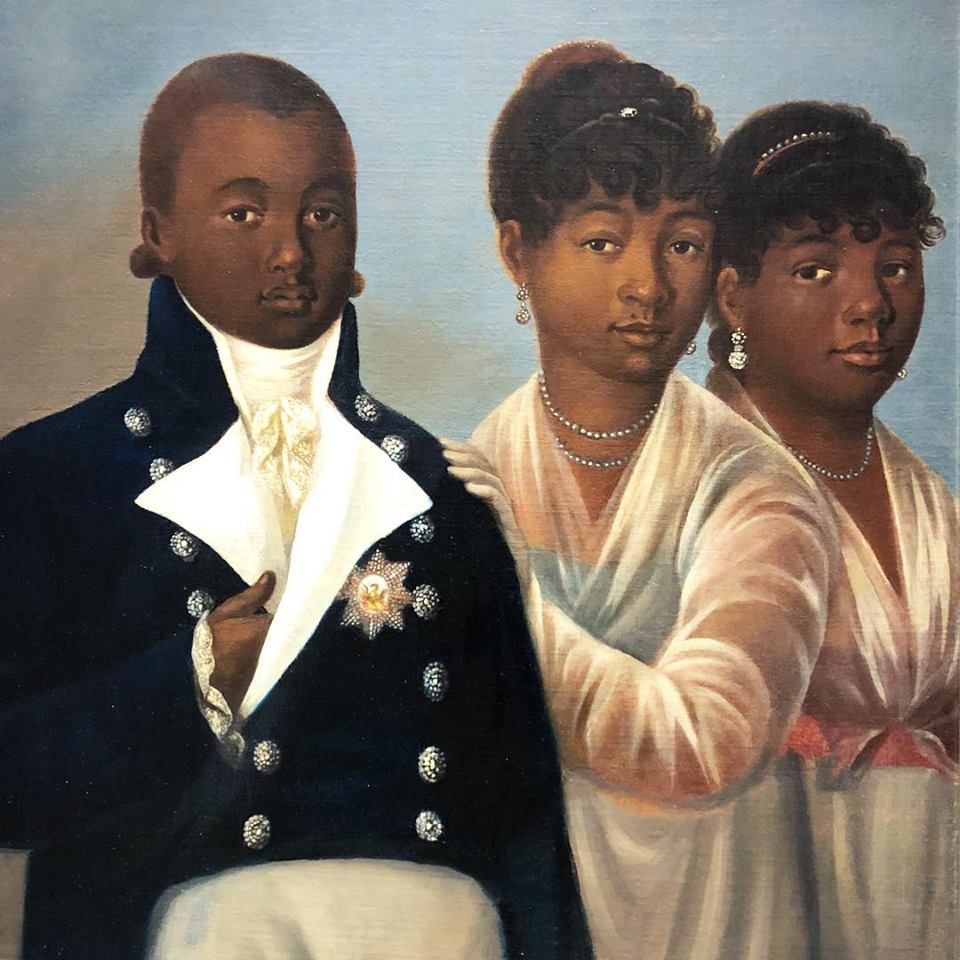
A lost painting from the court of Henry Christophe, King of #Haiti, has just gone on sale in NYC's. Prince Victor Henry & the only known likenesses of Princesses Améthyste & Athénaire. Beautiful!
@butteposter1 @ConanOBrien The complex was designed and built by the Haitian architect Chéri Warloppe between 1806 and 1813. Sadly, it was destroyed in an earthquake that devastated the region in 1842.
@AltSwitters@ConanOBrien No, this is the home of King Henry Christophe. Born a slave in Granada, he served as a drummer in the battle of Savannah in the Am Revolution, became an officer during the Haitian Revolution, and staved of French colonial reconquest until his untimely death in 1820. A real hero.
@Impedit_Nihil @ConanOBrien The complex was designed and built by the Haitian architect Chéri Warloppe between 1806 and 1813. Sadly, it was destroyed in an earthquake that devastated the region in 1842.