Gute Frage heute von Tom Lausen heute an den anwesenden General Hoffmann zu zivilem Einsatz der Bundeswehr in der Coronazeit:
Weshalb wurde eigentlich schon am 19.01.2020, lange vor Bergamo bzw. dem ersten PCR-Fall in Europa, General Holtherm von @jensspahn zum Leiter des Corona-Krisenstabs im BMG bzw. der neu geschaffenen Abteilung 6 „Gesundheitsschutz, Gesundheitssicherheit, Nachhaltigkeit“ und damit weisungsbefugter Vorgesetzer des RKI?
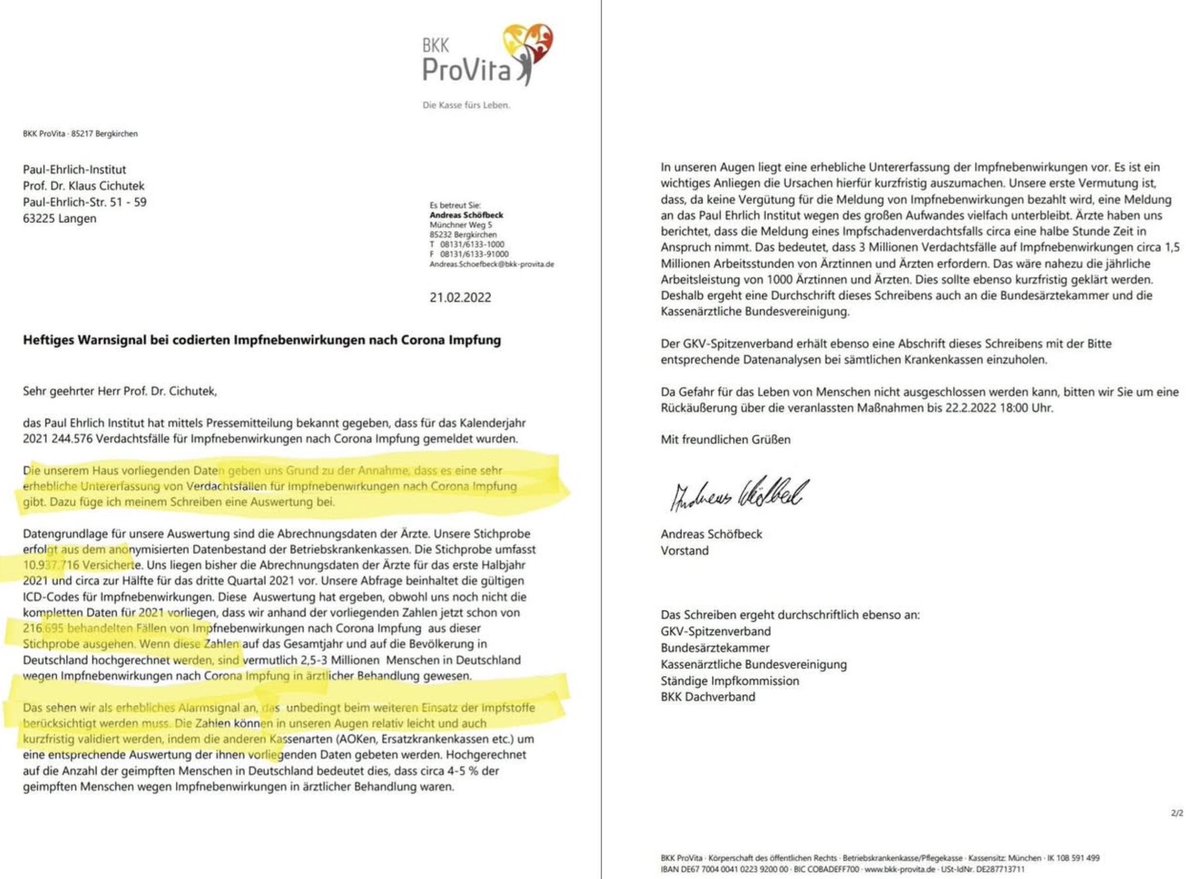
Heute vor 4 Jahren:
Der Vorstand der Krankenkasse BKK Provita Andreas Schöfbeck schreibt einen offenen Brief an das PEI und warnt vor möglicher massiver Untererfassung von Impfnebenwirkungen nach Analyse der eigenen Daten.
Er verliert seinen Vorstandsposten. #RichtigErinnern
Mit der Rede von MARCO RUBIO ist der Höhepunkt der Münchner Sicherheitskonferenz erreicht.
Er hält den Europäern den Spiegel ihrer falschen Lageeinschätzung nach 1989 vor und ihre darauf begründete verfehlte
▪️Klimapolitik,
▪️Migrationspolitik,
▪️Sicherheitspolitik,
▪️Industriepolitik
▪️Wirtschafts- und Handelspolitik.
RECHT HAT ER❗️
Die Europäer hatten sich ein Luftschloss gebaut, das wie eine Seifenblase zerplatzt.
Germany, your Chancellor is lying to you.
There is NO growth under “Klimaschutz” (Net Zero).
I was Chief Sustainability Officer at Deutsche Bank / DWS — I’ve seen the WEF system from the inside.
Net Zero means higher bills, unstable power, and jobs leaving Germany.
There is no climate emergency — only a multi-trillion-euro power grab.
Working families pay for it. Elites profit from it.
How is this right?
🇪🇺 More great news from Europe 😊
Gradually, then suddenly. Nothing changed for 2 years and now a lot of things are finally changing:
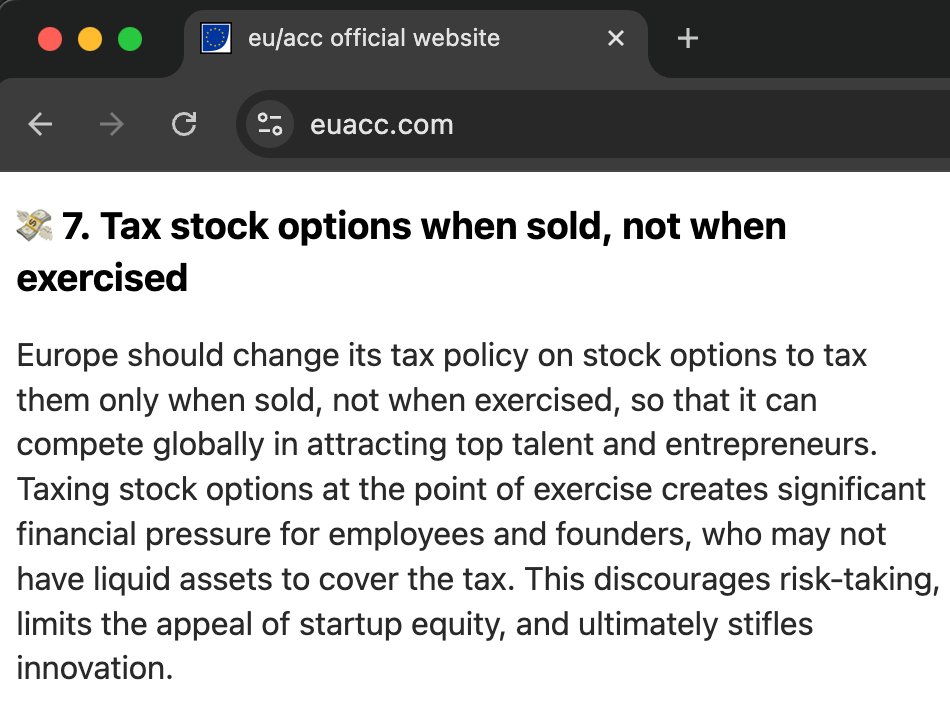
The Netherlands is changing its stock options tax to be modeled after the American system, which is the default in startups
(!) Stock options will now be taxed when sold, not when exercised (!)
This was #7 most voted idea on https://t.co/NdorAWrhrB to save Europe and now it's happening!
Right now in most of Europe, stock options are taxed when exercised
This creates very problematic situations: imagine you have stock options for a startup you worked for. Many/most startups have a clause that says "you must exercise your vested options within 90 days after leaving, or you lose them". So you exercise them, which in Europe means paying tax on their value immediately, that's regardless if you actually made money on them!
So you could exercise your stock options when the price is $100, and let's say you have 10,000 stocks, so that's 10,000 * $100 = $1,000,000 in value at the time of exercising. Let's say you pay 50% tax on that, so you pay $500,000 in tax
Where do you get that $500,000 from in the first place? Remember you now exercised your stock option but you haven't sold it yet. So you're still a broke startup guy. Often you'd loan the money from the bank.
And then you could just sell the stock immediately right? No wait...you can only sell your stock that you just exercised during a liquidity event. That means when the company is acquired, or IPOs, or a secondary sale happens (you can sell your stock to other investors)
So that means the wait can be forever, while you already paid tax on your options, now you pay back that $500,000 loan over many years
But startups are risky, we know that. What if the stock price crashes from $100 to $10? Doesn't matter. You already paid $500,000 on the exercised stock. But now you only make 10,000 * $10 = $100,000 instead of $1,000,000!
So now you got a $500,000 loan, paid $500,000 in tax with that loan, only made back $100,000, and now have to pay back this loan with what money? Exactly. You can't and you lost at least $400,000! And that's without the interest of the loan!
You just lost a lot of money by being European and working for a startup!
Crazy right? But that's the reality in most of the EU (including Germany, Spain, etc).
With the new Netherlands law, that finally changes. And that makes working for European startups much more attractive for the top-tier talent. Because startups in the beginning are lean and can't pay a high salary but they can pay in stock in their company easily.
The Netherlands also reduces the tax rate of stock options to something more similar to the US: from 49.5% to 32.17%
The new ruling only applies to employees at a startup or scale-up
The amendment to the Netherlands Income Tax Act is expected to come into effect on January 1, 2027 (in ~1 year)
h/t @bobbygaal for the tip