Consistency and feedback are what make marketing actually compound.
Think about a golf swing. You can take a thousand practice swings, but if no one tells you what to correct, you just get more consistent at the same flaw.
Reps build the habit. Feedback turns the habit into progress.
Here’s the part that matters: you’re already an expert. At your business, your craft, your customers.
Marketing is a full discipline on top of that, and you don’t have the hours to master it while running the company. You shouldn’t have to.
That’s what we do at MindShift.
Not just a read on what’s working, but the strategy, the systems, the support, and in many cases the execution itself, done for you.
You stay focused on the business only you can run. We handle the part that makes it grow.
You run your business. Let us run the marketing. Reach out and let’s talk about what that looks like.
Try this experiment for one week.
Pay attention to how you search.
When you need a recommendation, where do you go first? Google? ChatGPT? TikTok or Instagram? Reddit? YouTube? Or do you text someone you trust?
Then ask the people around you.
Your partner. Your kids. Your coworkers. Your friends.
“When you’re looking for something new, where do you go first?”
And if you own a business, take it one step further:
Ask your customers how they found you.
Not where you think they found you. Ask them.
For one week, don’t worry about changing your strategy. Just collect the information. Notice the patterns.
Then use what you learn.
If the way people search has changed, the way you reach them has to change, too.
If you sell anything with a long buying cycle, a real decision, some risk, a price that makes people pause, then people are buying you as much as the product.
That's doubly true when the product is new and has no track record yet.
Which means your thought leadership isn't optional.
You can't show up in AI answers without it. The engines pull from people who've published a point of view. And the more AI gets involved the more your POV is the only thing that separates you from everyone else.
The part most owners miss: you're not selling the product in these posts.
You're exposing a risk your buyer hasn't clocked yet, and showing the cracks in the way the big institutions have always done it.
You're the bridge between where they are now and where they need to be.
Then do it once a week. Once every two weeks.
Be where your ideal customer is before they need you and be there when they're ready for you.
Everyone is debating the difference between AEO and GEO.
AEO gets your content pulled out as the answer. The snippet at the top. The line Siri reads back. The AI grabs a clean chunk off your page and serves it.
GEO gets you name-dropped when an AI writes a full answer. When ChatGPT pulls from ten sources and picks whose brand to mention, that's GEO. Not "can it grab your text" but "does it trust you."
Quick test:
→ AI reads one line off your page = AEO working
→ AI writes a paragraph and names your company = GEO working
And for 2027, you're not picking one. You're doing both, on top of the SEO you already have.
Disagree? Agree? Let us know.
Google isn't showing your page because it decided that page was simply not the best answer to that search.
Relevance decides everything.
Start with an audit. Check when your pages were last updated. Pull up Search Console and see what terms Google already connects to each page, then compare that to what your customers are actually asking.
Another tip: Google ranks pages, not websites. A blog post, a video, an FAQ answering one specific question, each one is a new shot at relevance.
Answer the questions your customers ask most, and you show up in more than search. ChatGPT, Grok, Claude, and Perplexity are pulling from the same relevance signals.
One ad. One job.
Here's the thing about Meta: it's very good at giving you more of whatever you tell it to optimize for.
Ask for video views, it finds people who watch videos. Ask for leads, it finds people who fill out forms. Different audience. Different message. Not the same person.
Ask one ad to do both, and you don't get a blend of two results. You get a compromise. Meta doesn't know which behavior to chase, so it chases neither one well.
The fix isn't complicated. Run a visibility campaign first, weeks out, to build awareness. Then run a separate lead gen campaign closer to the deadline, aimed at the people who already engaged.
We see this constantly.
The businesses that get real traction aren't always doing more things. They're doing strategic things, on purpose, with the right settings.
Old saying in our industry: if you give the machine garbage, it'll target garbage.
That used to mean bad data. Now it mostly means vague messaging.
Meta doesn't know who your best customer is. It only knows what you tell it, through the words you use and the people who respond to them.
Write an ad for "everyone" and Meta shows it to everyone, which in practice means nobody in particular.
The businesses getting real traction right now are doing the opposite.
They're specific about who this is for, what problem it solves, and who it's not for.
It teaches the algorithm who to go find more of.
Vague gets you vague. Specific gets you specific.
Meta just lost a major lawsuit, and while the case wasn't about advertisers, it's worth understanding why it still matters if you run ads on Facebook or Instagram. Meta's entire business model depends on advertising revenue. When that revenue source comes under legal pressure, the platform's incentive to protect and grow ad spend gets sharper.
That incentive shows up in what Meta recommends inside Ads Manager. Automatic placements spread your budget across Feed, Stories, Reels, and Audience Network without telling you which ones are actually converting. Expanded audience targeting gives the algorithm more room to spend, not necessarily more room to find your actual buyer. These are defaults built to keep spend moving.
Q4 raises the stakes. More advertisers enter the auction as retail and holiday campaigns ramp up, which pushes CPMs higher and can shift what you're paying per lead or sale. Rising costs often mean the market got more competitive, and this is the wrong time to run Meta ads on autopilot.
Before Q4 hits, check four things in your ads manager: what placements are turned on, what Meta's optimizing for, what you're paying per result, and whether those results are turning into paying customers.
A client came to us last year convinced the fix was a bigger ad budget.
Made sense to them since they weren't getting results.
Darrell didn't touch the ads.
He looked at where the clicks were going.
Every dollar was aimed at the homepage. A page built to explain the company, not to convert a stranger who'd just clicked one very specific ad.
So we built a single page. Matched that ad, spoke to one problem, asked for one thing.
Same budget. Same audience.
The leads started showing up, and not a dollar more was spent.
Sometimes the budget really does need to be increased but this is a time where more money wouldn't have helped.
The blind spot is almost never where you'd guess.
Where's your paid traffic landing right now?
If the answer is your homepage, that's where we'd start.
The busiest business owners we talk to are struggling.
They're posting constantly. Running ads. Chasing whatever format is hot this month.
Exhausted, and still stuck.
The problem almost never turns out to be traffic. Someone lands on the homepage, pokes around, and leaves, and no one's looked at why. Posting more just pours more people into the same offer and infrastructure that isn't working.
You need more leads? Sure. But before you add anything else to your tactics, look at where your traffic lands and what it does once it's there.
Honest question: what's the last thing you added to your marketing that you're still not sure is working?
Tell us in the comments and we'll say whether we'd keep it or cut it.
You've seen the headlines: "Google search is collapsing."
Not quite. And the real story matters for your business.
People are still searching. What changed is what happens next.
Almost 6 in 10 searches now end without a single click. The answer shows up right on the results page.
Some of the searching has moved to AI entirely.
So the traffic you used to earn from ranking on page one is shrinking, even if your ranking never moved.
The businesses adapting are doing two things: getting named inside the AI answers, and building an audience on platforms where a real person still hands out the click.
Seeing fewer clicks even though your rankings look fine? Tell us what you're noticing.
You post daily. Run ads weekly. Send emails on schedule. Numbers barely move.
Darrell's read on it comes from The Art of War: "tactics before strategy is the noise before defeat."
Every post, every ad, every email is a tactic.
Fire them off without a target behind them and you're just generating noise and going nowhere.
Strategy sets the destination.
Tactics are the driving.
Skip the map and you can floor it all day and still end up nowhere.
Do you agree?
"Human-AI-Human". That's how we operate at MindShift Digital.
Many businesses are underestimating the true power of AI, using it only to QC emails or handle basic tasks.
But the companies that are moving forward the fastest are treating AI as a thinking partner and a deeply integrated resource.
Instead of looking at tools like ChatGPT, Claude, or Perplexity as a software subscription, start thinking of them as a salaried employee for every team member.
By adopting a "Human-AI-Human" model, you can offload time-consuming research and deep data analysis, turning weeks of work into hours.
This is the ultimate transformative engine that allows small companies to level the playing field and compete with the big ones.
Stop treating AI like a tool and start using it as your ultimate competitive advantage.
#AIinBusiness #BusinessStrategy #ArtificialIntelligence #AICoaching #BusinessGrowth #SmallBusinessTips #AIToolsForBusiness #FutureOfWork #EntrepreneurMindset #BusinessOptimization #HumanAIHuman
We know. This is a graphic telling you graphics don't work as well as video. But I want you to read this clearly.
Native video reads as authentic to both the platform and the person watching it.
Polished graphics read more and more as an ads.
If you're trying to grow reach, three things matter more than production quality:
1. Say the thing your customer is actually thinking, not what you want to say about your product.
2. Post the realest take, not the most edited one. Perfection slows you down and the algorithm doesn't often reward it.
3. Keep it short enough that finishing the video is easy, not exhausting.
Graphics still work for quick hits and educational content (like this). But if you want reach, get someone on camera and let them talk.
Try it out and let us know how it goes.
Target the few. Not the many.
You don't need everyone's attention. You need the right people's trust.
A stadium full of strangers doesn't sell anything. A living room full of the right ten people does.
That's the difference between reach and relevance.
Chasing reach fills the stadium. Chasing relevance fills the room.
A million followers who don't engage, don't buy, don't move anything, aren't an audience.
They're a number on a screen.
Ten people who trust you and are ready to buy will outperform a hundred thousand who scroll past your name every day.
Relevance beats reach.
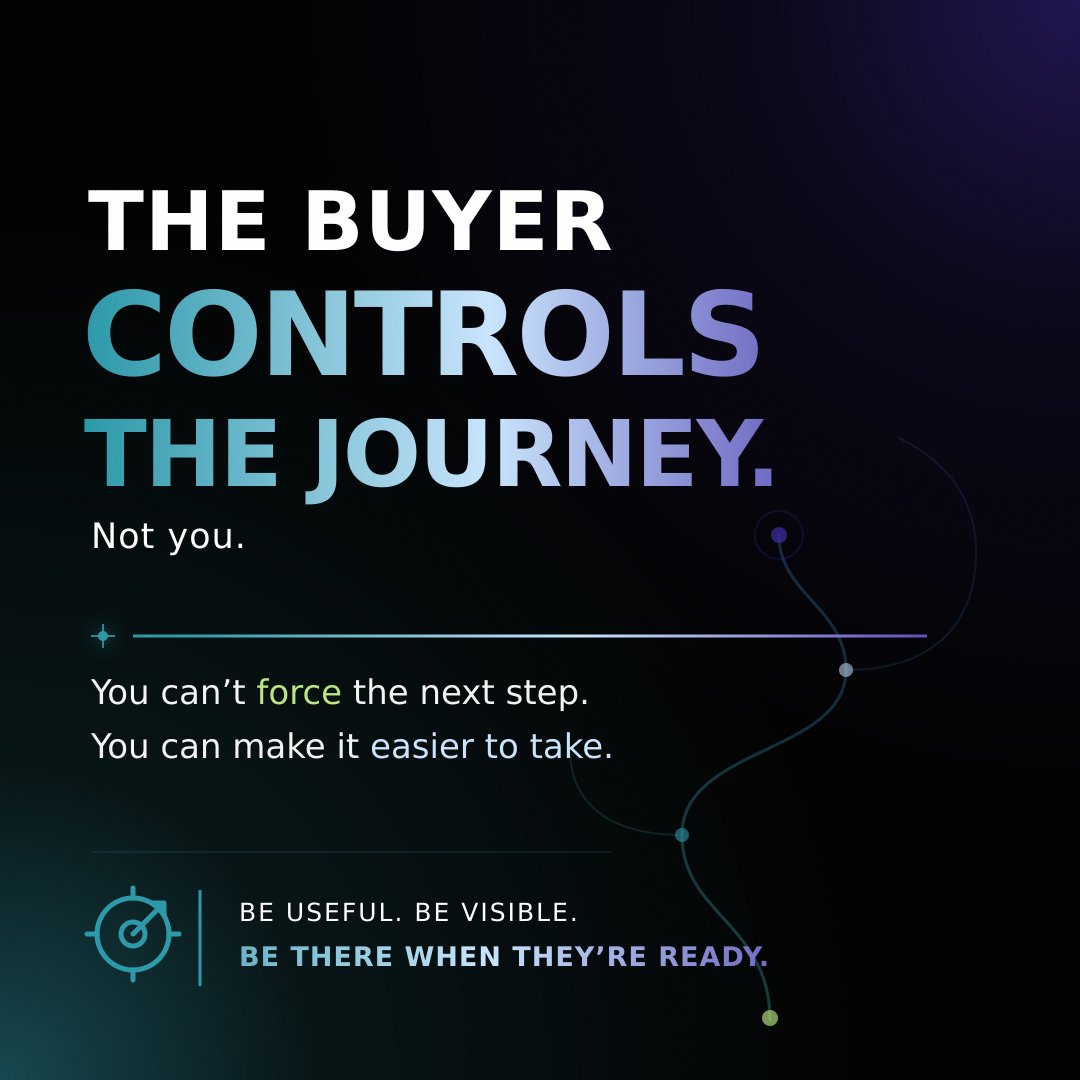
The buyer controls the journey. Not you.
You can't force the next step. You can make it easier to take.
Show up consistently, for yourself and for them, and you'll be there when they're ready. You won't always know when that is.
Everyone's working through different constraints, different timelines, different reasons to buy later rather than now.
Be mindful of where they are in that journey.
Be useful. Be visible. Be there when they're ready.
Why isn't your marketing working?
It's one of the most common questions we hear from business owners.
The challenge is that "marketing" is rarely just one thing. IF your foundation is strong, marketing amplifies growth.
If your message isn't clear, marketing amplifies confusion.
If your offer isn't compelling, marketing amplifies hesitation.
If your website creates friction, marketing amplifies drop-offs.
That's why the first step IS diagnosing what's going wrong at a foundational level.
Before you spend more on ads, post more content, or invest in another marketing tool, take a step back and identify what's actually holding your business back.
Our Marketing Blind Spot Quiz was designed to do exactly that. You'll uncover the biggest opportunities to improve your marketing so you know where to focus first.
🎯 Take the free Marketing Blind Spot Quiz below to find out.
https://t.co/mIY4SyTgTQ
#Marketing #DigitalMarketing #BusinessGrowth #LeadGeneration #SmallBusiness #MarketingStrategy #BusinessOwner #MarketingTips #GrowthStrategy #Entrepreneur
Is Reddit starting to be trusted more than Google for research? Here's what you need to know.
Most Google searches today feature Reddit right on the first page — but does that mean Reddit’s the new reliable research king?
Not quite. What’s really happening is that Reddit offers real-time conversations with actual people—even if many stay anonymous.
This gives brands a window into what customers truly care about, frustrations and all — stuff you won’t always find on polished blogs.
And here’s the kicker: studies now show Reddit is being pulled into AI search queries, ranking high on results.
So, should you be on Reddit? Absolutely. Use it to tap into authentic customer insights, instead of relying solely on traditional channels.
But don’t get it twisted, Reddit isn’t replacing Google. It’s a financial partnership, not a competition.
How do you get more Google Reviews?
Reviews on Google are the modern equivalent of word-of-mouth. They are vital because they immediately build consumer trust, heavily influence purchase decisions, and are a top factor in local SEO rankings.
Listings with higher ratings naturally grab more attention in Google Maps and Search. Consumers are significantly more likely to click on and patronize a business with a solid 4- or 5-star rating.
One of the biggest mistakes businesses make is treating reviews like an afterthought. Getting more Google reviews doesn't start after the job is finished.
It starts during the customer experience.
A technician finishes the job.
The customer is happy.
Everyone leaves.
Three days later someone sends an automated text asking for a review.
The moment is gone.
The best time to ask is when your customer is already telling you how happy they are.
That's when emotion is highest.
That's when saying "Would you mind sharing that on Google?" feels natural. Timing is everything.
Make it easy.
Send the link.
Keep it simple.
Thank them.
How do you create compelling videos for boring businesses, without a budget or camera person?
Here's what not to do first. Do not make videos about the product or its features. Instead, focus on the problem your audience is facing every day.
People don’t care what you know or what your product does — they care about how it solves their pain, frustration, or concern.
Speak directly to those emotions, and invite them on a journey toward a solution.
And yes, you can do this with just your phone! No fancy setup needed.
Worth thinking about.
#ContentTips #VideoMarketing #SmallBizHacks #MarketingStrategy #B2B