I think what struck me most was the ending.
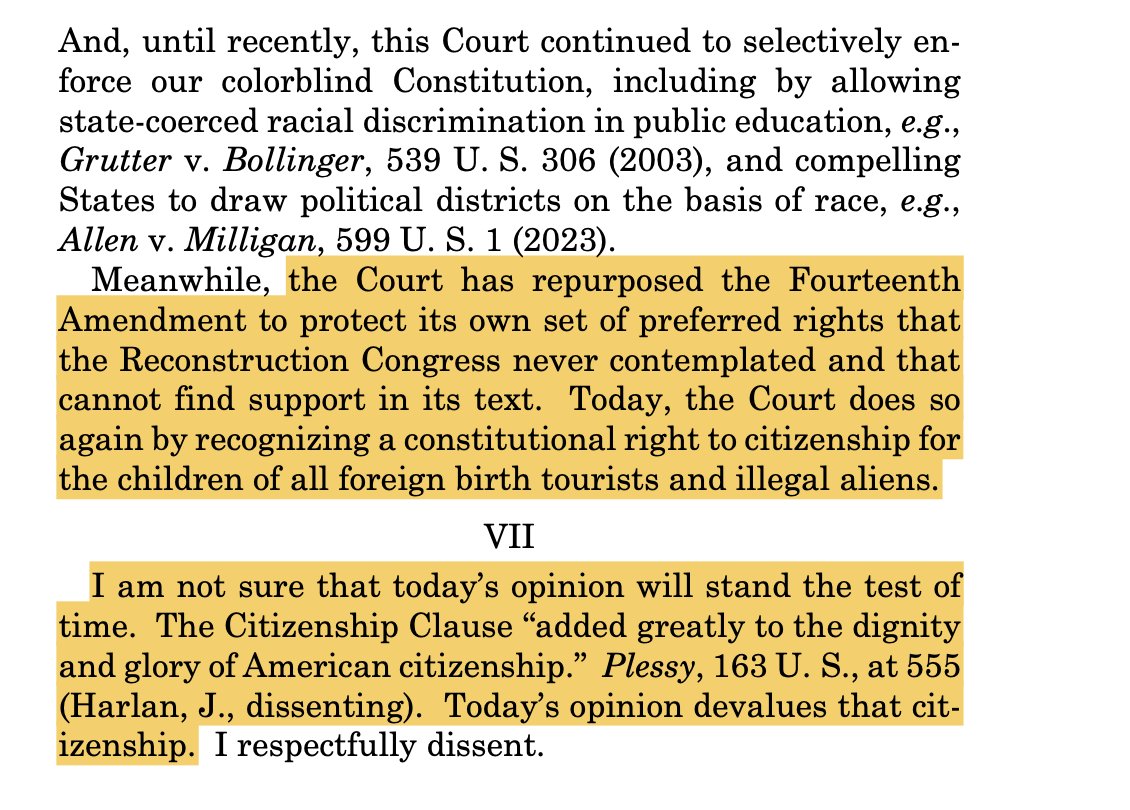
Justice Thomas closed his opinion on kind of a sad note where he says that the entire purpose of this part of the Constitution was to lift up a people who had been despised and degraded, and to hand them the full pride of dignity of being American citizens.
It was meant to be something that carried a lot of weight and was honorable.
Now, he believes, that same is being given away cheaply, handed to the children of birth tourists and people here illegally on the basis of NOTHING MORE than the spot where a baby happened to come into the world.
He says he doubts this ruling will hold up over time, and that it actually cheapens the very citizenship it claims to be protecting.
In his words: "I am not sure that today's opinion will stand the test of time. . . . Today's opinion devalues that citizenship. I respectfully dissent."
Justice Thomas was clearly annoyed that the Court didn't just rule on the specific situation in front of it.
He seems upset that the Court threw out the President's order COMPLETELY, declaring it off-limits in every imaginable case, all at once.
And Thomas says that's reckless, because it sweeps in extreme cases the Court never even paused to consider.
For example, he points out that the government couldn't deny automatic citizenship even to the baby of an ENEMY SOLDIER, or the baby of a FOREIGN SPY, or a child who is raised in another country, joins a foreign army, and comes back to FIGHT A WAR against the United States.
In his words: "He cannot enforce the Order against a child of an alien enemy or a child of a foreign spy. He cannot even enforce the Order against children who are raised in foreign countries, join foreign armies, and fight wars against the United States."
His view is that a court should decide the actual dispute in front of it, carefully, one situation at a time, rather than slam every possible door shut.
He attacks the other side's best evidence as a very strange thing for America to copy.
To support its broad reading that anyone from anywhere at anytime could plop a baby here and be a citizen... the Court leaned heavily on an old English court case from the year 1608.
But Thomas says that case is a shaky foundation for two reasons.
First, it wasn't even really about citizenship. It was about whether a Scottish man was allowed to own land in England.
Second, the idea behind it was deeply old-fashioned and, frankly, UN-AMERICAN. The notion that anyone born on the king's land automatically belonged to that king FOREVER, bound to him for life, a bit like a servant tied permanently to a master.
Thomas asks the obvious question.
Why would the United States, a country that had just fought a bloody war SPECIFICALLY TO BREAK FREE from a king, turn around and adopt a king-and-subject idea as the basis for American citizenship?
It doesn't fit.
If a stranger is a guest at your dinner table, you owe him courtesy and good treatment while he's there.
But being a welcome guest for an evening DOESN'T MAKE HIM YOUR SON.
People who lived back then read it his way too.
Thomas actually argues that the fairest way to settle what the rule means is to ask how people understood it RIGHT AFTER it was written, while the meaning was still fresh.
And when you do that, he says, the evidence lines up behind his logic.
He points to a Supreme Court ruling from 1884 that read the rule exactly the way he does: you had to be fully under U.S. authority and owe loyalty to no other country.
He also points to the legal scholars of that era who studied the new rule closely and reached the same conclusion.
His larger point is that his reading isn't some clever modern reinterpretation cooked up to win this case.
It's literally just the PLAIN, ORDINARY UNDERSTANDING people had at the time the rule was new.
But the true legal fight comes down to this phrase: "subject to the jurisdiction."
The Constitution says a citizen is someone born here and "subject to the jurisdiction" of the United States.
EVERYTHING turns on what those words mean.
The Court reads them loosely, to mean something like "anyone who has to obey our laws while they're standing on our soil," which would include almost everybody, tourists included.
Thomas reads them to mean something much stronger: someone who is FULLY under America's authority and FULLY loyal to America, with no competing loyalty to another country.
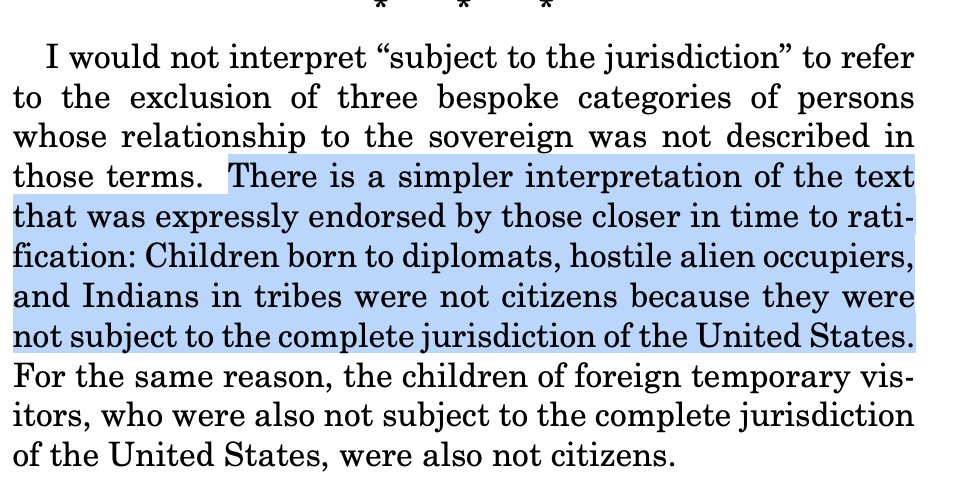
To show he's not just making this up, he points to three groups that everyone has always agreed were left out of citizenship: the children of foreign ambassadors, the children of enemy soldiers occupying American land, and Native Americans living under their own tribal governments.
Why were all three left out?
Because none of them were fully under U.S. control.
They each answered to some OTHER authority.
In his words: "Children born to diplomats, hostile alien occupiers, and Indians in tribes were not citizens because they were not subject to the complete jurisdiction of the United States. For the same reason, the children of foreign temporary visitors, who were also not subject to the complete jurisdiction of the United States, were also not citizens."
Thomas says a tourist's baby fits the same pattern because the baby and the parents are still tied to another country.
So the same logic that excludes those three groups, he argues, should exclude the visitor's child too.
The wording was chosen carefully, on purpose, to leave certain people out.
Before the rule went into the Constitution, there was an earlier version of it: a law passed in 1866.
And the people who wrote that law picked their words VERY DELIBERATELY to make sure the children of temporary visitors would NOT be included.
The senator who led the effort said it about as plainly as a person can: people who are only here for a short time are folks "we would have no right to make citizens," and that includes their kids.
He even worried that a looser wording might accidentally scoop those families in, so he tightened it on purpose to keep them out.
Thomas's point is that when the rule later went into the Constitution itself, it carried that EXACT SAME INTENTION.
The fancier constitutional language was meant to do the same job the 1866 law did.
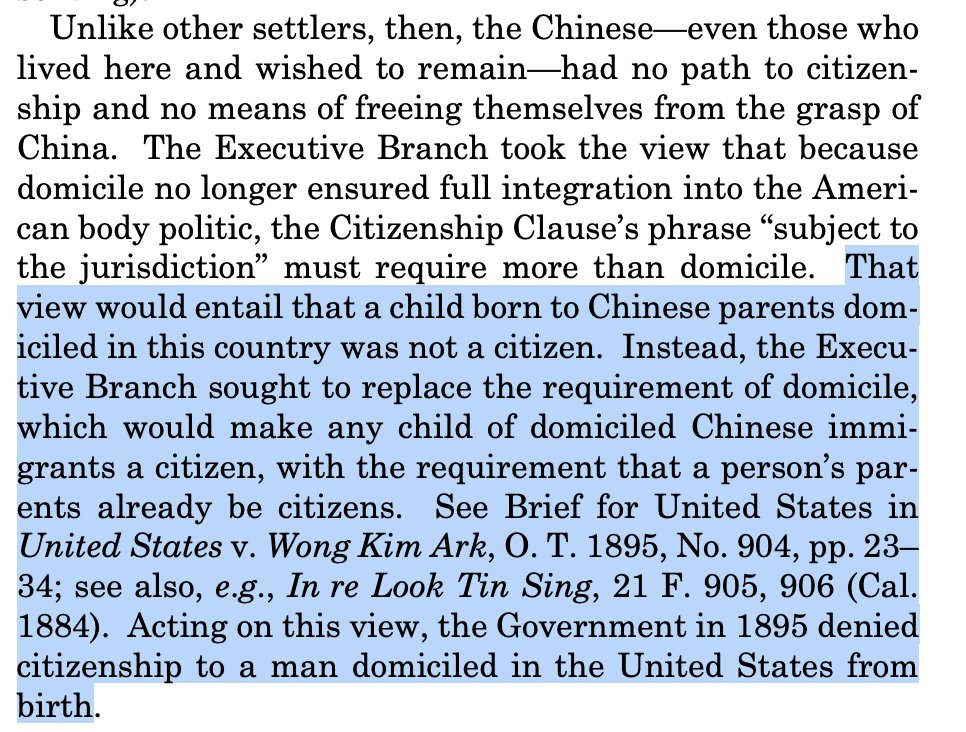
Back then, being a "citizen" basically meant "this is your real, permanent home."
In the era when this rule was written, being a "citizen" of a place and having your permanent home there were treated as nearly the SAME IDEA.
You were a citizen of the place where you actually lived your life and intended to stay for good.
Now you might reasonably ask: "But weren't people made citizens simply by being born somewhere?"
And the answer is yes, usually, but here's WHY that worked.
In those days, almost every baby was born in the exact place its family lived.
Crossing an ocean while pregnant just to give birth somewhere else and leave wasn't a thing... air travel didn't exst.
So "born here" was a reliable hint that "this family lives here."
Being born in a place was a CLUE pointing to your real home, not the actual rule itself.
His main point is that there's a difference between someone belonging here and someone just passing through.
Freed slaves, Thomas says, belonged here in every way that mattered.
They had no other country to go back to.
They owed loyalty to no foreign king or government.
America was the ONLY home they had ever had, and they had worked, suffered, and fought for it like everyone else.
Now picture a completely different situation: a baby born to two tourists who are in the country for a two-week vacation.
That family still has a home somewhere else, still belongs to another nation, and will go back to it.
Thomas's point is that these two situations are NOTHING ALIKE, even though both babies were technically born on U.S. soil.
The citizenship rule, he argues, was built for the first kind of person, the one who truly belongs, not for the second.
A long time ago, the Supreme Court made a ruling that said Black people could never be U.S. citizens, no matter what.
That ruling helped push the country toward the Civil War. After the war, the nation set out to bury the hatchet for good by adding a NEW citizenship rule directly into the Constitution.
Thomas's whole argument starts right here.
He says you can't figure out what the rule MEANS until you remember what problem it was created to SOLVE.
The problem was simple: a group of people who GENUINELY BELONGED to this country were being told they could never be citizens.
The rule was written to guarantee that those people, and people like them, would always be citizens, no matter their race.
It was a PROMISE TO PEOPLE WHO ALREADY BELONGED.
It was not, Thomas argues, designed as an automatic prize for anyone who happens to be born on American soil.
In today’s world, unrestricted, automatic birthright citizenship is suicidal.
The Supreme Court could and should have read the Fourteenth Amendment as something other than a suicide pact.
Those who drafted and ratified that provision certainly didn’t regard it as such.
Alito accurately described this:
CBS News reports on Chinese parents traveling to the US to have anchor babies in 2013:
“They traveled from China to Los Angeles so their baby could be born in America and claim U.S. citizenship."
Justice Alito, per usual, is 100% right in his dissent on Birthright:
"The court's interpretation has national security implications. Suppose that the only connections someone has to this country are that he was born here to a mother who was present just long enough to give birth."
"Then returned to her country. Suppose that country was a strategic adversary. According to this court, that person is a citizen of this country."
God save us.
@JeffXmemes They signed of on the communist bastardization of the originally intended meaning of the 14th amendment by the author and ratifiers:
https://t.co/ou6YhLtwwX
The author of the 14th Amendment:
"This will not, of course, include persons born in the United States who are foreigners, aliens..."
The SCOTUS didn't just go against President Trump, they went against the Constitution.