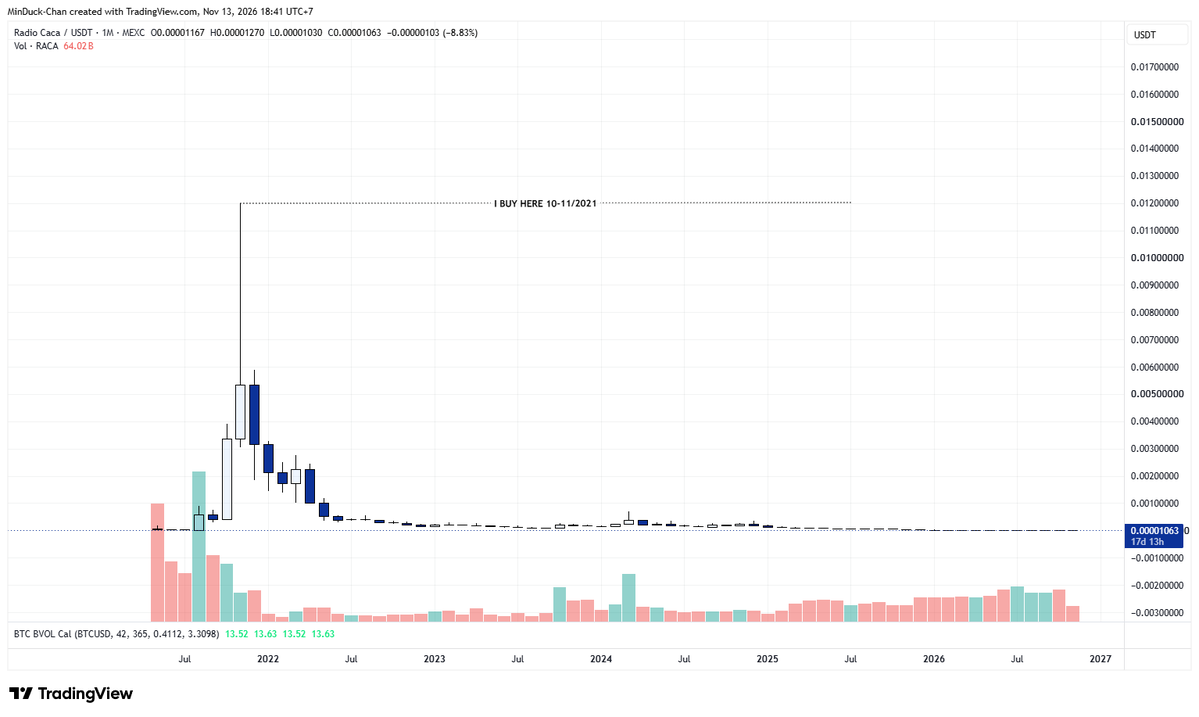
(#1) My Worst Trade
If you are a trader and somehow landed on this post, this is a competition where crypto traders share their worst trade. Read every story in here, especially if you are new. The lessons inside these losses are the real alpha you have been looking for.
"My Worst Trade" Competition
Pain is temporary but the Screenshot stays forever.
Most people - including me - mostly show their wins. This creates a wrong impression and is misleading.
To get into reality - and have some fun - a special competition:
7 Traders will show their worst Trade. The one they would Love to forget but that stays in memory forever.
Lineup:
@blackwidowbtc@Market_Emotions@MikeRosko@ConvexEdgeX@lucas67261771@minduckchan@CryptoChaseCase
Every mentioned Trader will quote this post and flex their worst Trade. Time to shine!
How to vote and enter:
Follow me @Albert_618
Follow the Trader you're voting for
Repost this Post
Comment their @ below
You must follow both @Albert_618 and the trader you vote for to win. One comment per account. Duplicates and alt accounts don't count.
Prizes are sponsored by @breakoutprop
The winning Trader: $25K Turbo account + 1 free week in the 618ers paid Discord
Random voter 1: $25K Turbo account + 1 free week
Random voter 2: 1 free week in the paid Discord
Voting closes Mon 16 Nov, 10:00 UTC.
Winners announced the same day. I guess the RR here is fine!
Good Luck!
@Albert_618 In terms of material assets, I would accumulate both gold and silver. IMO given the current pace of scientific and technological development, the consumption of silver will continue to rise.
@SenshiTrades316 Exactly, I think so too. It’s still possible for BTC to go to zero, but not right now. They first need to offload a large amount of BTC onto retail investors—something that typically happens when the economy is peaking and people have savings to spend
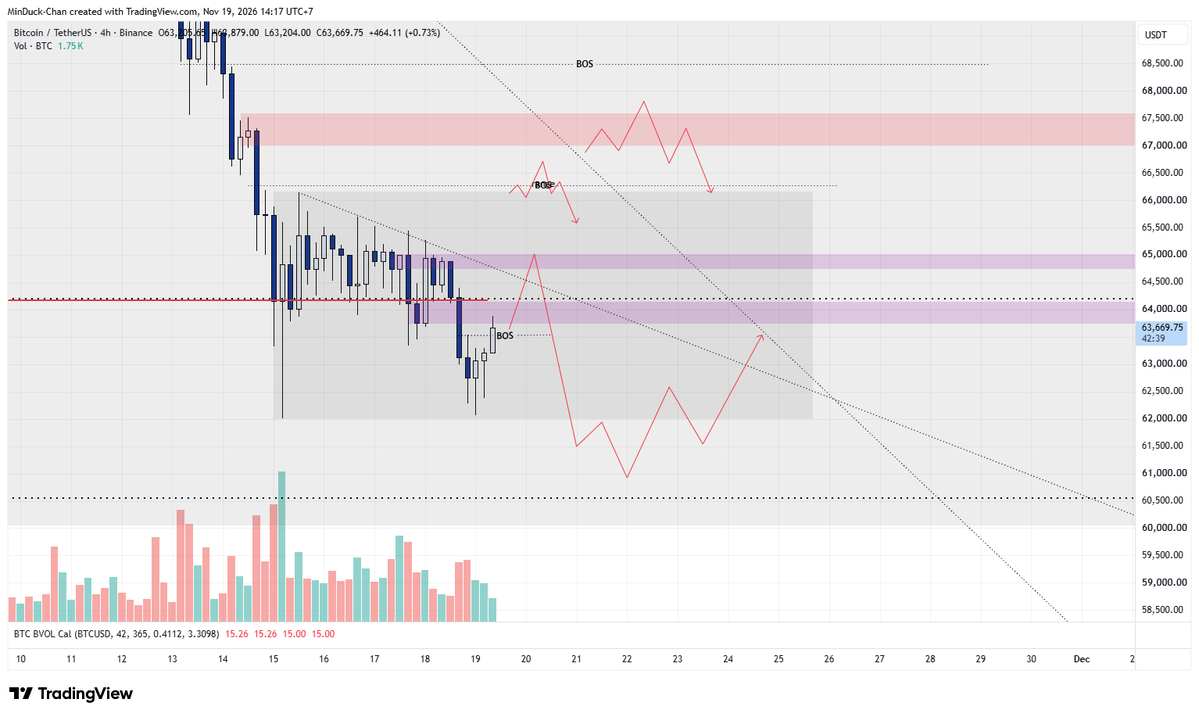
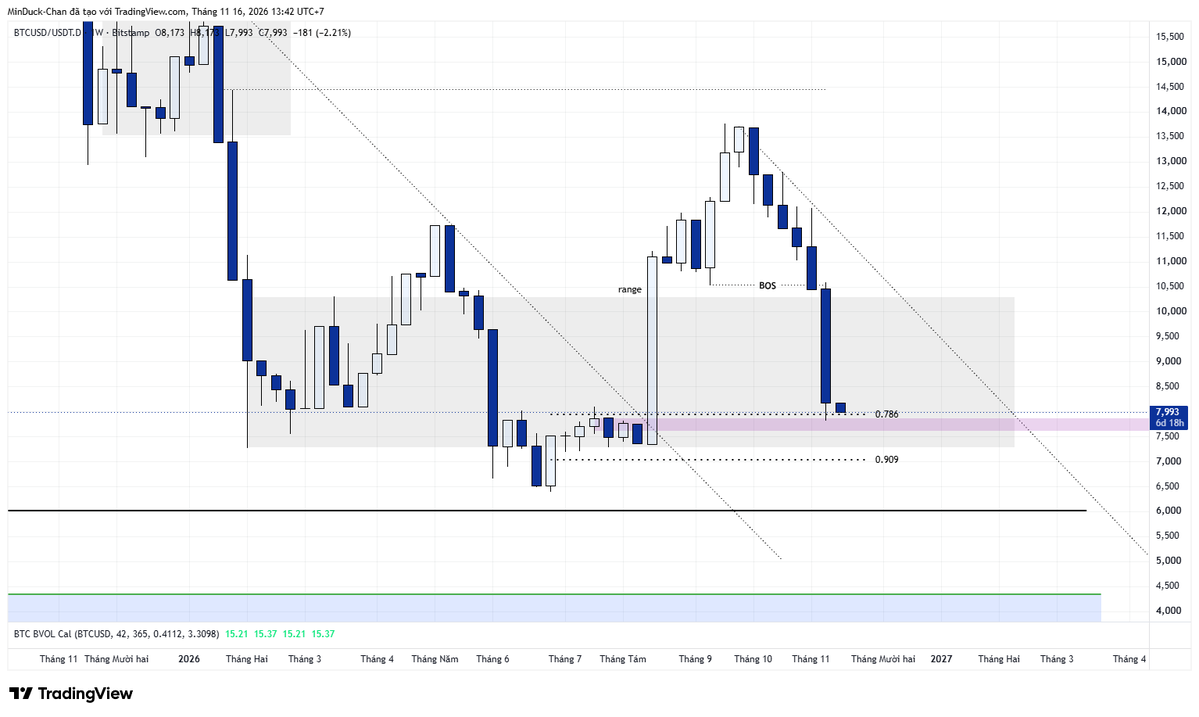
BTC: đã chạm vùng cầu lớn theo kế hoạch
LTF đã hình thành bojan 4h, vol mua lớn xuất hiện nhưng chưa thực sự hấp thụ được vol bán
Do giá đã sập quá mạnh nên giờ cần kiên nhẫn chờ range mới hình thành. Còn sang tuần bos ngày phá vỡ thì tôi sẽ đổi kế hoạch
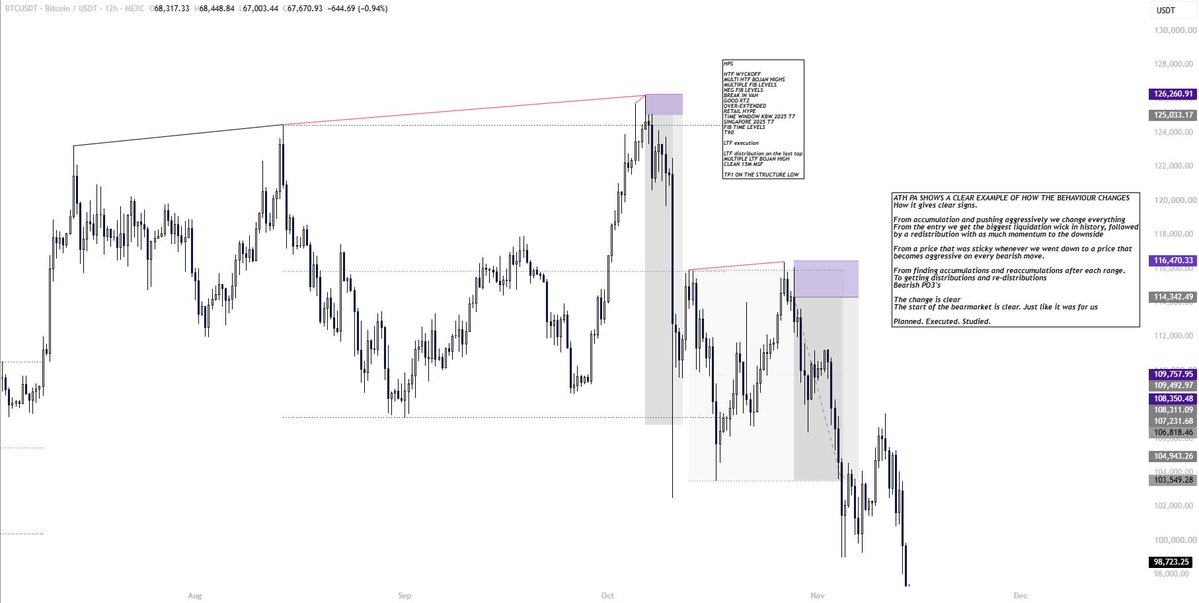
MARKET TRANSITIONS. UNDERSTANDING THE CONDITIONS V17
The market doesn't always move with the same purpose.
Sometimes it expands aggressively, breaking structure and covering significant distances. Other times, price becomes sticky. Every breakout fades, every move struggles to follow through, and both buyers and sellers find themselves trapped.
Understanding the difference is essential.
WHEN WE'RE IN BALANCE OR SEEKING FOR BALANCE.
When price trades around an area of accepted value, the market often becomes balanced.
We range. Volatility contracts. Moves fade. Price repeatedly returns to the same areas.
This is where patience gets tested.
You enter a valid setup, price reacts, but nothing happens. It moves in your favor, returns to your entry, and spends hours going nowhere.
Do you actually trust your narrative? Do you understand your invalidation? Or are you simply uncomfortable because the market isn't rewarding you immediately?
Sometimes the market is simply finding agreement between buyers and sellers.
And that agreement cannot last forever.
Before meaningful expansions, markets often spend time building structure, establishing liquidity pools, and developing the conditions for the next imbalance.
The range creates the environment. The breakout reveals whether the market is ready to leave it.
TIME, VOLUME & VOLATILITY
Market conditions also change throughout the day, week, month, quarter and year.
During active sessions, participation and volume can increase, creating opportunities for displacement and expansion. During quieter periods, price may become more rotational, with weaker follow-through.
But high volume doesn't automatically mean continuation. Significant volume with little price progress can also suggest absorption or opposing pressure.
This is why understanding ATR, Average True Range, matters.
ATR measures how much an asset has typically moved over a given period of time. It doesn't predict direction, but it helps you understand the scale of movement that is reasonable to expect.
If an asset has already covered most of its typical daily range, expecting another enormous expansion without a meaningful change in volatility or participation may be unrealistic.
ATR is a reference, not a limit. Strong trends can exceed it.
HPS VS. SCALPING
This is where traders need to understand what kind of opportunity they're actually trading.
A scalp is designed to capture a relatively small movement within the current market conditions.
You cannot enter a scalp during a quiet session and expect an enormous expansion simply because your chart shows distant liquidity.
Your targets must respect the timeframe, available volatility, nearby structure, and the purpose of the trade.
An HPS is different.
When I identify a potential significant high or low, supported by HTF structure, Wyckoff, liquidity, and confirmation, I'm looking for something much larger than a temporary reaction.
I'm anticipating a possible transition in market conditions.
From accumulation to expansion.
From distribution to markdown.
From balance to imbalance.
This is where holding a position for a larger structural objective can make sense, provided the market continues confirming the thesis.
The difference isn't just the distance to the target.
It's the expectation behind the trade. 1/2
@SenshiTrades316 I believe that something similar to Binance would eventually emerge, even if Binance had never existed or if it were to collapse completely