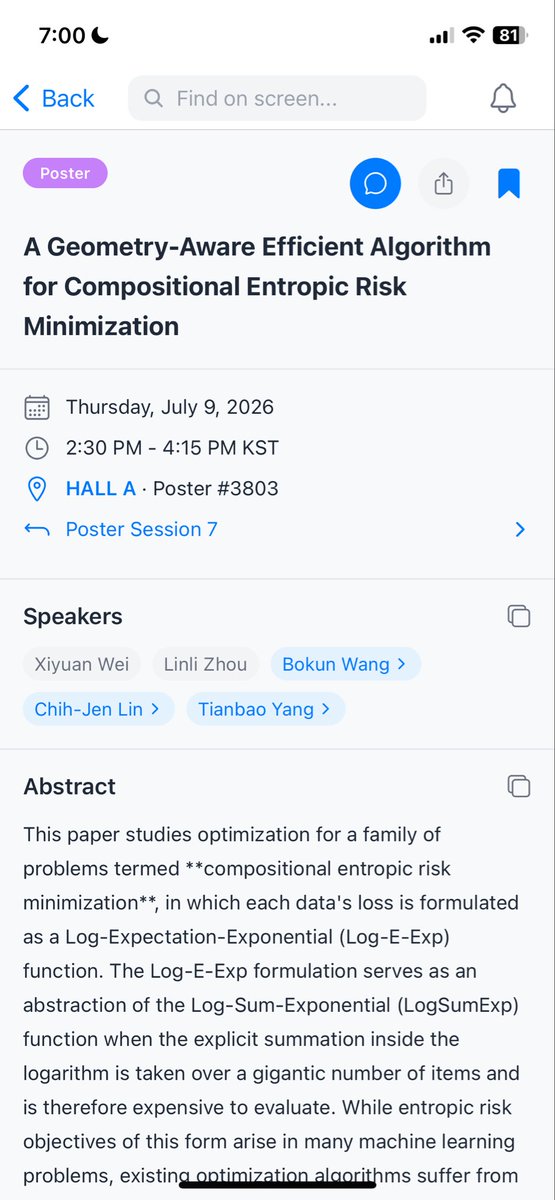
1/n Today, I will present the most interesting algorithm that I have worked on in my career so far.
- solves a fundamental objective in ML, i.e. log-expectation-exponential (entropic risk).
- a novel synthesis of mirror descent and stochastic proximal point methods.
We are excited to have a poster presentation for our new work "BLISS: A Lightweight Bilevel Influence Scoring Method for Data Selection in Language Model Pretraining" in #ICML2026 at Hall A (#2607), COEX Convention & Exhibition Center in Seoul on July 8th (5:00-6:45 p.m. KST).
Our COLT 2026 paper!
A single stepsize with high probability gives both fast and robust rates in TD learning, without using any projection.
IMO, Wei-Cheng put together a very interesting proof, with some new tricks as well.
Final version of my book (with a new title)
Online Learning: A Modern Introduction Using
Convex Optimization
Especially proud of the Foreword by @NicoloCB!
It'll be printed by Cambridge University Press.
The end of 7 years of updates :)
https://t.co/NeqTSih2ra
It is now official: My lecture notes on online learning will be published by Cambridge University Press.
The final version is due by the end of May.
So, if there is anything I missed/anything unclear/some refs I missed/anything else you don't like, please send me a message!
We've just finished some work on improving the sensitivity of Muon to the learning rate, and exploring a lot of design choices. If you want to see how we did this, follow me ....1/x (Work lead by the amazing @CrichaelMawshaw)
@tonysilveti Thank you for your kind words! Our algorithm aims to automate the process of selecting the correct per-layer learning rate scale in geometry-aware optimizers on the fly, such as Muon and Scion, so that strong performance can be achieved without any hyperparameter tuning.
Thank you for your kind words! Our algorithm aims to automate the process of selecting the correct per-layer learning rate scale in geometry-aware optimizers on the fly, such as Muon and Scion, so that strong performance can be achieved without any hyperparameter tuning.
I love this paper's idea to boost Scion (and Muon) by trying to estimate the variance of the per-layer gradient noise (and it's even done in the noneuclidean norm used for the LMO, e.g., spectral!). Really interesting results in their experiments, too.
https://t.co/EpQpun52bN
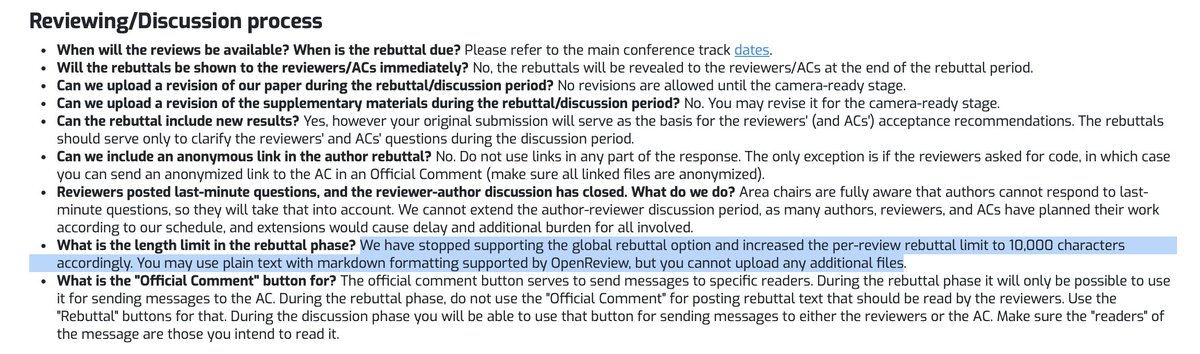
@NeurIPSConf, why take the option to provide figures in the rebuttals away from the authors during the rebuttal period? Grounding the discussion in hard evidential data (like plots) makes resolving disagreements much easier for both the authors and the reviewers.
Left: NeurIPS author instructions from yesterday, Right: Same page today.
I highly recommend @bremen79! I learned a lot during my postdoc in his group—not only about research, but also about navigating the academic job market, writing clear and impactful papers, and mentoring students. Feel free to contact me: I'm happy to share my experience!
I have an opening for a post-doc position: I am looking for smart people with a strong CV in optimization and/or online learning
All my ex post-docs (@kwangsungjun, @mingruiliuCS, and @emsaad_p) became assistant professors, I'd like to continue this trend 😉
Please share it!