Building TokenMax. We help teams turn customer enquiries, sales follow-ups and company knowledge into usable AI workflows, from model access to delivery.
At TokenMax, we help teams put AI to work, from multi-model access to custom systems.
I share practical AI workflows for customer enquiries and sales follow-ups.
Have a recurring task in mind? DM me what you do today, what result you need and where you get stuck.
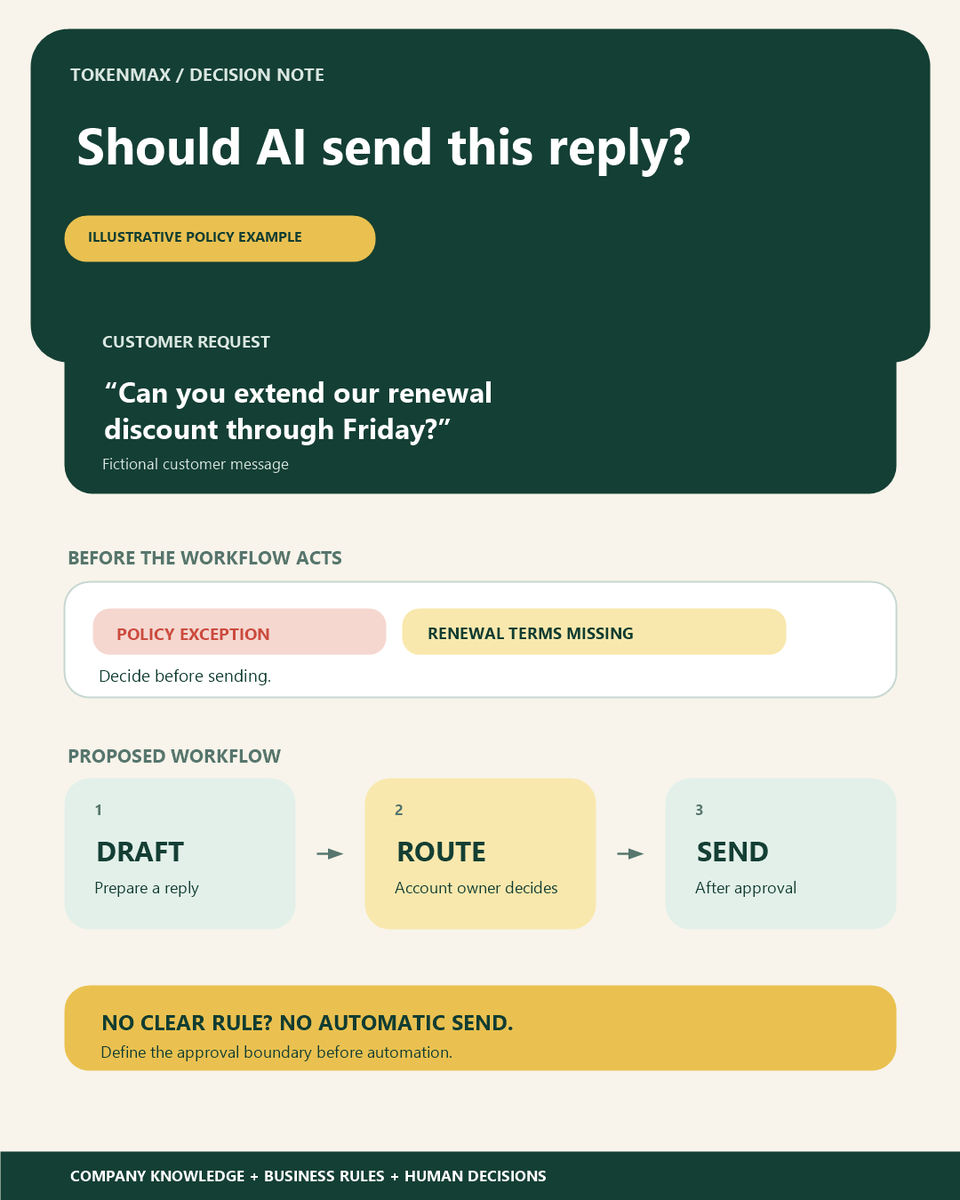
AI can draft a reply. The account owner should decide on the exception.
Missing context or a policy exception? Route the decision before anything is sent.
TokenMax builds workflows around company knowledge, rules, and approvals.
Which customer-facing action needs approval?
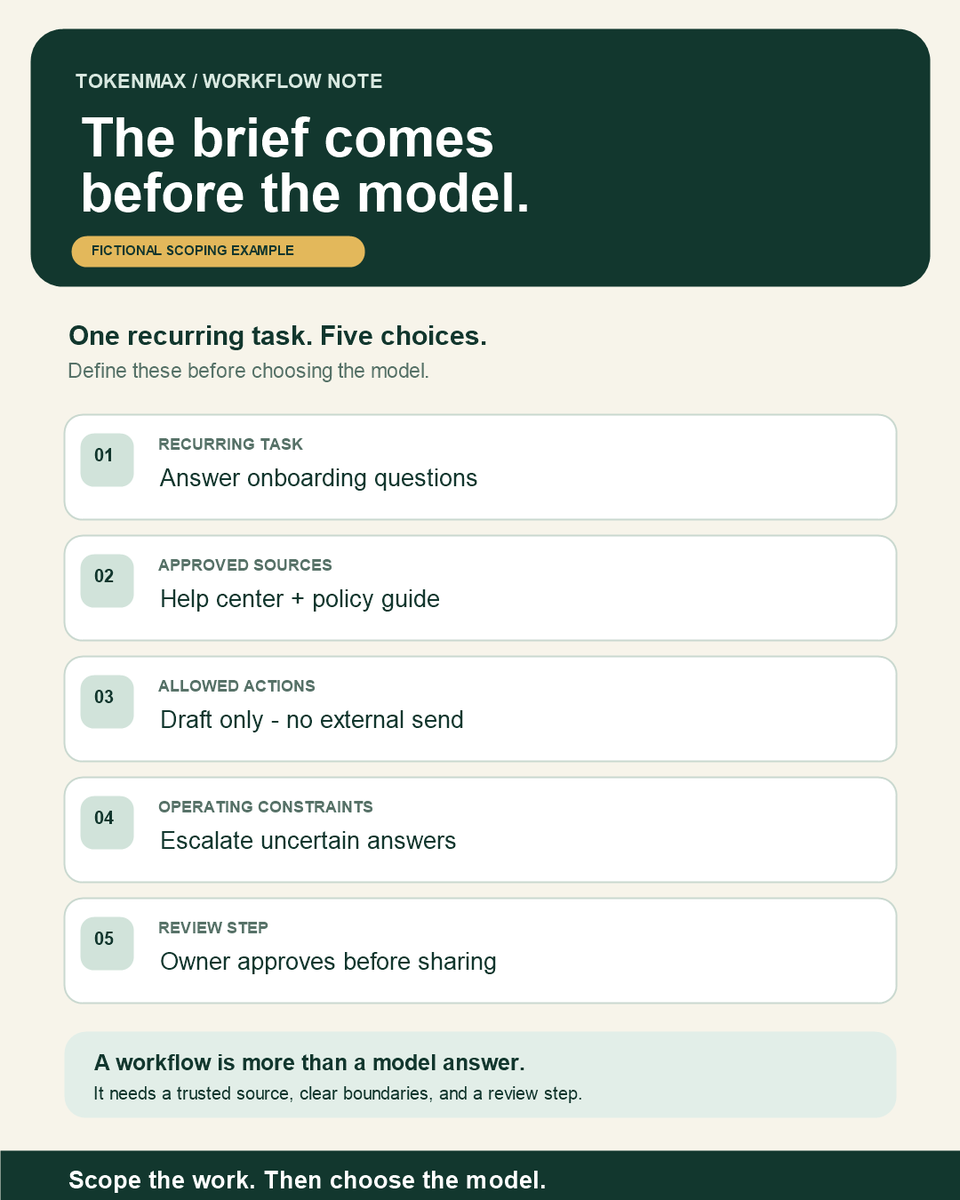
The first question in an internal AI project is not "Which model?"
Define the recurring task, approved sources, allowed actions, operating constraints, and review step first.
At TokenMax, we help teams turn that scope into an AI workflow.
Which part is still unclear?
@romanbuildsaas@SlackHQ@claudeai@gojiberryai The review step is key. Do you feed rep edits back into the playbook—what context changed the reply, what was corrected, and who owns the next action? That is what lets the workflow improve, not just move faster.
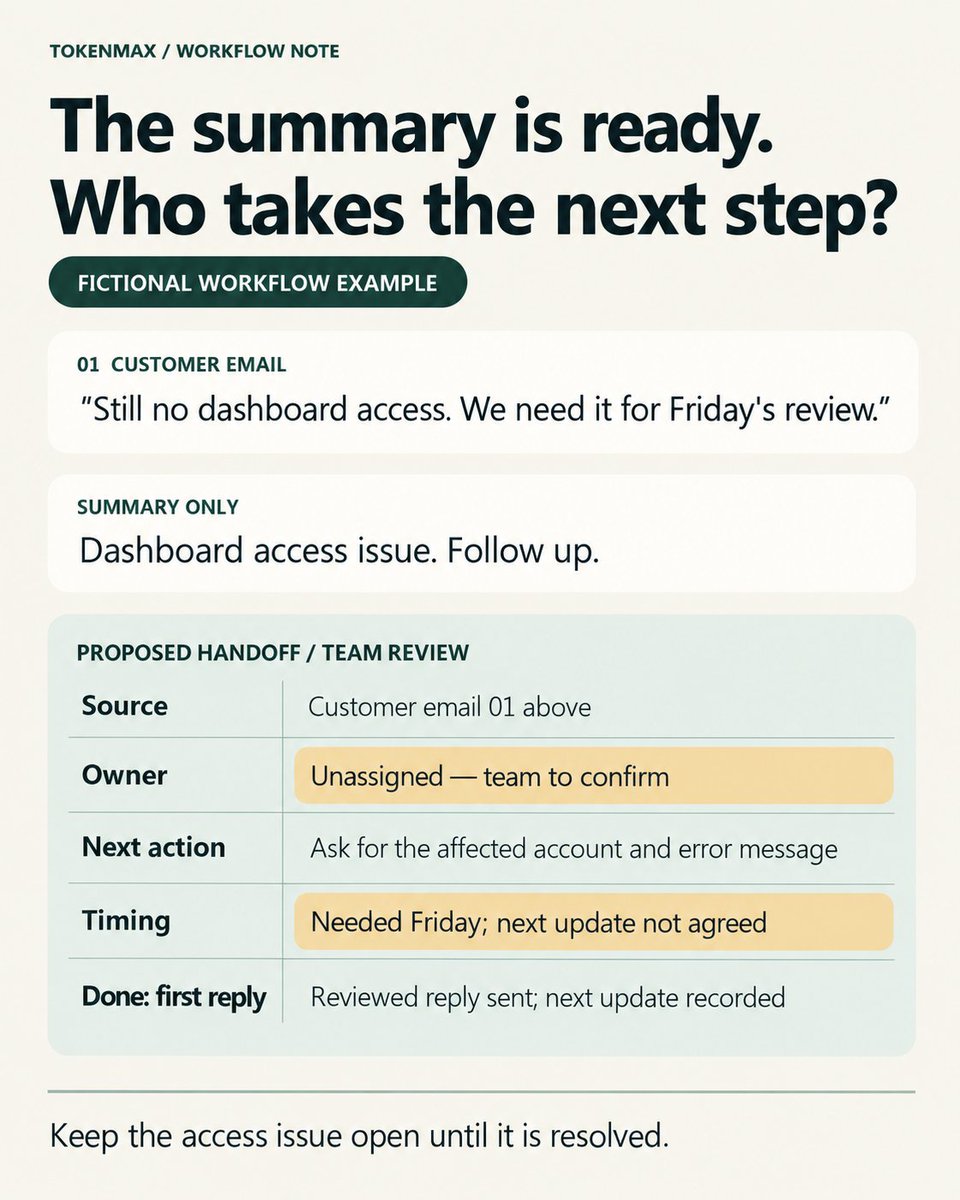
An AI summary can be accurate and still leave the customer waiting.
At TokenMax, we build custom AI workflows using your company's knowledge and business rules to turn customer messages into reply drafts and clear next steps.
Which step does your team still handle manually?
@vibeconnectfyi That human verification step is the key. Do you keep the representative tickets and a note on why each cluster was accepted, so the FAQ backlog stays traceable as new issue patterns appear?
@JessicaRevops One place these paths often break is at the handoff. A clear owner helps, but so does an acceptance rule: what information must be present before the next person takes over? Without that, every exception still lands with the founder.
A sales follow-up doesn't always need an agent.
Start with the customer's message and approved product facts. Draft a reply for review.
Pulling CRM history or booking a meeting requires permissions and integrations.
Define those actions before deciding what to build.
@BadDecizens The correction loop feels crucial here. When someone edits a parsed order or overrides cartonization, do you capture why and turn it into a rule or test case? That seems key to keeping the system reliable as SKUs and customer formats change.
@TeraTechCF Exactly. Those hours turn an abstract risk into something a client can weigh alongside the next feature request. Making it visible early gives maintenance a fairer place on the roadmap.
Your best AI user is on leave. Can someone else draft the next sales follow-up?
The team needs the inputs, product facts and an example of a good reply—not just a prompt.
At TokenMax, we help turn this into a repeatable AI workflow.
What still lives in one person’s head?
@DanKornas An agent stopping is not a completion signal. The hard brownfield case is a patch that passes tests but quietly makes an architecture decision. Does `/migrate` surface the missing ADR/RFC, or is that intentionally a human-review checkpoint?
@DanKornas Useful collection. The hard part isn’t collecting skills; it’s deciding which ones belong in a repo, when they should be invoked, and how to verify their output. Have you seen teams get better results from a small versioned set than from a broad catalog?
@Gh0stCompute@solana Exactly. A private prompt is not enough if the retrieval context, logs, and inference path are still outside the customer's control. Where does Ghost Compute draw the trust boundary?
@shedntcare_ The browser is real; the services are stateful replicas, not production accounts.
That makes failure useful: verify final state and audit the action trail without risking a customer workflow.
How do they test recovery after a bad change?
Local deployment is not enough for high-stakes AI.
A TokenMax agent is live at a client site. It combines live signals with authorized context and flags potential health or safety issues for staff review.
People make the final call.
Where would you put the human checkpoint?
@therealmissjo The problem isn’t an AI agent answering first. It’s an AI agent blocking the path to a resolution.
When it cannot solve the case, the handoff should include the context already collected—otherwise the customer has just been put on hold twice.
@devXritesh One extra test: can a human take over after a failure without replaying the whole run?
If the task state, last tool call, and next safe step are not visible, “recovery” is just manual debugging with a nicer UI.
An AI agent can sound convincing and still leave a customer's task unfinished.
Before launch, Parloa simulates customer conversations to check whether the agent follows instructions, uses tools correctly, and completes the task.
What failure would make you stop a launch?