Dear traders, very few of you know that Jeffrey Epstein was also a renowned trader in the industry.
Here’s a rare clip of him explaining how to catch the top & bottom of markets (and he’s partly right):
역시나 예상했던것 처럼 ...
현재 미국의 전략은 달러 시중 유동성을 줄이면서 자산가격을 폭락시키는 그림이다 이게 트럼프 행정부 작품인지 연준 작품인지 아니면 흑막뒤의 거대한 지배자 로스차일드 거기 인지는 모르겠지만... 의도된 플레이다
이렇게 계속 유동성에 스트레스를 주게 되면 다음과 같은 결과가 나온다
달러와 미 국채 가치는 UP
주식, 코인 ,귀금속 등 자산버블 붕괴로 가치 DOWN
그뒤에는 실물경제로 전이 되고 경기침체발생 그러면 인플레이션은 자연스럽게 잡을
수 있다
또다른 골치였던 미 국채금리가 내려가고 다른 투자상품들이 폭락하기 때문에 미 국채수요가 다시 살아난다
이게바로 미국이 증시와 자산시장을 희생시키고 달러와 채권시장을 구하는 치트키다
미국은 항상 결정적인 달러위기의 순간이 올때 어김없이 달러를 구하기 위해서 어떠한 희생을 치르더라도 그방법을 사용했다
아마 이번에도 우리가 목도하는게 바로 그것일꺼야... 지금은 섣불리 바닥을 짐작할수 없을거같다
Trump was well aware of the dire straits the mkt was in last week, he tweeted about it. For him to introduce more tariffs (and therefore more hawkishness from the fed) it really says alot. He clearly wants the market lower.
Two rules that you absolutely can not break
1. Dont fight the Fed
2. Dont fight the White house.
Both right now are short the upside and have their boot on the markets neck.
The headline today says the US is raising tariffs on India. I think the more accurate reading is that India is going back to where it was in February.
Let me explain, because the sequence matters.
In February, India and the US agreed a framework deal. The tariff on Indian goods came down to 18%, from as high as 50% last year.
Two weeks later, the US Supreme Court struck down most of those tariffs. Since July, Indian goods have faced only about 10%.
So for a few months, our exporters have been paying less than the deal said they would.
Today the US proposed new tariffs on 14 trading partners, including India, China, the EU and Japan. The reason given is "excess industrial capacity."
Two details matter more than the headline.
First, a US official said no country's rate will go above what was agreed in its trade deal. For India, that ceiling is 18%.
Second, the new tariff will not be added on top of the existing 10%.
So the worst case for India is a move from about 10% back to 18%. That is a real cost for an exporter working on thin margins, and I do not want to dismiss it. But it is not a new shock. It is the February deal coming back.
What has changed is the legal basis. The old tariffs were struck down because of how they were imposed. These are being built through an investigation, which makes them much harder to challenge in court.
I would say that is the real news. Tariffs are no longer an emergency measure that a court can remove. They are becoming a permanent part of how the US trades.
China gets the highest rate, 20% on top of the 25% from the first Trump term.
What I am keeping an eye on is not India's number alone. It is the gap between India and its competitors like Bangladesh and Vietnam. In textiles, that gap decides who gets the order.
The exact rates are due today. I will update when they are out.
My opinion here and not advice.
*US PROPOSES AT LEAST 17% TARIFF ON INDIA IF DEAL REACHED
*US PROPOSES 10% TARIFF ON FINISHED AIRCRAFT FROM BRAZIL
*US PROPOSES AT LEAST 15% 'DEAL RATE' TARIFF ON TAIWAN
In game theory, if you want someone to behave well, you'd better make sure you two see each other again. It's a proven phenomenon: if other players believe they will see each other again, they'll prioritize cooperation. But once the finite horizon approaches and the final round is here, they can turn adversarial fast. The future dictates current actions. If you desire cooperation, ensure a shared future.
The Panic Selling Reversal Pattern:
From the book: 10 Price Action Trading Setups Based on Math: Advanced Trading Strategies for Breakouts, Reversals, and Major Trend Changes: https://t.co/NpJXUwG16X
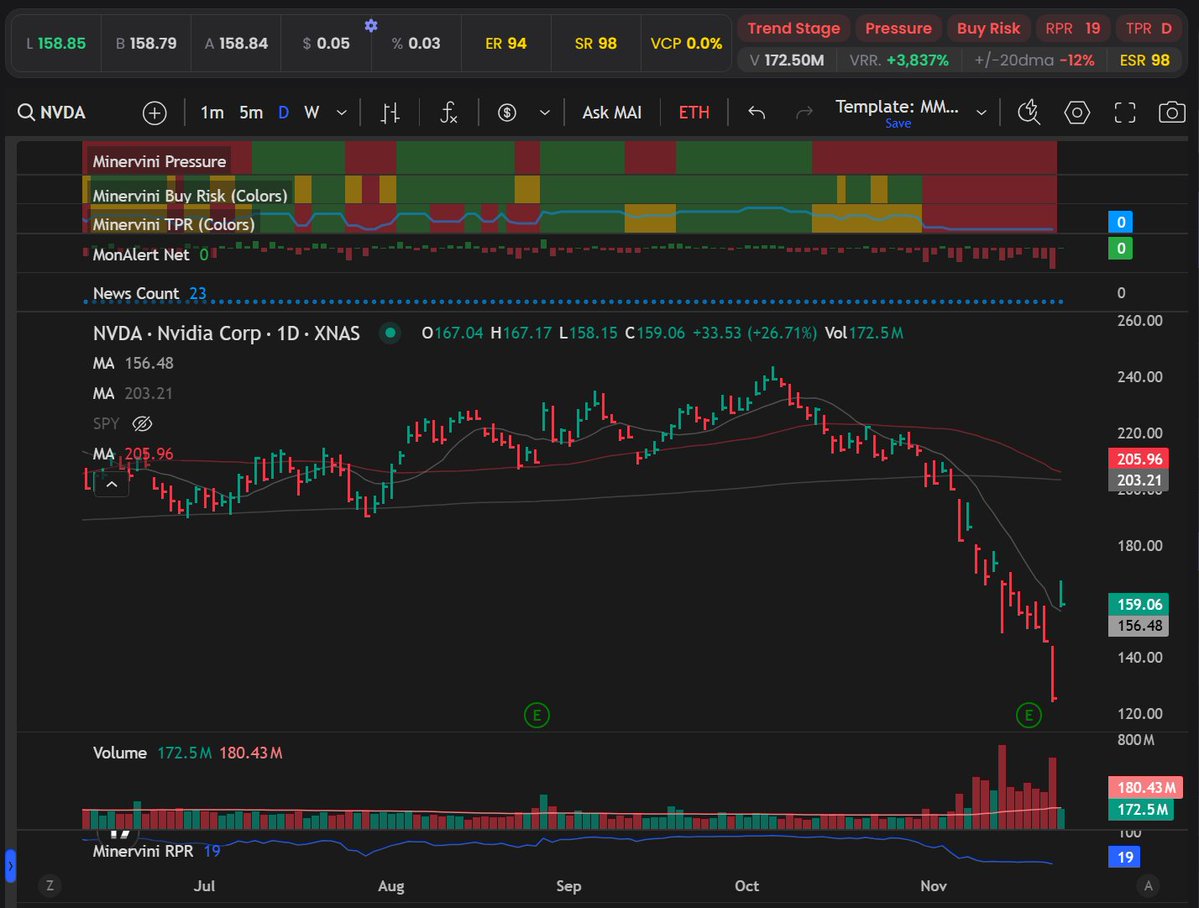
This morning’s rally may look impressive, but this is exactly why I covered the shorts. The market had gotten oversold enough to produce a rip-your-face-off rally. After capturing nearly 7R on the downside, there was no reason to overstay the trade.
That said, keep this morning’s action in perspective. A number of stocks are up a whopping 10%-30%, but most are barely a blip on the charts. For now, they’re counter-trend rallies in stocks that are still in significant downtrends, particularly in Technology.
The S&P 500 fell 11.6% from its October 6 record high, the first 10% correction since the February-April 2025 selloff, but we are not out of the woods. There’s still work to do before we can say an effective bottom is in place. One strong day doesn’t suddenly create a new uptrend.
For now, I expect volatility to remain elevated. Enjoy the rally, but keep it in context. The market still has to prove itself. Prepare for backing and filling, and even lower lows in the major indexes before this correction is over.
The tricky thing about an oversold market is that it can always get more oversold. And even after momentum bottoms, price can still go on to make lower lows while divergences develop.
What I want to see now is whether this rally can last more than a day or two and broaden out beyond the most beaten-down stocks. That would increase the odds that a sustainable year-end rally can develop. If it can’t, then what we’re seeing is probably just short covering with more selling still to come.
Stronger signals have come from upside breadth thrust signals than downside oversold readings. For example, returns after 10:1 upside volume days have been higher than after big downside volume days. An even stronger message would come from two 10:1 up days without an intervening 10:1 down day. It pays to wait for upside confirmation.
A follow-through day (+1% on higher d/d volume) could occur as early as this Friday, assuming Friday’s lows hold. That would be an initial step in determining a low has been made.
During corrections, my focus ultimately turns to individual stocks and market leadership. Currently, our list of potential candidates is small. A market cannot carry itself very far on the backs of counter trend rallies in broken leaders. To get bullish, we need to see more. https://t.co/JXzFFTmMtn