Your online and neutral source of mining companies data & projects around the globe with historical growth of production & assets. Try it out for 2 weeks free!
Turning our attention to Europe, developments in France naturally take center stage—and not just those in the financial markets. The spread between market yields on French and German government bonds has widened once again and now stands at a hefty 160 basis points, or 1.6%. Très inquiétant!
#bonds #france #oat #bund #interest
For beneath the seemingly mirror-smooth surface of the water, things continue to bubble violently. The swap market offers a warning signal: When credit investment-grade spreads there narrow significantly, it usually doesn’t take long before the stock market marches in the same direction.
This almost eerie calm also has an interesting side effect: Investors apparently no longer feel it’s necessary to hedge against price losses. The skew index—which reflects the valuation of long-term put options with strike prices well below the current market level (so-called out-of-the-money puts)—speaks volumes here. These hedges are now strikingly inexpensive. Or to put it another way: the demand for this “safety belt” is surprisingly low. Apparently, hardly anyone expects the ride to suddenly get bumpy.
This almost eerie calm also has an interesting side effect: Investors apparently no longer feel it’s necessary to hedge against price losses. The skew index—which reflects the valuation of long-term put options with strike prices well below the current market level (so-called out-of-the-money puts)—speaks volumes here. These hedges are now strikingly inexpensive. Or to put it another way: the demand for this “safety belt” is surprisingly low. Apparently, hardly anyone expects the ride to suddenly get bumpy.
Long positions in the Swiss franc—the classic safe-haven currency—have been increased quite dramatically. And with this, an individual or group of investors is sending a pretty unambiguous message: While the stock markets are still basking comfortably in the sun, some investors with particularly deep pockets are already taking precautionary steps to secure their positions. They clearly expect that this deceptive calm could soon come to an end…
Last week, we speculated that ECB President Christine Lagarde would likely comment very soon on the situation surrounding rising market yields on French government bonds. We didn’t have to wait long. Just a few days later, confirmation came from the highest level: The central bank has sufficient tools at its disposal to combat “unfounded” and disorderly market dynamics. As expected, this statement initially brought some calm to the bond markets. The spread between German and French government bonds did not widen further—though it hasn’t narrowed yet either…
The insurance premiums against a French default—known as credit default swaps (CDS)—remain significantly higher than those for neighboring Germany — and have not yet declined even after the verbal reassurance of the ECB.. Mmmmhhh.
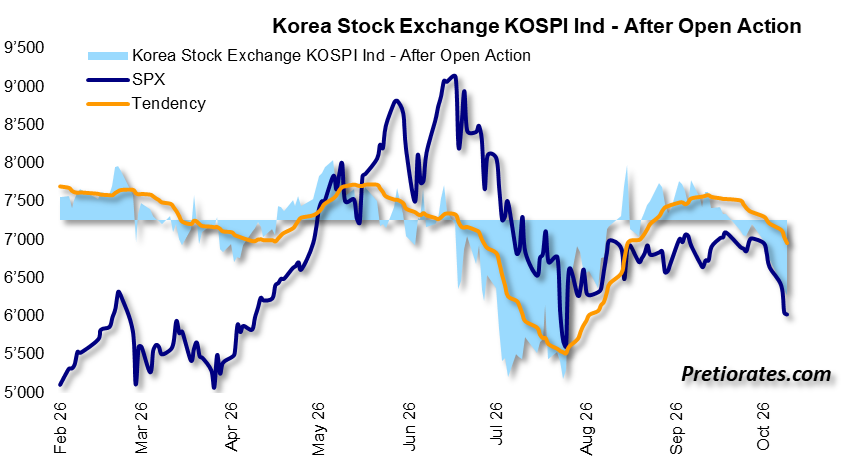
The real test for AI companies likely lies ahead. In recent months, the Korean stock market has almost become a pioneer of the AI movement. And after the KOSPI triggered a minor global AI earthquake back in the summer, the index now appears to be taking a significant hit once again. Distribution by professional traders has recently increased sharply once more. Should the Korean KOSPI index fall below its late-July low in the coming days, the pulse of AI stocks on Wall Street is also likely to quicken noticeably.
The spread between 10-year German and Swiss government bond yields has widened from practically zero to about 3 percent—or 300 basis points—in just four years. That’s not a small step, but rather a significant leap.
New thoughts have been published!
Pretiorates’ Thoughts – Whatever it takes… again?
https://t.co/n1OrVODliJ
The spread between German and French government bonds, which we discussed two weeks ago, has since risen to over 150 basis points. That’s a whopping 1.5%.
New thoughts have been published!
Pretiorates’ Thoughts – Whatever it takes… again?
https://t.co/IHgeqjb1ho
The problem of excessively rising market yields is concentrated primarily in France. While the spread between German and Italian government bonds has also risen, it remains almost unremarkable by comparison.
New thoughts have been published!
Pretiorates’ Thoughts – Whatever it takes… again?
https://t.co/n1OrVODliJ
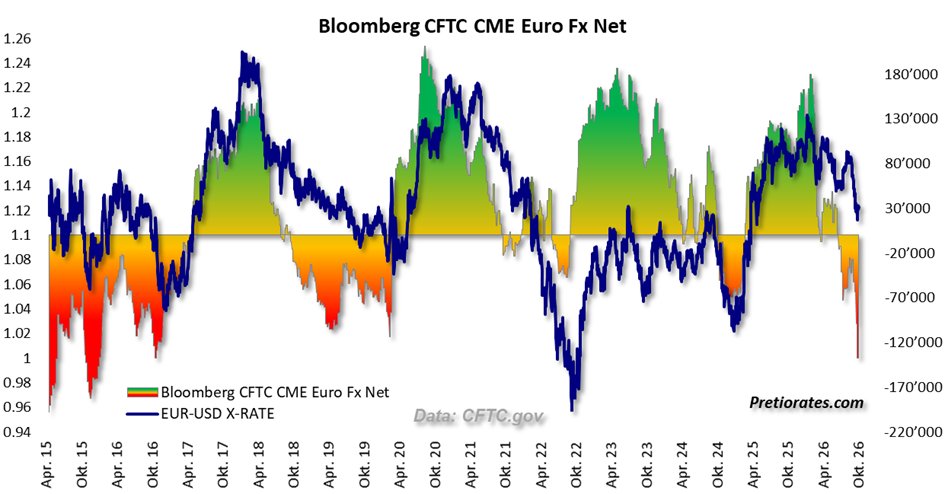
The euro is already showing initial signs of weakness. It is striking that the onset of this recent weakness coincides almost exactly with the weakness of French government bonds.
New thoughts have been published!
Pretiorates’ Thoughts – Whatever it takes… again?
https://t.co/n1OrVODliJ
The trend in the European Central Bank’s balance sheet total shows a very high correlation with the trend in the European currency—with a lag of about three months. This indicator suggests that the euro is likely to remain on a downward trend in the coming months as well.
New thoughts have been published!
Pretiorates’ Thoughts – Whatever it takes… again?
https://t.co/n1OrVODliJ
Investor concerns about government debt are also growing in the U.S. Market yields have also risen sharply recently. Inflation, energy prices, and similar factors are often blamed for this. But it’s not that simple: Unlike nominal yields, real market yields exclude expected inflation. If rising inflation expectations were the main reason for the rise in yields, the spread between nominal and real yields would have had to widen significantly recently. But that is precisely what has not happened. Nominal and real yields have risen largely in tandem, while their spread has remained surprisingly stable for about five years. Ergo: The rise in yields is likely attributable primarily to investors demanding higher yields to compensate for increased credit risk. The strength of the U.S. economy is likely to play only a minor role in this.
New thoughts have been published!
Pretiorates’ Thoughts – Whatever it takes… again?
https://t.co/n1OrVODliJ
The 43-month cycle of the U.S. dollar suggests a possible peak around the turn of the year.
New thoughts have been published!
Pretiorates’ Thoughts – Whatever it takes… again?
https://t.co/IHgeqjatrQ
The 20-year yield cycle for U.S. Treasuries is somewhat more complex and consists of several cycles. If the track record to date holds true, we could see a massive correction in market yields in the final weeks of this year.
New thoughts have been published!
Pretiorates’ Thoughts – Whatever it takes… again?
https://t.co/n1OrVODliJ