I really believe I gave enough warnings @Stacks
https://t.co/72WNaTyBeX https://t.co/LLJ1e3jU2e https://t.co/KHunz9yYMu https://t.co/tTyCcSPfCo
stacks hit with the Binance warning Tag.
I think Failed public communication and questionable tokenomics shifts is the reason
I loved this ecosystem deeply. Every piece of advice I gave was out of care. But there was never real dialogue just the illusion of it, while decisions were pushed through anyway.
It naturally makes you think of Heinrich’s Law. Before this moment, there were countless red flags and warnings from true OGs. Yet, the team chose radio silence and did as they pleased. at least 300 warning & failure sign
So, What will you shout to the world now? @stacks@StacksEndowment 🤔
Are you still going to call yourselves the top Bitcoin L2?
Will you keep selling the dream that "our future is bright"?
Are you going to run fake-engagement SIPs, filter out valid criticism, and celebrate inside an echo chamber of spam accounts with zero on-chain activity?
The choice was yours to make. or maybe after this tag, that choice is already gone.
I’ll leave you with one final thought: This disaster was 100% self-inflicted. Do not deny it.
Crypto Winter
(Feat#1: Where We Stand Now)
For a while now,
I've been stepping back from crypto — just watching from the sidelines.
The reason is simple.
The gap between price appreciation and actual ecosystem infrastructure felt way too wide. I couldn't shake the feeling of a bubble.
When the critical 80K support level broke, my read was clear — there's no liquidity left driving buy-side demand. Until we find a price where buying and selling pressure actually find balance, retail investors are in for a brutal ride absorbing this massive sell overhang.
That view hasn't changed.
So what about infrastructure and development?
Equally bleak, honestly.
#1 — Legacy systems are outpacing crypto development.
Crypto's foundation is decentralization. Individual ownership. Data sovereignty. These principles still matter.
But the pace of traditional IT has been impossible to ignore. The industry has expanded into AI, and now AI agents are leading an entirely new wave of system modeling.
So where does crypto fit in all of this?
Through AI agents, individuals can now build and operate the WEB systems they want — without ever touching crypto infrastructure. Think about it: would you rather connect a wallet to an Ethereum platform and manage your own keys on-chain, or just tell an AI agent what you need and have it done instantly?
The answer is obvious.
For the average user, this isn't even a fair competition.
#2 — Crypto can't compete at the system modeling level either.
In the era of traditional server-based systems, crypto had a clear edge. There were real alternatives to the weaknesses of centralization, and the DePIN sector was building genuine competitive ground.
But that edge has been fading ever since AI agents arrived.
Right now, GPUs are in short supply. Astronomical capital, infrastructure, and hardware buildout are happening on the AI side at a scale crypto simply cannot match.
And here's the most painful part — if crypto builders had taken the money they raised, the coins they sold, and actually built serious system infrastructure, we wouldn't be in this crisis.
Instead, the space has been flooded with speculators, gamblers, and outright fraudsters. (I include myself here — anyone chasing profits in this market isn't so different.)
The gap between the speculative market and actual infrastructure buildout has brought us to a point of self-destruction.
And yet — I don't believe crypto has no future.
There is a role that only crypto can play. And that role may arrive sooner than most people expect.
I'll get into that in the next piece.
Crypto winter is brutal.
Unforgivingly cold, with no clear end in sight.
But survive.
Because in crypto, like always — you have to be alive to see what comes next.
#CryptoWinter #Crypto #Bitcoin #BTC #Web3 #DePIN #Ethereum #ETH #CryptoMarket #Blockchain #CryptoCommunity #BUIDL #CryptoTwitter #AI #AIAgents
My Investment Theory:
Execute. Return. Accumulate again.
Real investors don’t chase. They repeat.
(Note: The following is a translation of the original Korean text. Some nuance may differ from the original.)
Since 2013, I’ve met countless people on my investment journey.
I’ve seen success and failure up close.
And through all of it, one truth kept emerging:
Every investment has an order.
To stay grounded and not lose focus, I define that order for myself:
Accumulation → Execution → Patience → Expansion
1️⃣ Accumulation
This is the phase of building up — not just saving money, but creating the foundation that allows consistent growth.
Whether it’s a job, freelance work, or any form of labor,
you steadily secure cash and simultaneously study to shape your long-term direction.
This isn’t “investment study.”
It’s study to avoid wasting time and resources.
2️⃣ Execution
Once you’ve accumulated enough and shaped your direction, it’s time to execute.
Noise and temptation will appear — greed, doubt, distractions.
But here’s the key rule:
After every execution, return to accumulation.
Success or failure doesn’t matter.
You go back, rebuild, and execute again in the same direction.
Accumulation → Execution → Accumulation → Execution → ...
This repetition is the true meaning of execution.
3️⃣ Patience
Patience is enduring the repeated cycle of accumulation and execution.
Most people quit here.
Those who endure will eventually see
that their direction was right all along — it just required time.
The time you endure between repetitions — that’s patience.
4️⃣ Expansion
When execution achieves its goal, you reach the threshold of success.
But it’s not the end.
Successful investors use this moment to start a new cycle of accumulation,
this time with a cashflow engine — a cash cow that sustains future investments.
Your money begins to work for you,
and that cycle becomes the foundation for the next execution.
“Recovery isn’t the end — it’s the beginning of a new loop.”
🔚 Final Thoughts
Everyone who has truly succeeded says the same thing:
“You can’t schedule success — you can only endure until it arrives.”
Life may feel short,
but the time we spend building, one day at a time,
is never wasted.
So I keep accumulating,
thinking of the version of myself ten years from now.
#InvestmentPhilosophy #CapitalCycle #PowerOfTime #OrderOfInvesting #EndureToGrow
Warming Up
(feat. A personal perspective on the crypto ecosystem)
For a while, I couldn’t write due to personal reasons.
Still, I kept watching the crypto space and its market moves.
Now that I finally have some time again, I want to refocus.
Before diving in, I want to revisit my past thoughts and memories—
to recall how I once saw the vision of crypto.
(Please note that some meanings may differ due to translation.)
1. Decentralization
When I first started investing in crypto back in 2017,
I went through countless doubts and questions.
Eventually, I became fascinated by the vision of cryptocurrency itself—
the fall of dollar hegemony, the tyranny of central banks,
and the dream of financial freedom.
All of these ideas were rooted in one word:
"Decentralization."
The world was rapidly adapting to digital life.
Physical transactions were fading,
while web-based and digital payments exploded in scale.
But as digitalization grew, so did cybercrime and hacking.
In that landscape, Bitcoin’s blockchain emerged as something that could truly change the system.
That’s when I gained conviction.
(Details of the tech are unnecessary here.)
2. Pump and Dump
The market back then was immature—
liquidity was thin, and the ecosystem barely existed.
It was an easy target for coordinated funds and big players.
The result?
Prices became the main focus, and volatility turned insane.
The chaos drew attention from the world,
and speculative capital flooded in.
Pleasure and pain coexisted,
and we, the early believers, slowly transformed from visionary holders into mere speculators.
“Sell during the pump, buy during the dump — that addictive illusion.”
The market lacked protection.
Regulation and traditional finance started creeping in,
turning crypto into just another financial product.
So, is decentralization still meaningful today?
Looking at Bitcoin’s price, it’s hard not to feel bitter acceptance.
Ironically,
after all that, I began to feel that the crypto space had somehow lost its direction.
3. Anonymity
Now, countless institutions dominate the crypto ecosystem.
Their movements are driven purely by self-interest.
They manipulate narratives, distort information, and drain investor confidence.
The market is once again being controlled—
this time through economic trends and old financial tactics.
It’s exhausting.
To truly preserve the value of decentralization,
I’ve come to believe that anonymity is no longer optional—it’s essential.
We’ve grown sick of manipulation,
of the same centralized mechanisms we once sought to escape.
Maybe it’s just our instinct—
the same instinct that drew us to Bitcoin when it was still underground.
“A new beginning through anonymity.”
It won’t be easy.
But I don’t think it’s impossible either.
Those who feel tired of the institutionalized crypto market will inevitably crave a new ecosystem,
one that doesn’t depend on the existing order.
To break free from control, anonymity is indispensable.
Even within this structural dead end,
I feel a strong sense that new possibilities are forming.
Perhaps crypto hasn’t even truly begun yet.
It will take time—
but less time than it took for Bitcoin to come this far.
4. To Conclude
Maybe these are just premature thoughts—
but I wanted to record them here nonetheless.
For now, my focus is shifting toward Ethereum and its ecosystem.
I believe we’re standing at the edge of the Ethereum era.
From here on, most of what I’ll write will likely revolve around it.
(Of course, if the winds change, I’ll follow where they lead.)
#Crypto #BTC #ETC #Ethereum #Decentralization #Blockchain #PersonalThoughts
STACKS..Let’s Break Up.
It’s been a really long time since I’ve left a post.
(During this period, STX’s trajectory has been so disastrous that I couldn’t even find the words to comment on it.
I am speaking purely from the perspective of a holder and investor, not a builder.)
For the time being, I don’t think I will be making any more posts about STX.
From my perspective, it is difficult to understand the roadmap of the foundation and stakeholders.
Whether their vision for BTC L2 remains firm, I do not know.
But at the very least, I no longer have the will to be part of what the @Stacks ecosystem has become.
Let me share a few reasons why I made this decision.
First, the outsider issue of developer infrastructure.
For the ecosystem to thrive, developers are essential.
However, the accessibility and entry barriers of the core STX language have left it uncompetitive in the market.
They are trying to solve this with SIP-031, but honestly, I am skeptical.
As time goes on, the gap with more accessible developer languages like Ethereum and Solana will only widen.
Second, SIP-031.
I understand the need for this governance proposal.
To expand liquidity and the ecosystem, capital reserves are indeed necessary.
That said, from a holder and investor perspective, was the loss caused by increased circulating supply ever considered?
I don’t think so.
Their aim is simply to keep dApps and projects alive, even if it means holders must absorb the losses.
And then?
What about measures for that increased supply?
In my view, at the very least, what is consumed should also be withdrawn from circulation—that’s only logical.
Yet instead, they wrap the issue in difficult financial analyses, using words that ignore the actual market shock.
In the end, it is the investors who are left to bear the cost.
Lastly, the risk of signer rewards.
I’ll skip the full details of the signer and stacker systems.
The daily pressure of 144,000 STX being allocated is something the foundation and stakeholders view very differently than holders do.
Objectively, there is no capital or liquidity solution available to absorb 144,000 STX of sell pressure every day.
This continues to burden holders and investors.
From the foundation’s perspective, they do not consider capital loss.
For them, maintaining the chain is the sole purpose—even if STX falls to $0.10, as long as signers are maintained, the system is “working.”
In the end, if we break it down,
Reserve capital + Signer rewards < Buy-side capital
must be the structure for value to rise.
Of course, some argue that stacker rewards will offset or cushion this.
But that is mistaken.
Two conditions would be required for that:
1. A floor price for signer bids (currently it is a free market).
2. A system where stacker rewards are supported by converting BTC earned from signer fees back into STX as payback.
But nowhere in this governance proposal do I see acknowledgment of these systemic flaws.
Instead, it only seems to serve stakeholder interests.
I believe SIP-031 should have also considered the risks to investors, not just the needs of projects.
And so, I have decided to acknowledge that my investment in Stacks has been a failure.
After such a long journey with it, I have come to the conclusion that STX has no real vision for its ecosystem.
I am giving up on it.
That said, I sincerely wish those holders who continue to believe in and invest in STX success.
Stay true to your investment principles and convictions, and I hope you achieve victory.
Going forward, I plan to share more posts about various crypto trends.
(Things like the recent hype around Yapping, or insights on the Ethereum ecosystem.)
@yashhsm The AI Hackathon was not organized by the SOLANA Foundation, but was the result of the @thesendcoin team.
I was amazed at how amazing it was.
That's really cool.
Fast block processing speed will make true crypto gaming possible. I expect the MEME pool to significantly increase liquidity provision. The moment when the GOAT team's efforts bear fruit is approaching.
They are the protagonist of the Nakamoto release.
I'm holding the highest expectations.
We're live! The largest virtual Bitcoin developer event, discussing Bitcoin Script, Runes, and L2 Stacks 🧡
We're celebrating today's massive developer event with a Mojo NFTs giveaway.
Share this post & win one of the NFTs shown in the replies below 👇
https://t.co/PFefI3ivfo
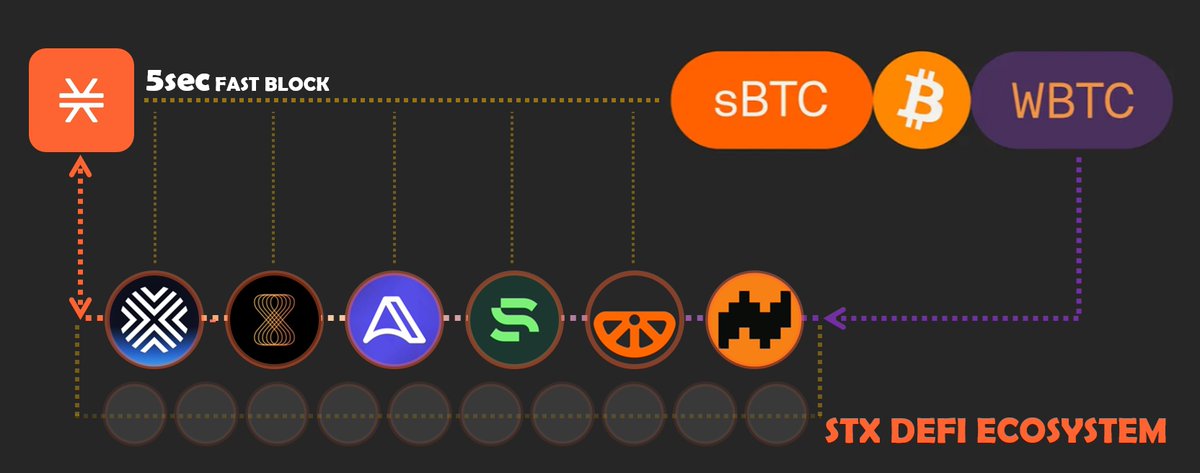
The Beginning of Ecosystem Acceleration: Fastblock and STX Defi
Chapter #3: Defi Service Projects
Before writing, there are too many new projects emerging within Stacks to organize all the projects. Therefore, it was impossible to organize everything. I have organized it based on the most actively developed projects. (Please understand in advance that this is my subjective organization and personal opinion.)
Before reading this third chapter, I recommend you read the previous posts:
▶ Starting post:
https://t.co/sBpxGdLRqb
▶ Previous post Chapter #1 (INDEXER):
https://t.co/yxt7odSOWr
▶ Previous post Chapter #2 (sBTC):
https://t.co/uHGf02kuZV
Current Overview of Stacks Ecosystem
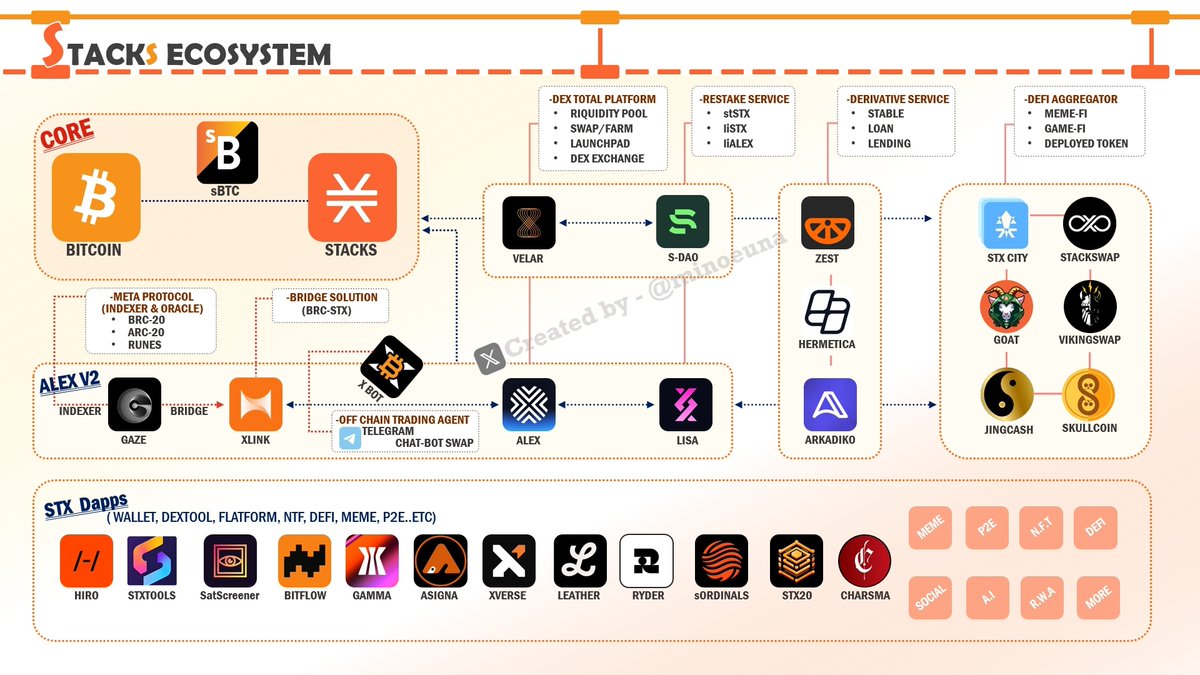
The chart above was organized while continuously checking the @Stacks ecosystem.
(I apologize for the delay in posting as it took a lot of time.)
Currently,
the Stacks ecosystem is heavily focused on liquidity.
Accordingly,
I have divided it into three categories as follows:
1. Core - POX Engine with Fastblock and sBTC
After applying the Nakamoto update, Fastblock will finally be activated on the core engine.
Now, all transactions on the Stacks chain will be processed every 5 seconds.
Additionally, the immense liquidity of dormant Bitcoin will soon be awakened through sBTC.
To achieve this, @StacksOrg and its peers have moved quickly at the forefront.
They will offer a new DEX market in time for the update application.
2. STX DEFI - ALEX, VELAR, and Projects for Liquidity
Currently, the DeFi pool (based on pool supply TVL) seems to be divided into the @ALEXLabBTC and @VelarBTC . Both projects are equipped with basic token swap and pool supply functions within the Stacks ecosystem.
However,
there is a clear distinction between the two projects.
ALEX TEAM is specialized in creating a system that potential investors feel comfortable with. They seem focused on building a user-friendly swap system that emphasizes familiarity and convenience. Even though the team suffered from a hacking incident that caused significant losses, their dedication to the project remains evident. Their TVL recovery has been swift, and they have proven their resilience in the ecosystem. The "wounded champion" is set to rise higher than before, and I will cover more about this in detail later.
On the other hand, VELAR TEAM steadily increases its TVL share with a focus on financial derivatives. Their aggressive approach to DeFi liquidity is particularly notable. They continue to expand partnerships with new projects, as well as develop derivative products like savings, loans, and restaking.
In addition, other DeFi-related projects such as Dapp Aggregators(@stxcity, @bitflow ), MEME-FI (@Stackswap_BTC , @JingCash, @CharismaBTC, @GoatCoinSTX ),GAME-FI (@SkullcoinBTC) and SWAP(@Stackswap_BTC), which are driving the ecosystem with significant liquidity, even before Fastblock is applied.
(@HermeticaFi is actively being prepared. Personally, I expect a significant synergy after sBTC.)
To summarize,
the ALEX ecosystem consists of , @Gaze_Network, @XLinkbtc , @xbotbtc , @ALEXLabBTC , and @LisaLab_BTC , forming a strong DeFi camp. Meanwhile,
VELAR has partnered with @VelarBTC , @StackingDao , @ZestProtocol , @ArkadikoFinance , and Dapp Aggregators, creating a synergy that will be fun to watch in the rapidly evolving STX DeFi space.
Who do you think will capture the largest market share?
3. DEX TOOL and SELF Token
Do you remember the Ethereum ERC-20 TOKEN BOOM of the past? The current MEME MARKET has a similar vibe, with projects like ALEX and STX CITY making it incredibly easy to generate tokens through their respective self-token pool creation and token generators. While investment risks do exist, their liquidity is undeniably attractive.
To support this growing ecosystem, we also see the rise of crucial tool projects. @SatScreener and @stx (STXtools) function as vital DEX screeners, while @bitflow serves as an exchange channel. @hirosystems provides STX exploration, and wallets like @LeatherBTC , @xverse , @asignaio , and @Ryder_ID enable staking deposits and coin storage. The meta protocol is supported by @StxOrds and @stx20stacks , while @trygamma takes charge of the NFT market services. These tools and services are essential for the dynamic circulation of the Stacks ecosystem.
Just as winter ends and spring comes, Stacks is also entering a spring where flowers bloom. The long-awaited journey is finally beginning, and a new journey is expected to unfold. I always express my deepest respect to all who contribute to the Stacks ecosystem!!!
(Thanks and Final Notes)
Thank you for reading my long posts over the past few weeks. I tried to make Stacks easy for anyone to understand, but I'm not sure if I did it well. In the future, I will post with lighter topics and focus on projects of interest.
(If it was helpful, please follow, like, and retweet.)
After Nakamoto Activation, Next Task
Chapter #2: sBTC
"The first pegged BTC in crypto to achieve 100% decentralization."
Isn’t this one sentence enough to define sBTC?
Since the technical aspects and functionalities are already explained in detail on the team’s blog, I won’t be covering those here.
Today, following up on the previous chapter, I will be discussing the second chapter, sBTC.
In this post, I’ll be sharing my personal thoughts on sBTC from the perspectives of both the BTC ecosystem and the STX ecosystem.
For a more detailed explanation of the mechanisms and technical aspects, please refer to the blogs from the Stacks team:
▶Previous post Chapter #1 (INDEXER):
https://t.co/yxt7odSOWr
▶sBTC English Blog:
https://t.co/1Sdjgj4eJy
▶sBTC Korean Blog:
https://t.co/zJ007ndyIp
Now, let’s start discussing how sBTC can contribute to both the @Bitcoin and @Stacks ecosystems.
1) BTC, Idle Wealth—Dormant, Yet Dangerously Potent
The value of assets held by Bitcoin holders currently amounts to approximately 1 trillion dollars.
Among these vast assets, only about 1% of Bitcoin is actually being utilized through wrapping.
Even this level of liquidity can have a tremendous impact on the market, as already proven by the Ethereum ecosystem.
At the same time, this also implies that there is still significant room for market growth.
▶CryptoQuant Bitcoin Asset Value Tweet: https://t.co/rTflXaKpjA
▶CryptoQuant WBTC Total Supply Chart: https://t.co/4x1vvjfHj9
All STX supporters expect that sBTC will make a significant contribution to the expansion of the ecosystem, based on such examples.
However, on the other hand,
From the perspective of Bitcoin holders, it may not be that attractive.
Even though there were ways to utilize the liquidity of the Ethereum ecosystem through wrapping, their assets did not budge.
Some say it's due to security risks.
But, well...
From the perspective of users utilizing the DEX ecosystem, it is hard to understand why they wouldn't use asset accumulation tools for that reason.
Rather, I believe that
It’s because they are already confident in their asset accumulation and revenue models through simply holding Bitcoin.
(Even just looking at the increase in Bitcoin over the past few years is enough to convince you.)
Therefore, they wouldn’t want to complicate things and take on risks for unguaranteed profits when they already have a product with a reliable asset accumulation model.
(If I were a buyer who purchased Bitcoin for less than $10,000, I would be even more inclined to think this way.)
From this perspective,
Can the STX ecosystem appeal to them with more attractiveness than Bitcoin’s accumulation model?
2) STX, Breaking Down the Barriers to Expansion
Forming a market where sBTC can be utilized is perhaps an even more important and necessary task than the Nakamoto release itself.
The @StacksOrg and @muneeb were also aware of this, which is why they have continuously communicated with and supported Dapps projects, showing interest.
In order to handle the massive liquidity of assets like sBTC, the stakeholders had to prioritize preparing and developing the DeFi section.
Over the past period, the steadily advancing STX ecosystem has paved the way for their entry.
Starting with the supply of @ALEXLabBTC and @VelarBTC, @StackingDao, @ArkadikoFinance, @ZestProtocol, and @bitflow have met the needs required for DEX trading.
(Due to the vast amount of data and content, the Dapps projects will be covered in the next chapter.)
Once the two-week code updates and the Nakamoto release are applied, all transactions will be processed on the block every 5 seconds.
In other words, the Stacks DEX ecosystem will be competitive enough to rival other chains.
3) The Onset of Liquidity Supply
I am confident that the moment the Nakamoto release is applied, massive volatility will occur.
Why?
Because the engine that had been suppressed and stalled due to block processing limitations will now start running at an explosive speed.
Ecosystem holders, who have been patient until now, will revitalize stagnant liquidity based on improved processing speeds.
Additionally,
Massive NFT projects will join, and meme projects will start moving actively.
Just as the ICO boom occurred in @ethereum, Alex's AUTO DEX pool listing will further accelerate these movements.
Think of the liquidity of Ethereum and @solana in the past.
The Stacks market will also be energized with enormous liquidity and volatility.
However,
To Bitcoin holders, the STX market is still just one of many altcoin ecosystems. Don’t worry about that.
sBTC is not yet complete, it is still in progress.
What we should focus on is the movement of @WrappedBTC .
They have already sensed this liquidity and are likely to follow the liquidity into our ecosystem.
We must continuously supply liquidity, expand the ecosystem, and increase our market share.
If we keep progressing in this way, I am certain that eventually, even Bitcoin holders will enter this ecosystem with sBTC.
(Of course, the necessary projects must be in place.)
The revolution of Stacks is nearing completion.
Our projects, which will become the weapons of this revolution, are being steadily prepared.
In the next chapter, I will go into detail about this.
Thank you for reading this long text.
(If you found this helpful, please follow, like, and retweet. )
Vitalik Buterin's Ethereum was launched as a response to the limitations of Bitcoin. It is undeniable that he is a pioneer of the crypto boom.
However, even so, it has not yet overcome the security risks associated with consensus mechanisms. Technologies like ZK-Rollups and Optimistic Rollups are still under development to address these issues.
I believe that Vitalik's recent post is significant within the Stacks ecosystem. The existence of Stacks could potentially diminish the significance of ongoing technological developments in consensus mechanisms. @Stacks uses a security model that shares Bitcoin blocks, and after the upcoming release update, it will overcome the limitations of speed.
This could lead to a seismic shift in the crypto ecosystem. If both Stacks and Ethereum manage to build trustworthy ecosystems and overcome issues related to speed and scaling, could we perhaps see the advent of a true era of competition in financial infrastructure?
I look forward to the emerging crypto ecosystem.
I take this seriously. Starting next year, I plan to only publicly mention (in blogs, talks, etc) L2s that are stage 1+, with *maybe a short grace period* for new genuinely interesting projects.
It doesn't matter if I invested, or if you're my friend; stage 1 or bust.
Multiple ZK-rollup teams have told me they're on track to be stage 1 by year end. I'm excited to see that happen!
Of course we should not throw away training wheels become we're actually confident that the proof systems are secure; that would be irresponsible. But stage 1 (75% threshold on council to override the proof system, 26%+ of council must be outside the rollup team) is a very reasonable moderate milestone. The multisigs I'm in have not had a single liveness failure in years, let alone 26%.
The era of rollups being glorified multisigs is coming to an end. The era of cryptographic trust is upon us.