Lee Kuan Yew explained this…
"In multicultural societies you don't vote in accordance with economic or social interests. You vote in accordance with your race and religion."
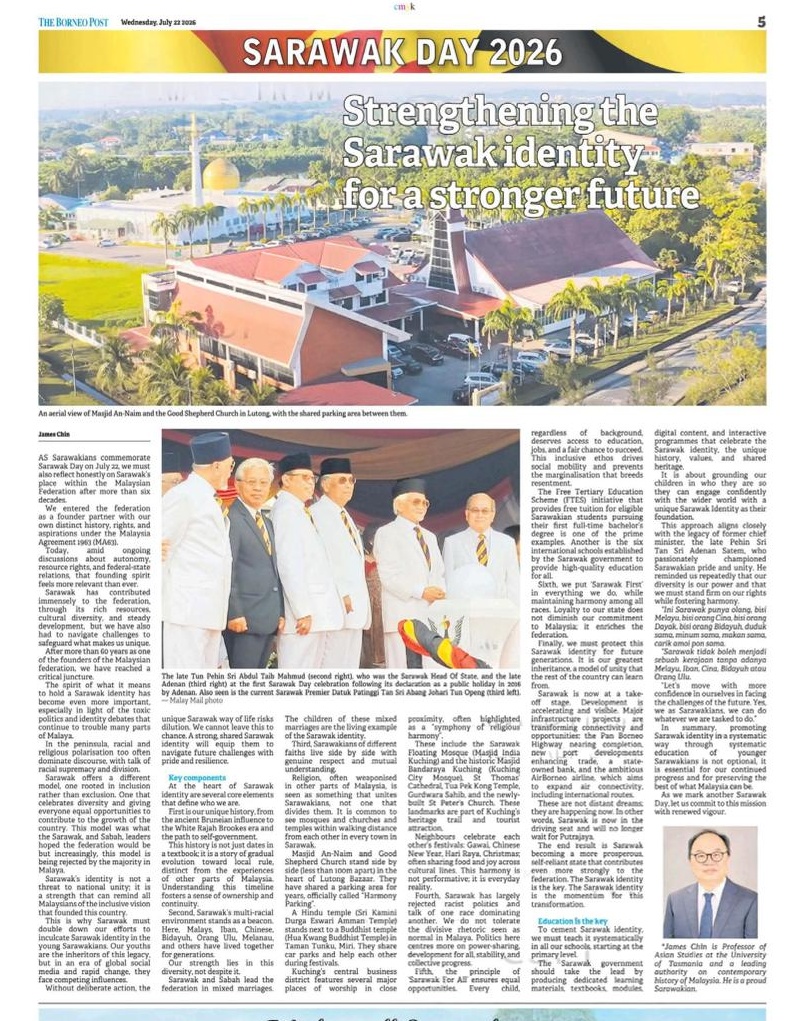
AS Sarawakians commemorate Sarawak Day on July 22, we must also reflect honestly on Sarawak's place within the Malaysian Federation after more than six decades.
We entered the federation as a founder partner with our own distinct history, rights, and aspirations under the Malaysia Agreement 1963 (MA63).
Today, amid ongoing discussions about autonomy, resource rights, and federal-state relations, that founding spirit feels more relevant than ever.
Sarawak has contributed immensely to the federation, through its rich resources, cultural diversity, and steady development, but we have also had to navigate challenges to safeguard what makes us unique.
A er more than 60 years as one of the founders of the Malaysian federation, we have reached a critical juncture.
The spirit of what it means to hold a Sarawak identity has become even more important, especially in light of the toxic politics and iden-tity debates that continue to trouble many parts of Malaya.
In the peninsula, racial and religious polarisation too o en dominate discourse, with talk of racial supremacy and division.
Sarawak offers a different model, one rooted in inclusion rather than exclusion. One that celebrates diversity and giving everyone equal opportunities to contribute to the growth of the country. This model was what the Sarawak, and Sabah leaders hoped the federation would be but increasingly, this model is being rejected by the majority in Malaya.
Sarawak's identity is not a threat to national unity; it is a strength that can remind all Malaysians of the inclusive vision that founded this country.
This is why Sarawak must double down on our efforts to inculcate Sarawak identity in the young Sarawakians. Our youths are the inherit-ors of this legacy, but in an era of global social media and rapid change, they face competing influences.
Without deliberate action, the unique Sarawak way of life risks dilution. We cannot leave this to chance. A strong, shared Sarawak iden-tity will equip them to navigate future challenges with pride and resilience.
At the heart of Sarawak identity are several core elements that define who we are.
First is our unique history, from the ancient Bruneian influence to the White Rajah Brookes era and the path to self-government. This history is not just dates in a textbook; it is a story of gradual evolution toward local rule, distinct from the experiences of other parts of Malaysia. Understanding this timeline fosters a sense of ownership and continuity.
Second, Sarawak's multi-racial environment stands as a beacon. Here, Malays, Iban, Chinese, Bidayuh, Orang Ulu, Melanau, and others have lived together for generations.
Our strength lies in this diversity, not despite it.
Sarawak and Sabah lead the federation in mixed marriages.
The children of these mixed marriages are the living example of the Sarawak identity.
Third, Sarawakians of different faiths live side by side with genuine respect and mutual understanding.
Religion, o en weaponised in other parts of Malaysia, is seen as something that unites Sarawakians, not one that divides them. It is corn-mon to see mosques and churches and temples within walking distance from each other in every town in Sarawak.
Masjid An-Nairn and Good Shepherd Church stand side by side (less than 100m apart) in the heart of Lutong Bazaar. They have shared a parking area for years, officially called "Harmony Parking".
A Hindu temple (Sri Kamini Durga Eswari Amman Temple) stands next to a Buddhist temple (Hua Kwang Buddhist Temple) in Taman Tunku, Miri. They share car parks and help each other during festivals.
Kuching's central business district features several major places of worship in close proximity, often highlighted as a "symphony of reli-gious harmony".
These include the Sarawak Floating Mosque (Masjid India Kuching) and the historic Masjid Bandaraya Kuching (Kuching City Mosque), St Thomas' Cathedral, Tua Pek Kong Temple, Gurdwara Sahib, and the newlybuilt St Peter's Church. These landmarks are part of Kuching's heritage trail and tourist attraction.
Neighbours celebrate each other's festivals: Gawai, Chinese New Year, Hari Raya, Christmas; o en sharing food and joy across cultural lines. This harmony is not performative; it is everyday reality.
Fourth, Sarawak has largely rejected racist politics and talk of one race dominating another. We do not tolerate the divisive rhetoric seen as normal in Malaya. Politics here centres more on power-sharing, development for all, stability, and collective progress.
Fifth, the principle of 'Sarawak For All' ensures equal opportunities. Every child, regardless of background, deserves access to education, jobs, and a fair chance to succeed. This inclusive ethos drives social mobility and prevents the marginalisation that breeds resentment. The Free Tertiary Education Scheme (FTES) initiative that provides free tuition for eligible Sarawakian students pursuing their first full-time bachelor's degree is one of the prime examples. Another is the six international schools established by the Sarawak government to provide high-quality education for all.
Sixth, we put 'Sarawak First' in everything we do, while maintaining harmony among all races. Loyalty to our state does not diminish our commitment to Malaysia; it enriches the federation.
Finally, we must protect this Sarawak identity for future generations. It is our greatest inheritance, a model of unity that the rest of the country can learn from.
Sarawak is now at a takeoff stage. Development is accelerating and visible. Major infrastructure projects are transforming connectivity and opportunities: the Pan Borneo Highway nearing completion; new port developments enhancing trade, a state-owned bank; and the ambitious AirBorneo airline, which aims to expand air connectivity, including international routes.
These are not distant dreams; they are happening now. In other words, Sarawak is now in the driving seat and will no longer wait for Putrajaya.
The end result is Sarawak becoming a more prosperous, self-reliant state that contributes even more strongly to the federation. The Sarawak identity is the key. The Sarawak identity is the momentum for this transformation.
To cement Sarawak identity, we must teach it systematically in all our schools, starting at the primary level.
The Sarawak government should take the lead by producing dedicated learning materials, textbooks, modules, digital content, and interactive programmes that celebrate the Sarawak identity, the unique history, values, and shared heritage.
It is about grounding our children in who they are so they can engage confidently with the wider world with a unique Sarawak Identity as their foundation.
This approach aligns closely with the legacy of former chief minister, the late Pehin Sri Tan Sri Adenan Satem, who passionately cham-pioned Sarawakian pride and unity. He reminded us repeatedly that our diversity is our power and that we must stand firm on our rights while fostering harmony.
"Ini Sarawak punya olang, bisi Melayu, bisi orang Cina, bisi orang Dayak, bisi orang Bidayuh, duduk sama, minum sama, makan sama, carik amoi pon sama.
"Sarawak tidak boleh menjadi sebuah kerajaan tanpa adanya Melayu, Iban, Cina, Bidayuh atau Orang Ulu.
"Let's move with more confidence in ourselves in facing the challenges of the future. Yes, we as Sarawakians, we can do whatever we are tasked to do."
In summary, promoting Sarawak identity in a systematic way through systematic education of younger Sarawakians is not optional; it is essential for our continued progress and for preserving the best of what Malaysia can be.
As we mark another Sarawak Day, let us commit to this mission with renewed vigour.
#SarawakDay #Sarawak #722
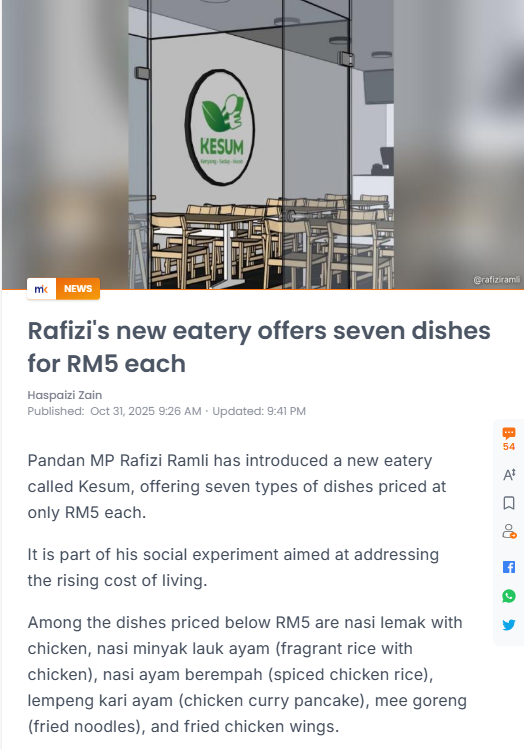
I wish more MPs were like RR. They accomplish things that truly benefit the public and could be scaled up widely.
RR isn't a minister anymore, but it's evident he can still lead effectively as an ordinary MP.
It's crucial for MPs and ADUNs, beyond just raising concerns in parliament, to make a positive impact in their communities. Most adopt the mindset that donating funds to local groups counts as sufficient good work. Sadly, that's the easy, lazy approach to community work.
#Malaysia #RafiziRamli #politics
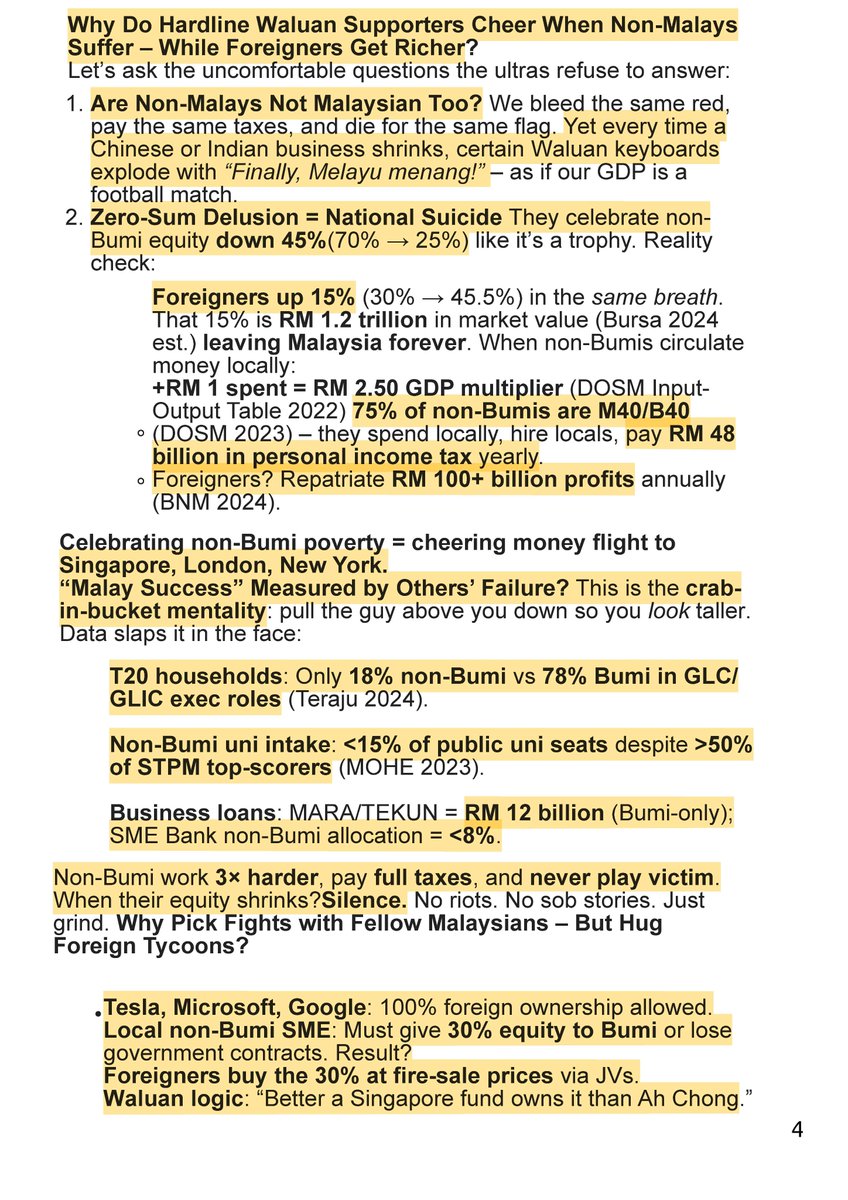
😭😿Please read carefully—this is only four pages long.
It argues that right-wing Malay forces in Malaysia would rather let the country's wealth fall into foreign hands than into non-Bumi (read: Chinese) hands. This speaks volumes about their hatred for the Malaysian Chinese. They stay silent when wealth slips into foreign control because many foreign companies can legally bypass the Bumi quota.
We shouldn't be shocked that this is happening.
What's truly shocking is how long Malay nationalists have kept quiet about it. Deep down, they agree with right-wing Malay forces like PAS that the Chinese and other non-Bumis are more dangerous than foreigners—and they don't mind if foreigners soon own the majority of Malaysia's corporate wealth.
That would take us right back to the pre-1957 colonial era, when the economy was mostly in foreign (British) hands. What is even crazier now is that many of these foreign money come via Singapore, and the right wing hates Singapore.
This is the depth of the right-wing Malay groups' hatred for the Malaysian Chinese.
Read it carefully and decide for yourself. While I disagree with some of the figures presented here, I fully agree with the core argument: right-wing Malay forces would rather see foreigners scoop up corporate wealth while letting Chinese corporate holdings crumble. They simply cannot accept the Chinese as full citizens. I hope you'll share this widely to make it go viral. Credit goes to The Coverage.
#Malaysia #Hate #Chinese #Malay #NewEconomicPolicy #Wealth #EthnicPolitics
888 ✨ MANIFEST ✨888
MAY AUGUST BE YOUR MOST PROSPEROUS MONTH EVER. MAKING MORE MONEY THAN EVER BEFORE, FINDING GREATER SUCCESS THAN EVER BEFORE, AND ELEVATING YOURSELF TO HIGHER HEIGHTS THAN EVER BEFORE.
RT TO CLAIM