In times of financial uncertainty, SaaS and tech companies face a stark reality: it's no longer about rapid growth at any cost.
Now, it's about sustainable, responsible, and profitable growth.
Budgets are shrinking, ROI scrutiny is rising, and long-term commitments are giving way to short-term strategies.
So how can your content marketing strategy not just survive, but thrive in this new economic cycle?
Minuttia's team achieved great results for one of our clients, a community-led website with a 2-sided marketplace in the works. This isn't a SaaS website in a traditional B2B category (e.g., email marketing) but a website targeting a B2C audience interested in niche topics.
Here's what Minuttia's team did:
*Caveats*
1) The website's domain rating (DR), as measured by Ahrefs, is 1. This means no other websites or publications are linking to or mentioning our client's website. That's a handicap for organic growth but not something Minuttia's team can't overcome.
2) There's no brand footprint online, as this new brand was in stealth mode until a few months ago. This means that everything needs to be built from the ground up, and our team had to work with the fact that the brand is unknown and has no established authority in its niche.
*What went in*
1) One of the first things Minuttia's team did was identify the relevant topics and sub-topics, map those topics to specific URLs, and develop critical page elements such as the URL structure.
2) Work on schema markup, which is generally a great way to establish communication avenues between the website and the search engine crawlers, especially if your brand isn't well-known.
3) Establish the website's technical foundation and ensure that essential processes such as indexation and crawlability run smoothly as the website grows quickly through database-based pages.
4) Create content briefs for our client's writers and ensure the quality and uniqueness of the content we publish. So far, only 41 pieces of content have been published on the website's blog.
*What came out*
1) The 41 pieces of content published on the website's blog bring in >200 organic clicks per day, while Minuttia's total contribution (since this is a website we built from scratch) is ~350 organic clicks on weekdays.
2) Visibility through >4.2K organic keywords, many of which are in high enough positions to bring in organic clicks. The total number of organic impressions (to date) is >558K, and that's just from the 41 content pieces published on the website's blog.
I don't have a doubt that other channels (e.g., paid social) could work well for acquiring cheap (yet relevant) traffic, which you can then a) turn into newsletter subscribers (which is the main objective of the website as it stands) or b) retarget through paid social or search. After all, that's something we do very well at Minuttia, starting from our own projects, such as GrowthWaves, where we unlocked consistent subscriber acquisition while maintaining low overall CPAs.
However, the problem with these channels (for a project like this) is that once you shut them down, results instantly stop. The same isn't true for organic search, and thus, depending on many different factors, organic search may be your best bet, even at an earlier stage.
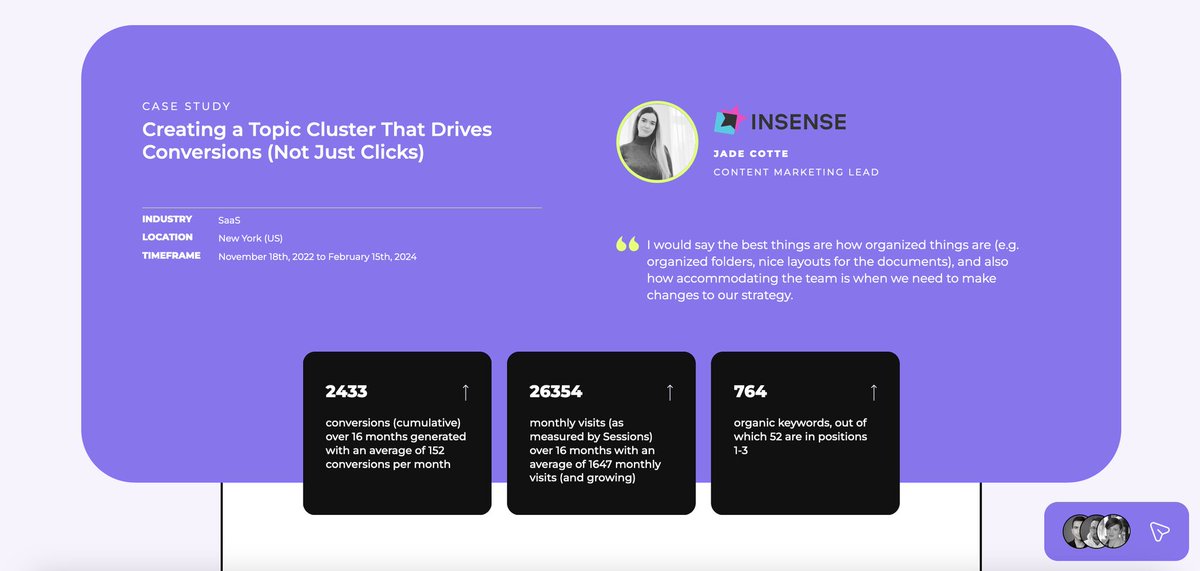
The topic cluster accounts for 28,369 of the content inventory’s total traffic (as measured by clicks) and 2,433 of its total number of conversions (cumulative).
It brings in 2364 visits and 152 conversions on average every month.
Learn more ➡ https://t.co/t7fwfy6wGq
Within 14 months, we helped Insense build a topic cluster for the topic ‘user-generated content’ that’s tightly connected to the product’s capabilities.
Our team provided an end-to-end service from redirect and consolidation strategy to building a topical map, content briefing, content creation, and offering suggestions on the design of the hub and the cluster pages.
#Desings of the month.
Building a newsletter without branded designs?
Good luck.
We've crafted aesthetic designs using the branded elements of GrowthWaves to appeal to our audience and convey the message in the best way.
Check our creative work on dribbble. 👇
Insiders call it a “staccato type of email,” which “fosters the crystallization of priority and thought.”
Interesting to learn more about Nvidia's approach to writing and how to apply these frameworks in content creation.
Then read our recent blog: https://t.co/U6dvqOqv4Q
As @nvidia employees shared in the @BusinessInsider article, emails usually list the top five things—so-called work priorities.
According to them, work emails must possess the following characteristics:
- Concision
- No more than 5-6 lines
- Double-space
- One sentence per line
What can we learn about content creation from the CEO of a trillion-dollar company?
And what's the correlation with ransom notes?
In the upcoming piece on Minuttia's blog, we'll discuss everything.
And we'll expand on applying these learnings in the content creation process.
Google released AI Overviews a few days ago, and we started running performance tests for our clients.
The screenshot is an example of a client with 39 published content pieces.
As you can see:
- Only 5 (or ~13%) of all queries trigger an AI Overview;
- Our domain is included (as a source) in 0 (or ~0%) AI Overviews;
- While we have visibility in the top 10 of the search results in ~51% of the cases.
A few important considerations:
1) AI Overviews are volatile, and the presence of the feature comes and goes, possibly due to testing and user experience signals;
2) This means that you have to monitor the search feature on a weekly (for important queries) or bi-weekly cadence (for secondary queries);
3) Being in the top 10 doesn't seem to correlate with getting into the AI Overview, as in our example, 20 pages make it to the top of the search results page but have no presence in the AI Overview;
4) We haven't noticed significant % differences in the amount or quality of traffic coming from queries that trigger AI Overviews;
5) It's still too early to reach conclusions about the impact of AI Overviews on the traffic and the amount or quality of traffic websites are receiving;
6) One of our team's objectives is to increase our presence in AI Overviews in a similar way we'd optimize for a featured snippet;
7) A secondary objective is to identify patterns between a keyword and topic level.
We'll keep updating you with findings from our team's research.
It’s 4:50 on Friday, and you're dreaming of the weekend. Then your boss emails: “Just checked GA4. Our bounce rate is unusually high. How can we fix that?'
The best marketers do two things when building a strategy. They use data to inform their decisions. But they also use their gut feeling, as if they are skipping unnecessary steps to reach a conclusion faster.
For today’s breakdown, we have none other than @hotjar.
We can discuss for hours the whopping number of 92 DR or the organic traffic.
But in the end, numbers are numbers.
Let's, dive deeper into:
- The tactics
- And their unique approach
That brought them to the top.