📰 Cha Eunwoo: Is It Right to Criticize Him Even After Paying 13B Won and Filing a Tax Appeal? Exercising a Basic Constitutional Right No One Can Criticize
“•Paying 13B Won in Advance: Diligent Fulfillment Without Moral Hazard
Under tax law, appealing an assessment does not automatically stay the obligation to pay taxes. If one disputes an assessment without paying on time, late payment penalties accumulate daily at a rate of 8 to 9% per year. For a major tax case worth 13B won, late payment penalties alone would amount to millions of won a day, accumulating to nearly 1B won per year in financial costs.
CHA EUNWOO fully paid the 13B won assessment without default prior to entering the legal dispute. By doing so, he completed his tax obligations without placing a burden on state finances, while directly proving through financial execution that there was no intent to evade or hold out on taxes.
In short, he chose to respect the tax authority's assessment by completing his social and legal obligations first, and only then disputing any unfair aspects. Criticizing this as moral avoidance borders on the error of denying a taxpayer's basic constitutional rights under tax law.
•The Mechanism of Tax Appeals and Administrative Lawsuits
The legal procedures taken when a corporation or high-net-worth individual disputes a tax assessment by the National Tax Service are largely divided into two stages: a tax tribunal appeal and an administrative lawsuit. Within 90 days after receiving the tax assessment notice from the NTS, Stage 1 involves filing an appeal with the Tax Tribunal; if unsatisfied with the result, it moves to Stage 2, which is an administrative lawsuit in court.
Stage 1: Tax Tribunal Procedure
This system involves specialized reviews of whether a tax assessment was illegal or unfair by the Tax Tribunal under the Prime Minister's Office—an independent third-party agency, not the NTS itself. An appeal must be filed within 90 days of receiving the tax bill, offering an opportunity to correct errors quickly within the administration before going to litigation. If the tribunal accepts the taxpayer's claim, the relevant amount out of the prepaid 13B won is refunded immediately, along with statutory refund interest.
Stage 2: Administrative Lawsuit
If the taxpayer still disputes the decision of the Tax Tribunal, this final step involves filing a lawsuit to cancel the tax assessment with the Administrative Court, part of the judiciary branch. It proceeds through a three-tier court system (District Court, High Court, and Supreme Court), where legal experts and the judiciary rigorously debate complex legal interpretations and the application of the principle of substance over form.
•Gray Zones in the Entertainment Industry and Procedural Legitimacy
In particular, one-person agencies and income distribution structures within the entertainment industry represent a typical gray zone under tax law where perspectives between tax authorities and taxpayers diverge most sharply. Matters such as the scope of actual service provision, corporate entity recognition, and potential double taxation lack clear guidelines, requiring high-level legal interpretation.
Disputing whether the tax base calculation was excessive or if any portions were unfairly taxed due to legal interpretation is a natural right guaranteed to taxpayers under tax law and the Constitution.
The fulfillment of duty and legal clarification must be strictly separated. Because state agencies that collect taxes cannot be perfect, the law puts safeguards like tax tribunals and administrative lawsuits in place to prevent unfair taxation. No one has the right to cast stones at a taxpayer who has fulfilled their obligations and seeks to avoid unfairness through legitimate procedures established by law. The actions of #CHAEUNWOO are not tax delinquency or tax avoidance, but the most diligent and legitimate exercise of rights available to a taxpayer in a rule-of-law state”
[🍿] How to support The WONDERfools during its Netflix premiere and help boost its ranking worldwide:
1- Watch immediately when it drops. The faster people start watching, the faster it can rise.
2- The first minutes matter. Netflix tracks whether viewers keep watching early on, so episode 1 needs strong support — don’t drop it after 5 minutes.
3- Try to join global watch times. Coordinated viewing helps increase impact across multiple countries at the same time.
4- Finish full episodes. Netflix tracks completion rate and watch time, so watching all the way through matters a lot.
5- Rewatching helps too. It increases total watch time and signals that the show is engaging. Even replaying episodes in the background after you’ve already watched them can make a difference.
6- Don’t forget the small actions: leave a 👍 and add it to your list. These signals help push the drama into recommendations for more users.
7- Don’t stay silent during premiere day. Tweet, post, make edits and talk about #TheWONDERfools #원더풀스 as much as possible in the first 24 hours to help boost visibility and attract new viewers.
8- Search for “The WONDERfools” instead of only clicking on it directly. Direct searches show strong interest and can help visibility on the platform.
9- Global engagement is key. Netflix Top 10 rankings work by country, so the more countries watching at the same time, the higher the chances of the drama going viral worldwide.
#원더풀스 #박은빈 #ParkEunbin #차은우 #ChaEunwoo #김해숙 #최대훈 #임성재 #손현주 #김해숙 #배나라
At long last, we finally have official confirmation that the highly anticipated superhero K-drama THE WONDERFOOLS starring Cha Eun Woo and Park Eun Bin is coming to Netflix on May 15, 2026.
🔗https://t.co/QT5OLLHUEG
Chaos in town and scoring superpowers were definitely not in the cards for this group of loveable misfits. Will they end up saving the day? Catch Park Eun-bin and Cha Eun-woo in The WONDERfools is coming May 15, only on Netflix.
#TheWONDERFools#원더풀스#ParkEunbin#ChaEunwoo #ChoiDaehoon #ImSeongjae
📄 𝗡𝗢𝗧 𝗧𝗔𝗫 𝗘𝗩𝗔𝗦𝗜𝗢𝗡: 𝗪𝗛𝗔𝗧 𝗔𝗖𝗧𝗨𝗔𝗟𝗟𝗬 𝗛𝗔𝗣𝗣𝗘𝗡𝗘𝗗
Cha Eunwoo fully paid the taxes notified by the National Tax Service. Some interpreted this as an admission of tax evasion, but that conclusion is not supported by how the tax system works. In practice, taxpayers may pay first to prevent additional penalties while continuing to dispute the assessment through legal procedures. Full payment does not equal admission of wrongdoing.
A key fact is that the 40% penalty for fraudulent under-reporting was not applied. Instead, a 10% general under-reporting penalty was used, which applies to administrative issues or differences in legal interpretation, not intentional tax evasion. Penalties are calculated through a combination of reporting penalties and late payment interest, not a single fixed rate. Claims equating the total to a “40% fraud penalty” misunderstand this structure.
The issue centers on tax classification. Income initially reported under a corporate structure was later reclassified as personal income, which carries a higher tax rate and explains most of the additional amount. As a result, the final confirmed additional tax is approximately 13 billion won, not 20 billion, since the higher figure ignores the refund of previously paid taxes and misrepresents the actual net burden.
Claims of “delayed payment” are misleading because taxes can only be paid after an official notice is issued with a confirmed amount, and paying immediately after receiving that notice is standard procedure. Tax disputes also involve multiple stages, and taxpayers have the right to challenge assessments through review and appeal processes. Paying upon notification is often a strategic decision to stop further penalties while continuing legal action, and further appeals remain possible in this case.
A major misunderstanding is the assumption that a large number automatically implies a crime. The 13 billion won reflects a tax rate difference caused by reclassification, not concealed income, and the absence of the 40% fraud penalty confirms that this is not a case of intentional tax evasion. The “20 billion tax evasion” narrative is misleading because it excludes the refund process and lacks proper context.
• There was no intentional concealment of taxes, and the fraud penalty was not applied.
• Payment was made immediately after the official notice, following standard procedure.
• The final additional tax is approximately 13 billion won after adjustments, not 20 billion.
#CHAEUNWOO fulfilled his obligations within the legal framework and exercised his rights through legitimate procedures.
#차은우 #チャウヌ #车银优 #ชาอึนอู #車銀優
📰 Cha Eunwoo’s actions were a reasonable defense, not a deceptive tactic, aimed at preventing additional penalties
On the 9th, lawyer and accountant Kim Myung-gyu posted on his social media a ‘Kind Explanatory Version for Non-Experts: Cha Eunwoo Edition’.
He stated, “Reports claim that he paid 13 billion won rather than 20 billion won in taxes, and public opinion is negative regarding why the payment is only being made now. (If the factual details regarding the amount are correct), this is not technically ‘tax,’ but a 13 billion won tax assessment (additional levy). This is not a late payment, but rather the execution of payment according to proper procedural timing.”
He continued, “It is not that he failed to pay during this time, but that he could not. #CHAEUNWOO was undergoing a pre-assessment review procedure with the National Tax Service. This is a process in which the taxpayer requests a review of the legality of the assessment before official taxation (issuance of a tax notice).”
He added, “Until this review is completed, no formal tax notice is issued. After the recently requested pre-assessment review was completed, the tax assessment was finalized, and he simply made payment according to the official notice issued thereafter.”
Kim explained, “If payment is not made after receiving the official notice, a late payment penalty of 0.022% per day (approximately 8% annually) is applied. If the 13 billion won is an assessed tax, the principal tax would likely be around 6.5 to 9 billion won. Roughly estimated at 7.5 billion won, about 600 million won in penalties would accrue each year.”
He further emphasized, “In tax disputes, the standard procedure is to first pay the full assessed amount to prevent additional penalties from accumulating, and then proceed with a challenge through the Tax Tribunal or administrative litigation. This is not a deceptive tactic unique to Cha Eunwoo; it is a standard and reasonable defense procedure used in corporate and individual tax disputes.”
#차은우 #チャウヌ #车银优 #ชาอึนอู #車銀優
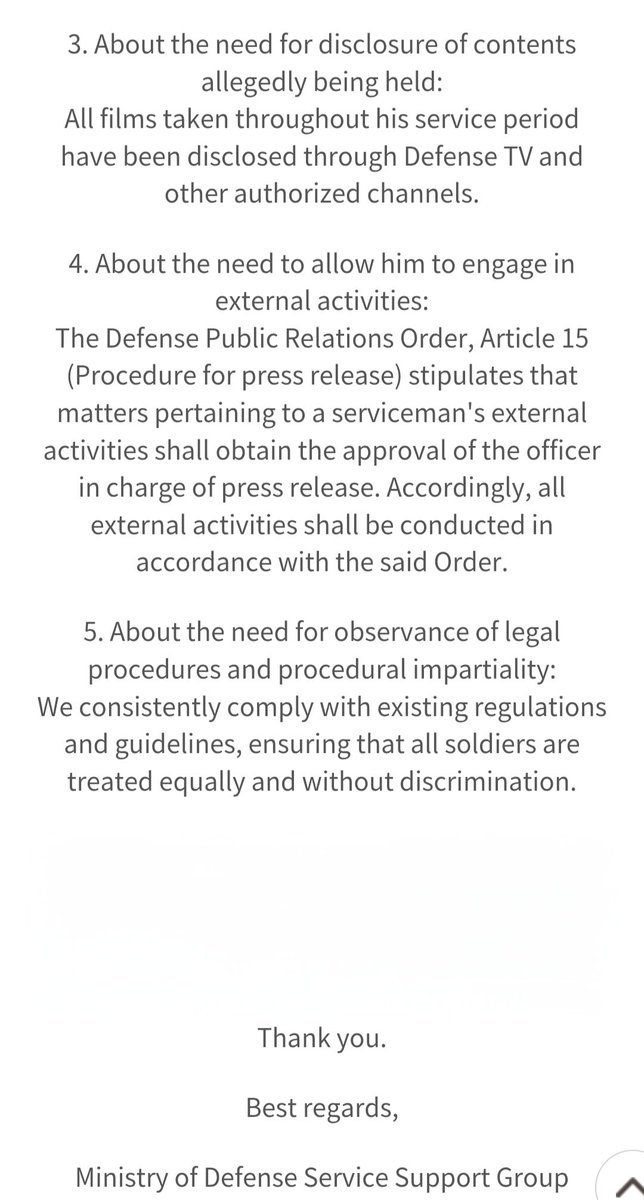
📢 [IMPORTANT] Petition Update: Response from the Ministry of National Defense (MND):
“Please be informed that your petition submitted through e-People has been referred to us for our reply. Your petition is found to be a request for protection of #CHAEUNWOO.
1. About the need for observance of the principle of presumption of innocence:
No official legal step has been taken against him, and he will not be subject to any disadvantage, such as a change of assignment.
2. About the need to respect his rights and treat him equally with other tax payers and servicemen:
We make every effort to avoid any discrimination against him and ensure that he performs his duties just like his fellow servicemen.
3. About the need for disclosure of contents allegedly being held:
All films taken throughout his service period have been disclosed through Defense TV and other authorized channels.
4. About the need to allow him to engage in external activities:
The Defense Public Relations Order, Article 15 (Procedure for press release) stipulates that matters pertaining to a serviceman's external activities shall obtain the approval of the officer in charge of press release. Accordingly, all external activities shall be conducted in accordance with the said Order.
5. About the need for observance of legal procedures and procedural impartiality:
We consistently comply with existing regulations and guidelines, ensuring that all soldiers are treated equally and without discrimination.
We wish you continued good health and happiness.
Thank you.
Best regards,
Ministry of Defense Service Support Group”
#차은우 #チャウヌ #车银优 #ชาอึนอู #車銀優
📢 IMPORTANT Petition Update
We share below a response received from The Ministry of National Defense (MND) for a petition forwarded through epeople.
#chaeunwoo#채은우@CHAEUNWOO_offcl
The truth, laid out clearly 🧵
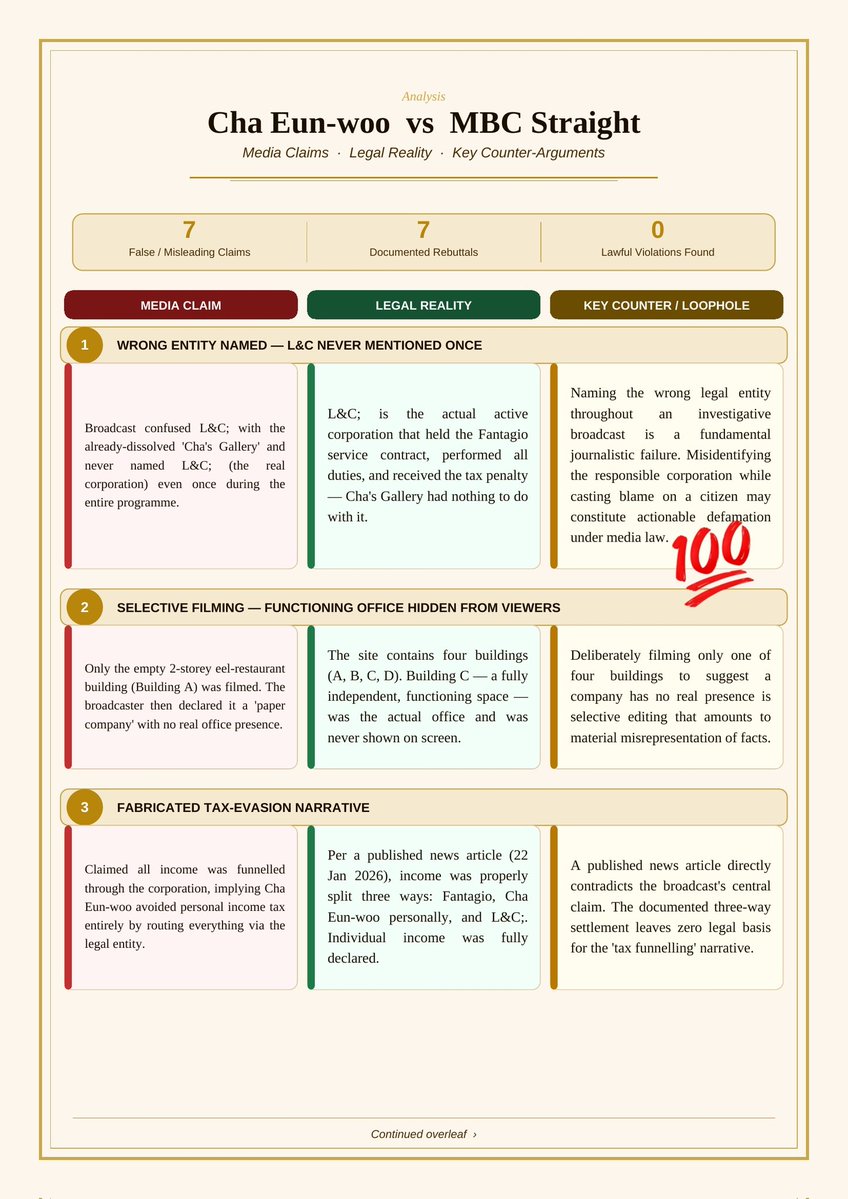
A full breakdown of the 7 misleading claims made by MBC Straight — with documented legal realities and counter-arguments for each.
Huge respect to the DC Gallery K fans who painstakingly compiled and fact-checked every single point. Facts matter💯
Official Statement: Refuting MBC "Straight’s" Misleading Report
This statement serves to refute the irresponsible and misleading information presented by MBC’s investigative program "@MBCstraight" (스트레이트) concerning #CHAEUNWOO’s tax assessment case.
The report in question contains several inaccuracies that distort the reality of the situation. Following a thorough fact-check of the available data, we present the following seven points to correct the record and expose the manipulation of facts, omissions, and deceptive editing present in the broadcast.
[Fact Check: 7 Points of Fabrication and Manipulation]
1. Intentional Misidentification of Target Entities and Concealment of L&C (엘엔씨)
—The Claim: The broadcast implied the entity under investigation was "Cha’s Gallery" (차스갤러리), now known as "The Ani" (디애니).
—The Fact: The actual agency that performed legitimate management services and received the tax assessment is "L&C" (엘엔씨). MBC staged a scene visiting "The Ani" (디애니) representatives while completely concealing the name "L&C" (엘엔씨) throughout the entire broadcast. "Cha’s Gallery" (차스갤러리) is a previous entity that has long since been dissolved.
2. Deceptive Portrayal of Office Premises (The "Eel Restaurant" Frame)
—The Claim: MBC showed a 2-story eel restaurant (Building A), claiming it was a "paper company" with no office presence.
—The Fact: The site consists of four separate buildings (A, B, C, and D). While Building A is a restaurant, Building C is a fully independent, functional office space used by the agency. MBC intentionally hid the existence of Building C to push a "ghost company" narrative.
3. Fabrication of Revenue Settlement and Tax Evasion Claims
—The Claim: CHA EUNWOO bypassed personal taxes by receiving all settlement money through a one-person agency.
—The Fact: As documented in reports (Jan 22, 2026), revenue was strictly divided among three parties: FANTAGIO, CHA EUNWOO individually, and the corporation "L&C". It was not funneled exclusively into a corporation to evade taxes.
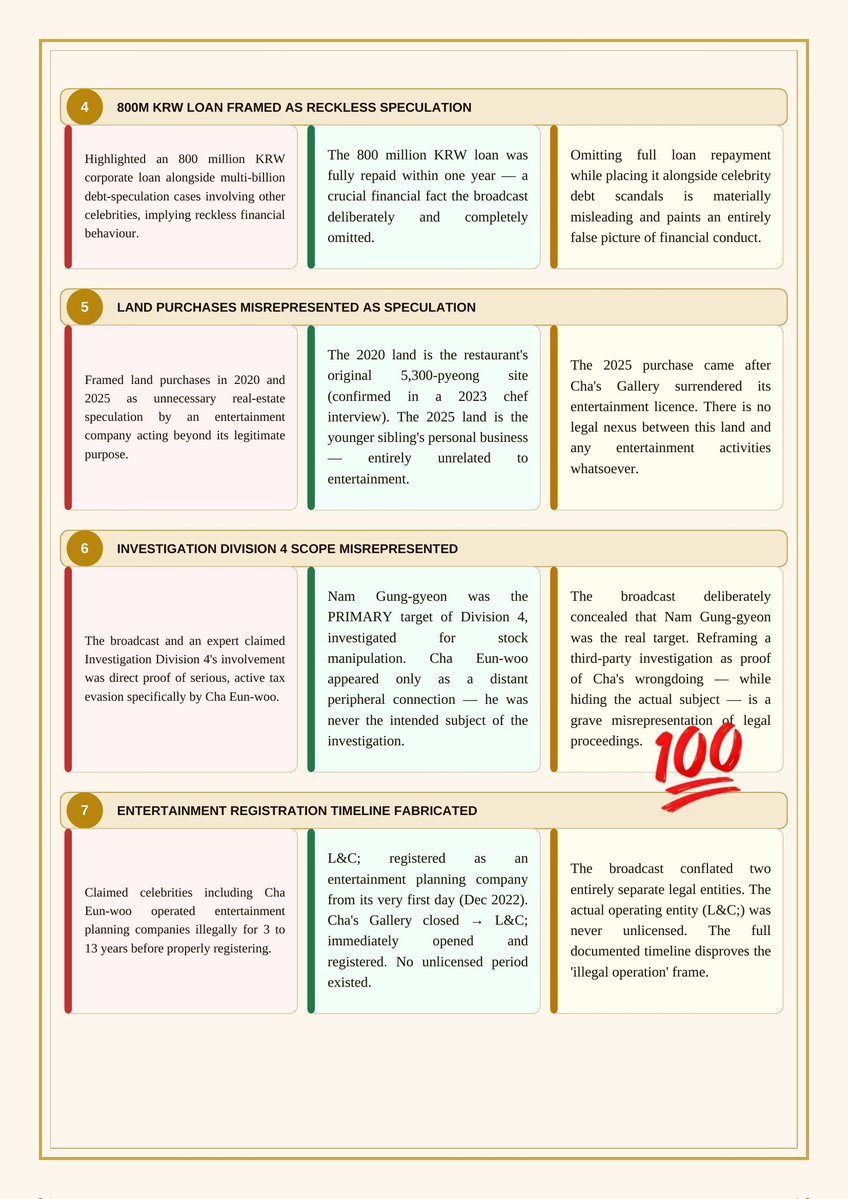
4. Malicious "800 Million KRW Loan" Frame and Omission of Repayment
—The Claim: Highlighting an 800 million KRW loan under the corporate name to frame it as speculative real estate investment.
—The Fact: MBC omitted the crucial fact that this entire loan was fully repaid within just one year, distinguishing it from cases of speculative profit-seeking.
5. Distortion of Real Estate Purpose and Brother’s Business
—The Claim: The agency purchased unnecessarily large plots of land (5,300 pyeong) for speculation.
—The Fact: The site was already an established large-scale restaurant facility long before the purchase. Furthermore, the 2025 land acquisition is related to his brother��s personal business, not CHA EUNWOO’s entertainment activities. This purchase occurred after "Cha’s Gallery" had already returned its Culture and Arts Planning Business license in 2022.
6. Concealing the True Context of "Investigation Bureau 4"
—The Claim: The deployment of the 4th Investigation Bureau proves "aggressive tax evasion."
—The Fact: The investigation actually began with Namgoong Kyun, Chairman of Mirae I&G, and stock manipulation allegations involving @fantagiogroup. CHA EUNWOO’s entity was swept into the investigation as a secondary "link" because of transactions with Fantagio, not because he was the primary target.
7. Fabrication of the Registration Timeline
—The Claim: The agency operated illegally for years before registering.
—The Fact: MBC conflated the timeline of the dissolved entity with the active one. "L&C" was legally registered for Culture and Arts Planning almost immediately upon its establishment in late 2022:
- June 15, 2022: Cha's Gallery registers.
- Oct 24, 2022: L&C is established.
- Oct 31, 2022: Cha's Gallery closes and returns license.
- Dec 2, 2022: L&C officially registers its license.
Source: Cha Eunwoo’s Korean fan community research, via 누누 DC Gallery.
K-fans are working carefully and responsibly, and as international fans, our role is to give thoughtful and respectful support in every way we can.
Before any official conclusion has been reached, some headlines are already using definitive labels. A pre-tax review is not a verdict — it is part of a legal process.
Presumption of innocence is a fundamental principle in any fair system. No one should be publicly branded before a final determination is made.
Cha Eun-woo has contributed greatly to South Korea’s cultural influence and global image. Turning an unresolved administrative matter into political spectacle risks harming not only an individual, but the integrity of public discourse.
Here is what we need to do:
First, email the lawmaker's office directly at [email protected]
Second, email the following institutions to report this as a human rights violation and a threat to Korea's national brand:
Ministry of Culture: [email protected] and [email protected]
National Human Rights Commission: [email protected]
Ruling Party: [email protected]
Anti-Corruption and Civil Rights Commission: [email protected]
Third, file a government petition at https://t.co/c0oUcYa4EG This action matters most because it leaves a permanent legal trace. The portal is available in English, making it accessible worldwide.
Always mention your country. Let them see that this isn’t local noise — it’s global attention.
Let’s support Eunwoo.
📰 Korea Taxpayers’ Association: Tax Official Bonus System Causes Administrative Distortion… ‘It Must Be Abolished’
The KTA stated that the system, introduced last March under the amended Framework Act on National Taxes, which allows tax officials to receive bonuses of up to 20M KRW per year, causes serious administrative distortions and must be abolished.
Article 84-3 of the Framework Act on National Taxes stipulates that “tax officials who have made special contributions to the assessment, collection, or litigation of national taxes may receive a reward,” and allows a bonus of up to 20M KRW or 10% of the additional taxes collected, amounts recovered through litigation, or delinquent collections.
The KTA expressed concern that this bonus system could undermine the fairness and objectivity of taxation. The association said, “Directly linking financial rewards to the performance of tax officials creates incentives for excessive taxation or aggressive audits in order to increase collection results.” They explained that “this poses a risk to the neutrality of tax administration”.
The association also argued that tax audits could instead encourage tax evasion: “In a system where collection results lead to bonuses, a strategy of ‘occasional evasion with partial collection’ may be a rational choice over ‘100% honest reporting,’” because even those who report honestly may have to pay additional taxes for the benefit of the investigating officials. “This can weaken the foundation of voluntary compliance”.
This, they said, also violates the principle of popular sovereignty. KTA emphasized, “Public officials serve all citizens,” adding that “the bonus system risks reducing taxpayers to mere tools for achieving audit targets”.
They further noted that the structure encourages after-the-fact collection rather than preventive measures. They explained, “Pre-audit guidance for honest reporting is not eligible for incentives, but high-value collections are immediately rewarded. In such cases, tax administration may become performance-driven rather than prevention-focused”.
KTA also questioned the actual revenue impact. “Even if the collected amount is later overturned in appeals or litigation, the bonus may already have been paid. Officials who lose in court years later face no real consequences, while taxpayers bear enormous time and financial costs, along with significant psychological stress”.
The association stated that the system is also inconsistent with international trends. “In the US, evaluation based on collection results or quota assignments is legally prohibited, and Sweden excludes collection performance from personnel evaluations,” the association explained. “By contrast, Korea institutionalized a performance-based reward system.”
They raised the possibility of abuse. “A bonus of up to 20M KRW is a significant financial incentive, which may lead to side effects such as the illegal leakage of tax information or excessive expansion of audit scope”.
Specifically regarding actor #CHAEUNWOO, the association commented, “The tax official who illegally leaked Cha Eunwoo’s tax information may have aimed for the bonus, expecting positive evaluation within the organization based on the apparent achievement of ‘20 billion KRW collected’ and the negative public opinion generated around high-income tax evasion”. They added, “Leaking tax information is clearly illegal, and a performance-driven system can encourage such deviations”.
Chairman Kim Seontaek said, “The Framework Act on National Taxes was hastily passed last March during the impeachment political crisis, and no lawmakers raised objections to this provision, indicating that the legislative function did not operate properly”. He continued, “High tax collections by the NTS do not necessarily represent socially desirable outcomes,” and concluded, “The bonus system must be abolished immediately”.
#차은우 #チャウヌ #车银优 #ชาอึนอู #車銀優




![ChaEunwooINTL's tweet photo. 📢 [IMPORTANT] Petition Update: Response from the Ministry of National Defense (MND):
“Please be informed that your petition submitted through e-People has been referred to us for our reply. Your petition is found to be a request for protection of #CHAEUNWOO.
1. About the need for observance of the principle of presumption of innocence:
No official legal step has been taken against him, and he will not be subject to any disadvantage, such as a change of assignment.
2. About the need to respect his rights and treat him equally with other tax payers and servicemen:
We make every effort to avoid any discrimination against him and ensure that he performs his duties just like his fellow servicemen.
3. About the need for disclosure of contents allegedly being held:
All films taken throughout his service period have been disclosed through Defense TV and other authorized channels.
4. About the need to allow him to engage in external activities:
The Defense Public Relations Order, Article 15 (Procedure for press release) stipulates that matters pertaining to a serviceman's external activities shall obtain the approval of the officer in charge of press release. Accordingly, all external activities shall be conducted in accordance with the said Order.
5. About the need for observance of legal procedures and procedural impartiality:
We consistently comply with existing regulations and guidelines, ensuring that all soldiers are treated equally and without discrimination.
We wish you continued good health and happiness.
Thank you.
Best regards,
Ministry of Defense Service Support Group”
#차은우 #チャウヌ #车银优 #ชาอึนอู #車銀優](https://pbs.twimg.com/media/HFTi39raIAAVtIh.jpg)


![ChaEunwooINTL's tweet photo. Official Statement: Refuting MBC "Straight’s" Misleading Report
This statement serves to refute the irresponsible and misleading information presented by MBC’s investigative program "@MBCstraight" (스트레이트) concerning #CHAEUNWOO’s tax assessment case.
The report in question contains several inaccuracies that distort the reality of the situation. Following a thorough fact-check of the available data, we present the following seven points to correct the record and expose the manipulation of facts, omissions, and deceptive editing present in the broadcast.
[Fact Check: 7 Points of Fabrication and Manipulation]
1. Intentional Misidentification of Target Entities and Concealment of L&C (엘엔씨)
—The Claim: The broadcast implied the entity under investigation was "Cha’s Gallery" (차스갤러리), now known as "The Ani" (디애니).
—The Fact: The actual agency that performed legitimate management services and received the tax assessment is "L&C" (엘엔씨). MBC staged a scene visiting "The Ani" (디애니) representatives while completely concealing the name "L&C" (엘엔씨) throughout the entire broadcast. "Cha’s Gallery" (차스갤러리) is a previous entity that has long since been dissolved.
2. Deceptive Portrayal of Office Premises (The "Eel Restaurant" Frame)
—The Claim: MBC showed a 2-story eel restaurant (Building A), claiming it was a "paper company" with no office presence.
—The Fact: The site consists of four separate buildings (A, B, C, and D). While Building A is a restaurant, Building C is a fully independent, functional office space used by the agency. MBC intentionally hid the existence of Building C to push a "ghost company" narrative.
3. Fabrication of Revenue Settlement and Tax Evasion Claims
—The Claim: CHA EUNWOO bypassed personal taxes by receiving all settlement money through a one-person agency.
—The Fact: As documented in reports (Jan 22, 2026), revenue was strictly divided among three parties: FANTAGIO, CHA EUNWOO individually, and the corporation "L&C". It was not funneled exclusively into a corporation to evade taxes.
4. Malicious "800 Million KRW Loan" Frame and Omission of Repayment
—The Claim: Highlighting an 800 million KRW loan under the corporate name to frame it as speculative real estate investment.
—The Fact: MBC omitted the crucial fact that this entire loan was fully repaid within just one year, distinguishing it from cases of speculative profit-seeking.
5. Distortion of Real Estate Purpose and Brother’s Business
—The Claim: The agency purchased unnecessarily large plots of land (5,300 pyeong) for speculation.
—The Fact: The site was already an established large-scale restaurant facility long before the purchase. Furthermore, the 2025 land acquisition is related to his brother��s personal business, not CHA EUNWOO’s entertainment activities. This purchase occurred after "Cha’s Gallery" had already returned its Culture and Arts Planning Business license in 2022.
6. Concealing the True Context of "Investigation Bureau 4"
—The Claim: The deployment of the 4th Investigation Bureau proves "aggressive tax evasion."
—The Fact: The investigation actually began with Namgoong Kyun, Chairman of Mirae I&G, and stock manipulation allegations involving @fantagiogroup. CHA EUNWOO’s entity was swept into the investigation as a secondary "link" because of transactions with Fantagio, not because he was the primary target.
7. Fabrication of the Registration Timeline
—The Claim: The agency operated illegally for years before registering.
—The Fact: MBC conflated the timeline of the dissolved entity with the active one. "L&C" was legally registered for Culture and Arts Planning almost immediately upon its establishment in late 2022:
- June 15, 2022: Cha's Gallery registers.
- Oct 24, 2022: L&C is established.
- Oct 31, 2022: Cha's Gallery closes and returns license.
- Dec 2, 2022: L&C officially registers its license.
Source: Cha Eunwoo’s Korean fan community research, via 누누 DC Gallery.](https://pbs.twimg.com/media/HC7FDPNaUAE0mFa.jpg)
![ChaEunwooINTL's tweet photo. Official Statement: Refuting MBC "Straight’s" Misleading Report
This statement serves to refute the irresponsible and misleading information presented by MBC’s investigative program "@MBCstraight" (스트레이트) concerning #CHAEUNWOO’s tax assessment case.
The report in question contains several inaccuracies that distort the reality of the situation. Following a thorough fact-check of the available data, we present the following seven points to correct the record and expose the manipulation of facts, omissions, and deceptive editing present in the broadcast.
[Fact Check: 7 Points of Fabrication and Manipulation]
1. Intentional Misidentification of Target Entities and Concealment of L&C (엘엔씨)
—The Claim: The broadcast implied the entity under investigation was "Cha’s Gallery" (차스갤러리), now known as "The Ani" (디애니).
—The Fact: The actual agency that performed legitimate management services and received the tax assessment is "L&C" (엘엔씨). MBC staged a scene visiting "The Ani" (디애니) representatives while completely concealing the name "L&C" (엘엔씨) throughout the entire broadcast. "Cha’s Gallery" (차스갤러리) is a previous entity that has long since been dissolved.
2. Deceptive Portrayal of Office Premises (The "Eel Restaurant" Frame)
—The Claim: MBC showed a 2-story eel restaurant (Building A), claiming it was a "paper company" with no office presence.
—The Fact: The site consists of four separate buildings (A, B, C, and D). While Building A is a restaurant, Building C is a fully independent, functional office space used by the agency. MBC intentionally hid the existence of Building C to push a "ghost company" narrative.
3. Fabrication of Revenue Settlement and Tax Evasion Claims
—The Claim: CHA EUNWOO bypassed personal taxes by receiving all settlement money through a one-person agency.
—The Fact: As documented in reports (Jan 22, 2026), revenue was strictly divided among three parties: FANTAGIO, CHA EUNWOO individually, and the corporation "L&C". It was not funneled exclusively into a corporation to evade taxes.
4. Malicious "800 Million KRW Loan" Frame and Omission of Repayment
—The Claim: Highlighting an 800 million KRW loan under the corporate name to frame it as speculative real estate investment.
—The Fact: MBC omitted the crucial fact that this entire loan was fully repaid within just one year, distinguishing it from cases of speculative profit-seeking.
5. Distortion of Real Estate Purpose and Brother’s Business
—The Claim: The agency purchased unnecessarily large plots of land (5,300 pyeong) for speculation.
—The Fact: The site was already an established large-scale restaurant facility long before the purchase. Furthermore, the 2025 land acquisition is related to his brother��s personal business, not CHA EUNWOO’s entertainment activities. This purchase occurred after "Cha’s Gallery" had already returned its Culture and Arts Planning Business license in 2022.
6. Concealing the True Context of "Investigation Bureau 4"
—The Claim: The deployment of the 4th Investigation Bureau proves "aggressive tax evasion."
—The Fact: The investigation actually began with Namgoong Kyun, Chairman of Mirae I&G, and stock manipulation allegations involving @fantagiogroup. CHA EUNWOO’s entity was swept into the investigation as a secondary "link" because of transactions with Fantagio, not because he was the primary target.
7. Fabrication of the Registration Timeline
—The Claim: The agency operated illegally for years before registering.
—The Fact: MBC conflated the timeline of the dissolved entity with the active one. "L&C" was legally registered for Culture and Arts Planning almost immediately upon its establishment in late 2022:
- June 15, 2022: Cha's Gallery registers.
- Oct 24, 2022: L&C is established.
- Oct 31, 2022: Cha's Gallery closes and returns license.
- Dec 2, 2022: L&C officially registers its license.
Source: Cha Eunwoo’s Korean fan community research, via 누누 DC Gallery.](https://pbs.twimg.com/media/HC7FDFFWoAA1N0v.jpg)






![TheWonderFools's tweet photo. [🍿] How to support The WONDERfools during its Netflix premiere and help boost its ranking worldwide:
1- Watch immediately when it drops. The faster people start watching, the faster it can rise.
2- The first minutes matter. Netflix tracks whether viewers keep watching early on, so episode 1 needs strong support — don’t drop it after 5 minutes.
3- Try to join global watch times. Coordinated viewing helps increase impact across multiple countries at the same time.
4- Finish full episodes. Netflix tracks completion rate and watch time, so watching all the way through matters a lot.
5- Rewatching helps too. It increases total watch time and signals that the show is engaging. Even replaying episodes in the background after you’ve already watched them can make a difference.
6- Don’t forget the small actions: leave a 👍 and add it to your list. These signals help push the drama into recommendations for more users.
7- Don’t stay silent during premiere day. Tweet, post, make edits and talk about #TheWONDERfools #원더풀스 as much as possible in the first 24 hours to help boost visibility and attract new viewers.
8- Search for “The WONDERfools” instead of only clicking on it directly. Direct searches show strong interest and can help visibility on the platform.
9- Global engagement is key. Netflix Top 10 rankings work by country, so the more countries watching at the same time, the higher the chances of the drama going viral worldwide.
#원더풀스 #박은빈 #ParkEunbin #차은우 #ChaEunwoo #김해숙 #최대훈 #임성재 #손현주 #김해숙 #배나라](https://pbs.twimg.com/media/HHwjXwqW8AQmiim.jpg)




![ChaEunwooINTL's tweet photo. 📢 [IMPORTANT] Petition Update: Response from the Ministry of National Defense (MND):
“Please be informed that your petition submitted through e-People has been referred to us for our reply. Your petition is found to be a request for protection of #CHAEUNWOO.
1. About the need for observance of the principle of presumption of innocence:
No official legal step has been taken against him, and he will not be subject to any disadvantage, such as a change of assignment.
2. About the need to respect his rights and treat him equally with other tax payers and servicemen:
We make every effort to avoid any discrimination against him and ensure that he performs his duties just like his fellow servicemen.
3. About the need for disclosure of contents allegedly being held:
All films taken throughout his service period have been disclosed through Defense TV and other authorized channels.
4. About the need to allow him to engage in external activities:
The Defense Public Relations Order, Article 15 (Procedure for press release) stipulates that matters pertaining to a serviceman's external activities shall obtain the approval of the officer in charge of press release. Accordingly, all external activities shall be conducted in accordance with the said Order.
5. About the need for observance of legal procedures and procedural impartiality:
We consistently comply with existing regulations and guidelines, ensuring that all soldiers are treated equally and without discrimination.
We wish you continued good health and happiness.
Thank you.
Best regards,
Ministry of Defense Service Support Group”
#차은우 #チャウヌ #车银优 #ชาอึนอู #車銀優](https://pbs.twimg.com/media/HFTi4ejboAAXCN8.jpg)
![ChaEunwooINTL's tweet photo. Official Statement: Refuting MBC "Straight’s" Misleading Report
This statement serves to refute the irresponsible and misleading information presented by MBC’s investigative program "@MBCstraight" (스트레이트) concerning #CHAEUNWOO’s tax assessment case.
The report in question contains several inaccuracies that distort the reality of the situation. Following a thorough fact-check of the available data, we present the following seven points to correct the record and expose the manipulation of facts, omissions, and deceptive editing present in the broadcast.
[Fact Check: 7 Points of Fabrication and Manipulation]
1. Intentional Misidentification of Target Entities and Concealment of L&C (엘엔씨)
—The Claim: The broadcast implied the entity under investigation was "Cha’s Gallery" (차스갤러리), now known as "The Ani" (디애니).
—The Fact: The actual agency that performed legitimate management services and received the tax assessment is "L&C" (엘엔씨). MBC staged a scene visiting "The Ani" (디애니) representatives while completely concealing the name "L&C" (엘엔씨) throughout the entire broadcast. "Cha’s Gallery" (차스갤러리) is a previous entity that has long since been dissolved.
2. Deceptive Portrayal of Office Premises (The "Eel Restaurant" Frame)
—The Claim: MBC showed a 2-story eel restaurant (Building A), claiming it was a "paper company" with no office presence.
—The Fact: The site consists of four separate buildings (A, B, C, and D). While Building A is a restaurant, Building C is a fully independent, functional office space used by the agency. MBC intentionally hid the existence of Building C to push a "ghost company" narrative.
3. Fabrication of Revenue Settlement and Tax Evasion Claims
—The Claim: CHA EUNWOO bypassed personal taxes by receiving all settlement money through a one-person agency.
—The Fact: As documented in reports (Jan 22, 2026), revenue was strictly divided among three parties: FANTAGIO, CHA EUNWOO individually, and the corporation "L&C". It was not funneled exclusively into a corporation to evade taxes.
4. Malicious "800 Million KRW Loan" Frame and Omission of Repayment
—The Claim: Highlighting an 800 million KRW loan under the corporate name to frame it as speculative real estate investment.
—The Fact: MBC omitted the crucial fact that this entire loan was fully repaid within just one year, distinguishing it from cases of speculative profit-seeking.
5. Distortion of Real Estate Purpose and Brother’s Business
—The Claim: The agency purchased unnecessarily large plots of land (5,300 pyeong) for speculation.
—The Fact: The site was already an established large-scale restaurant facility long before the purchase. Furthermore, the 2025 land acquisition is related to his brother��s personal business, not CHA EUNWOO’s entertainment activities. This purchase occurred after "Cha’s Gallery" had already returned its Culture and Arts Planning Business license in 2022.
6. Concealing the True Context of "Investigation Bureau 4"
—The Claim: The deployment of the 4th Investigation Bureau proves "aggressive tax evasion."
—The Fact: The investigation actually began with Namgoong Kyun, Chairman of Mirae I&G, and stock manipulation allegations involving @fantagiogroup. CHA EUNWOO’s entity was swept into the investigation as a secondary "link" because of transactions with Fantagio, not because he was the primary target.
7. Fabrication of the Registration Timeline
—The Claim: The agency operated illegally for years before registering.
—The Fact: MBC conflated the timeline of the dissolved entity with the active one. "L&C" was legally registered for Culture and Arts Planning almost immediately upon its establishment in late 2022:
- June 15, 2022: Cha's Gallery registers.
- Oct 24, 2022: L&C is established.
- Oct 31, 2022: Cha's Gallery closes and returns license.
- Dec 2, 2022: L&C officially registers its license.
Source: Cha Eunwoo’s Korean fan community research, via 누누 DC Gallery.](https://pbs.twimg.com/media/HC7FDTkW0AAyYS_.jpg)


