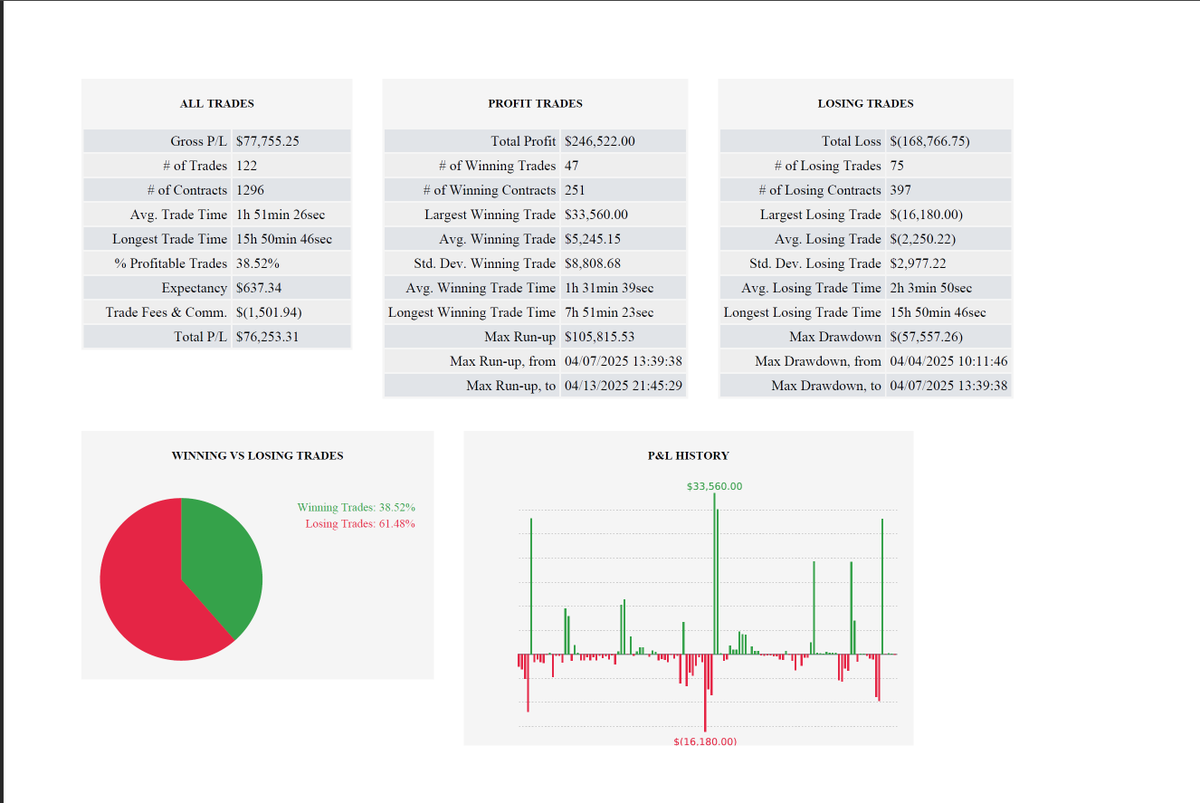
I don't know how much more clear I need to make it.
I've made MILLIONS of dollars trading a 35% win rate.
The turtle traders under Richard Dennis made MILLIONS with a 35-40% win rate.
I get it wrong MORE OFTEN than I get it right.
I don't know if this is new to you, but everyone's opinion has the probability of being wrong, EVEN MINE.
The people who tout "this guy doesn't know what he's doing, follow me instead" are misguiding you into believing you're always going to make money on every single trade.
Or that somehow they've figured something out that I haven't after 15+ years of doing this.
This game is about how much you lose when you're wrong.. and how much you win when you're right.
That's it.
Attaching my full Apex account statement.
I had a 35-38% win rate for 3 straight months... and made $3,000,000 doing it.
Stop trying to chase perfect.
Instead, chase profitability.
Trading is hard, but anyone can do it.
7 High ROI trading habits:
1) Backtesting
- Gain confidence
- Know your system
- Improve your execution
2) Studying charts
- Learn new setups
- Improve your system
- Improve your knowledge
3) Journaling trades
- Correct mistakes
- Maximize your strengths
- Improve your execution
4) Thinking in probabilities
- Maximize execution
- Maximize confidence
- Maximize emotion control
5) Increasing goals gradually
- Improve confidence
- Improve self-belief
- Increase trading accounts
6) Planning trades in advance
- Improve self-discipline
- Control your emotions
- Improve time management
7) Checking rules before a trade
- Minimize mistakes
- Improve your execution
- Maximize self-discipline
Everything depends on you.
Price moves for four reasons:
1- To generate liquidity.
2- To purge liquidity.
3- To fill liquidity.
4- To neutralize liquidity.
That's the whole cycle.
You just have to position yourself at the RIGHT TIME.
If you didn't agree that there's cycles where generational wealth is made via trading.. and not every month or every year is a prime opportunity to be active... I don't want to hear about you struggling in consolidating markets.
Your need to make money all the time is the reason you aren't making progress.
More indicators, strategies and confirmations
Thinking it gives you more certainty
But what it actually creates is:
Hesitation, overthinking and second-guessing
You don’t need more information.
You need less noise.
This was my biggest shift.
When I stopped adding… and started removing.
Because every extra variable…
Is another reason not to execute.
So I asked a simple question:
What do I actually need for a trade to work?
Turns out…
Not much.
I built my entire system around just 3 conditions.
That’s it.
Simplify your trading.
Execution gets easier.
Click here: https://t.co/N6uuPgZmiC
And I’ll show you how it works.
High Probability Models [All Of Them]
Require:
1) Knowledge Of Market Conditions [Profiles]
2) Time & Price Theory
3) Narrative [The "Why" Price Should Move Where]
4) Market Structure
5) Real Order Flow
6) Sound Money Management
7) Excellent Entry & Exit Criteria
Period.
Doing the bare minimum will make you a significantly better trader than 90%:
2 hours a week of journaling
2 hours a week of case studies
That's it. And almost nobody does it.
Daily reminder:
99% of trading Twitter is BROKE because they worry about what everyone else is doing.
Worry about yourself, focus on your money and stop being envious.
Envy often turns into unnecessary hate. At what point do you say “that’s enough” to your own mediocracy?
Grown ass men worrying about what other people are doing.
Sunday thought:
The hardest part of trading isn't the strategy. It's starting over after you blow up.
Every time you have to fund a new account and stare at $0 profit, your brain tells you you're behind. That you failed. That you're starting from nothing.
But you're not starting from nothing. You're starting with experience.
Big difference :))
One thing that always sticks with me when I talk to veterans about trading is learning how to protect what you’ve made.
Traders who amassed fortunes, 8-9 figures, who left the markets with nothing.
It’s a stark lesson that no matter how much you make, it’s more about what you KEEP.