Quantum computers will eventually be able to break the cryptography that protects blockchains today. The fix is new "post-quantum" signatures, but they are big and slow to work with.
We just showed they can be checked on Kaspa in seconds. Here is how.
In plain terms: we take the three new quantum-safe signature standards (NIST) and prove them correct inside a zero-knowledge virtual machine, so the network can trust the result without redoing all the work.
The numbers below are the time it takes to produce that proof.
All three NIST schemes, proved on an RTX 4090 (means of 5 runs):
Falcon-512: 1.91s
ML-DSA-44: 5.35s
SLH-DSA-128s: 16.3s
SLH-DSA is the hard one (hash-based). It was taking 30+ minutes. RISC Zero's SHA-256 precompile is what brings it down to 16s.
The important part: we did not run these on our own hardware. @0xfourier (GhostProver / NTH MOMENT) benchmarked it independently and the proof artifacts are published. Don't trust the graphic, check the artifacts.
https://t.co/sEmgWuDI9H
https://t.co/BPrOK5psRs
Thanks to @0xfourier and to the crypto interns who worked on this. PQ + ZK, built in the open. #Kaspa $KAS
Things really move fast on the AI Buildout, especially in the CPO ecosystem.
See this extensive list below? It has $SIVE on it, but $AAOI did not make the cut because the real ramp up started this year, and a re-rate for $AAOI is happening THIS YEAR.
Things move fast, scale fast, and re-rate even faster.
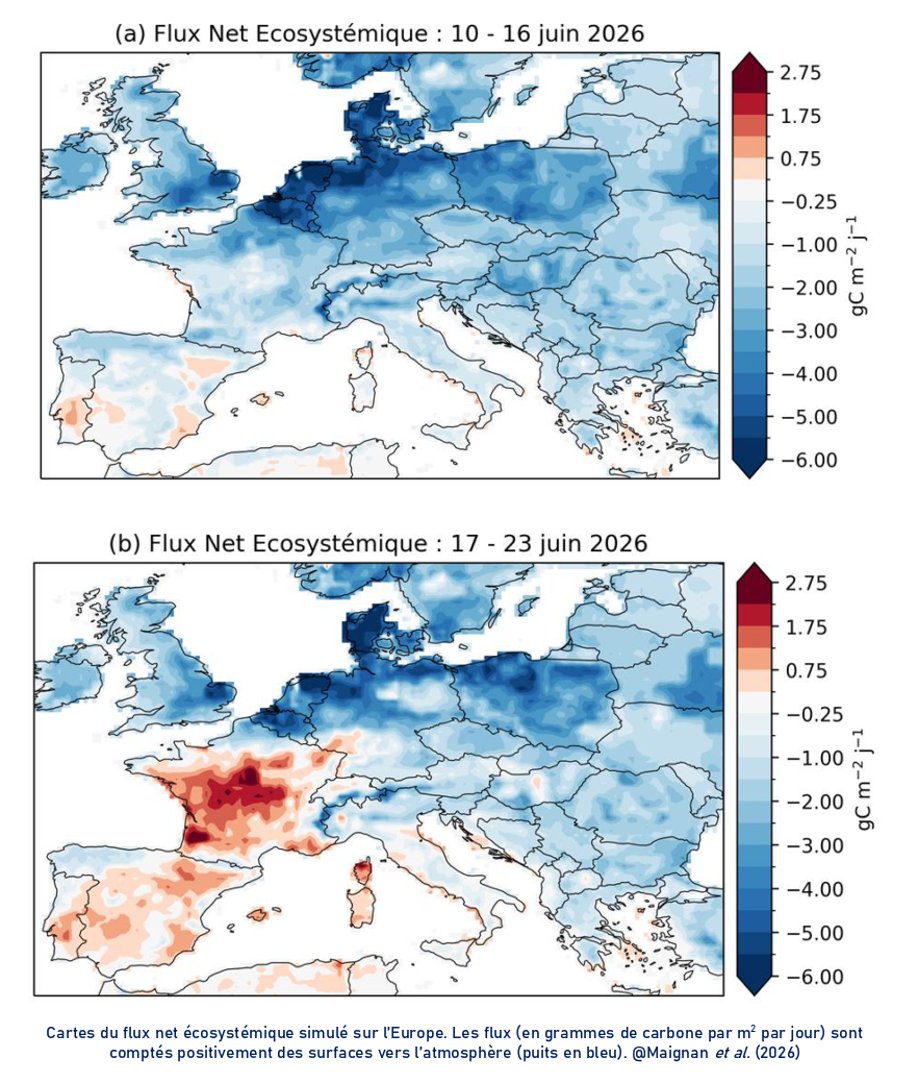
En brûlant une partie de la canopée et en réduisant fortement la photosynthèse, la canicule et la sécheresse de juin 2026 ont impacté nos écosystèmes à des niveaux jamais vu (jusqu'à plus de 50 % de baisse de l'activité des feuilles, de la Vendée à la Bourgogne – carte 1), elles ont même transformé certains territoires en émetteurs nets de CO₂ (carte 2).
C'est précisément ce que j'avais dénoncé le 21 juin en évoquant une sécheresse éclair de type Heat Wave Flash Drought (HWFD) (carte 4, issue de mon site AgroMétéorologie). Elle a bien eu lieu, avec des conséquences majeures.
Selon les études d'attribution, le changement climatique d'origine anthropique a rendu cette canicule de juin 2026 plus de 10 000 fois plus probable (carte 3).
Nos écosystèmes (forêts, cultures, prairies, mais aussi les océans) disposent de la technologie la plus efficace pour retirer le CO₂ de l'atmosphère : la photosynthèse. Elle n'est pas humaine, elle est végétale. Pourtant, face aux canicules, le débat public se concentre presque exclusivement sur la climatisation et l'adaptation des villes.
À quel moment comprendrons-nous que la santé de nos écosystèmes est tout aussi essentielle que celle de nos espaces urbains ? J'espère qu'à l'avenir, lors des épisodes de canicule, nous parlerons autant de l'adaptation des villes que de celle de l'agriculture, des forêts et des écosystèmes.
Ces résultats proviennent d'un travail exceptionnel réalisé par les chercheurs de l'IPSL. Soyons fiers de nos centres de recherche français.
https://t.co/E2YfY4xsus
You cannot mine Kaspa on a GPU anymore. That's not a limitation, it's the current state of the security budget.
ASICs turn hashing into a manufacturing and logistics problem: order the hardware, wait for the shipment, find the power, plug it in. That lag is exactly why hash rate and price can move in opposite directions for months. It's also why attacking the network isn't a software problem. An attacker needs to out-buy the actual physical hardware supply, not just write faster code.
$KAS