I’ve spoke in the past about the reasons I hate “vibe coding”, because it marginalizes the experts and equips people who have very little experience, using AI to generate some code.
Vibe coding might get you a decent POC, MVP, or personal tool, but it won’t get you to a product or something you want to run in production.
This is a great example of how AI is causing evolution of the job market and the skills needed for people to do those jobs.
Software development is the first set of jobs to be most disrupted by AI and as such, it serves a good use case for what will likely happen with other roles.
AI is really good at languages, including programming and shell languages. Over the last couple of years, it has gone from basic auto-complete of lines, to functions, to being able to write the entire thing from scratch or fixing issues in some of the most complicated code you’ve ever seen. It is better than humans at coding and software development.
So what then is the role for software developers and engineers?
This goes back to my point on vibe coding. AI is like having the worlds most capable assistant, sitting next to you, but it knows very little about innovation, issues, it’s highly limited in terms of how it solves problems, but it’s also highly better at us in how it does it. It has access to all of the world’s information, but you can only give it a very small amount of context at a time.
It’s a contradiction in itself.
So, how do you use it to get good output? Well bluntly, it is a tool, so you need someone to use and lead it who is knowledgeable in the area in question. Someone who not only understands what you want to build, but knows how to build it, and can guide the AI.
Then you need a process to manage the AI and keep it on track. I created one, and tested it by building a new Linux compatible kernel from scratch (Ginux), but others exist.
If you want to look up and/or use mine, it is called Human-Directed Agentic Engineering (HDAE) and can be found here:
https://t.co/qZ1S5DHnZk
My goal in creating it, testing it with the most complicated process I could think of that I’m very knowledgeable in, and writing a paper for it, is to demonstrate to other engineers that the future needs them, now more then ever.
Back to the point, you have to recognize that the work is changing. The genie is out of the bottle, it isn’t going back to what it was like before, you must evolve your skills to survive or thrive in what is coming.
And if you do that, you will very much find opportunities like you’ve never known before.
To reiterate, I built an operating system kernel that boots, runs a Linux user-space, and designed some different security methodologies, in 11 days.
Seriously, that is amazing!! If I can do that, so can you.
We just need people to realize that the wave is coming. You can surf, or you can drown. The choice is yours.
And this doesn’t just apply to software engineering, this will happen across the job market. All desk jobs will be affected, then eventually it will also happen with many physical jobs. This isn’t science fiction, it is reality.
But this isn’t going to create a job deficit like many are predicting. Not at all. This will change jobs, yes, of course, but it will create opportunity.
If you aren’t reconsidering how your job will be affected by AI now, you are falling behind.
Don’t listen to the doomers that are trying to use fear to drive their own personal wealth and attention. Jobs will exist but you will have to learn new skills.
This precedent has been demonstrated with all great innovations, while it is disruptive, we end up in a much better place.
I have a lot to gain from the same reasons as other tech CEOs, and I refuse to spread lies and unfounded fear.
AI is the greatest innovation I’ve seen over my lifetime, I’m excited by it, and I want to see it help people as it has already proven to do.
@GastonRiera Probably Google Photos was the only product I missed most, in the sense that it was a full featured app and it did have an awesome UI/UX, both web and iOS.
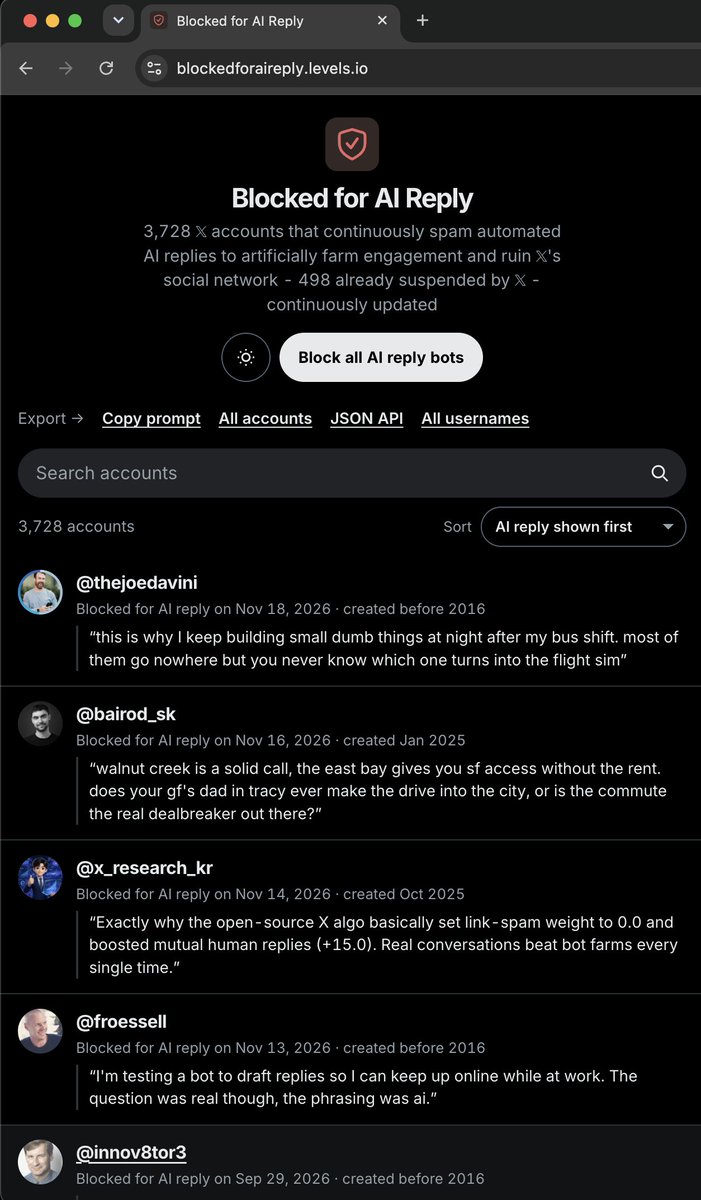
It took a while but as promised here it is...
"THE 𝕏 SPAMMERS LIST"
🛡️ Blocked for AI reply
https://t.co/0kzHNGpOrr
3,728 𝕏 accounts that continuously spam automated AI replies to artificially farm engagement and ruin 𝕏's social network - 498 already suspended by 𝕏 - continuously updated
✅ Evidence for every blocked account
✅ One-click block all button
✅ Continuously updated JSON API
✅ Text-only username list
Based on @ryanvogel's original Clankwall and @dillon_mulroy's X list
I hope everyone uses this and keeps using it, so my account becomes a honeypot for AI replies, once I block them they're blocked by the entire network and they stop being able to reply to anyone
+ It'd be cool to add more "scouts" like @ThePrimeagen and @JackEllis and sync their block list continuously too cause they and many others have the same issue
I've also submitted this list to @X's CEO @petersellis to train their spam models on
Again it'll be continously updated!
Enjoy a spam free 𝕏 experience! 😊🙏
Hi friends, in the latest weeks I worked with GPT 6.2 Astra. With it I built Redis features and most of YouRec (https://t.co/scfZPK4yr7). My feeling is that it is the *best* model for system programming in C and for complex data structures. (continue)
As a PHP/Laravel developer, I wanted something like DDEV but without Docker, so I built #LocalWeb in Rust.
It runs on Ubuntu, Arch Linux, macOS and Windows, and lets you set up LEMP or LAMP with any PHP version.
Would love some feedback!
https://t.co/8Fb9YU171c
What does software engineering look like when generating the code becomes cheap and verifying it is the hard part? A rare podcast focused on everything around building software, with @satyanadella. Timestamps:
00:00 Intro
02:12 Microsoft’s open-source shift
04:15 Building VS Code in the open
05:55 Copilot, Cursor, and Claude Code
09:52 Decision engines
12:32 Verifying AI-generated code
15:39 The software factory
20:45 Bringing AI to existing products
24:06 Why adopting AI is different to adopting React
26:29 The changing role of software engineers
29:25 Microsoft’s voluntary exit offers
34:05 AI anxiety and changing roles
36:35 Junior hiring
42:36 Open models
45:39 Owning your AI infrastructure
51:21 Building trust in AI agents
53:48 Local models and hybrid intelligence
56:39 Microsoft’s model strategy
59:26 Advice for engineers
1:01:21 Closing takeaways
Brought to you by:
• @turbopuffer – a vector and full-text search engine built on object storage. It’s fast, cheap, and extremely scalable. https://t.co/w9y67Gs8ab (I built a greatly improved podcast/newseltter search with it, check it out: https://t.co/6zbxlEaHlu)
• @linear – the product development system for teams and agents. https://t.co/knIF2mcz9p
• @WorkOS – everything you need to make your app enterprise-ready. https://t.co/aiAee0oF5h
3 interesting takeaways from Satya:
1. A new form of software engineering: teams building software factories to improve their work.
Satya cites the Azure networking team which manages 500+ fiber network operators and recently built an agentic system to better manage emails and processes. Now, they operate much more efficiently as a result. Satya sees this as the reality of “AI transformation”: brownfield work on building software factories to improve how teams operate, all while continuing the day-to-day work.
2. “Own the intelligence”: avoid lock-in & treat agents as an insider risk.
Satya cautions companies to avoid lock-in with any single model provider by ensuring that the harness, memory, and model are not coupled, so that they can be changed with ease. He also thinks more companies should consider using open models as a way to protect their core intellectual property (IP) from leaking out, and build private evals to decide what models to use and upgrade to. He also says that models are intelligent but unreliable, so it’s best to treat them as “insider risks” and build a separate system to verify that agentic systems work as expected.
3. What’s with those voluntary exit offers?
I asked Satya directly why Microsoft recently made voluntary exit offers to most of its software engineers for the first time in the company’s history. I also wanted to know if it could mean layoffs in the future. Unsurprisingly, his reply was diplomatic, but in the podcast I rehashed what I heard in a more direct way.
The #1 reply to yesterday's benchmark: "Now turn on OPcache and JIT."
Fair. So we did.
Every PHP baseline in elephc's CI now runs with:
• opcache.enable_cli=1
• opcache.jit=tracing
• jit_buffer_size=128M
And a probe checks the JIT is really on. If not, CI fails.
PHP at full speed vs native code. Results tomorrow.
Your guess: does the gap shrink, stay, or grow? 👇
Sunday homework for founders. ✋
Open Claude. Paste this:
"Go to [your site]. Sign up as a brand new user. Go through onboarding like a real customer. Give me the top 5 things to fix, with what you saw at each step."
When I ran it, it found our onboarding never asks you to create a booking type.
That's the whole product. 🤦
Then it mocked up the fix.
Your customers won't tell you.
Your dashboard won't tell you.
A robot pretending to be a new user will.
Takes 5 minutes. Run it before Monday. 🌶️
Linus Torvalds "Did What I Preach", Used AI To Make Code Decipherable & Uncovered More Bugs
Follow on from yesterday.... More AI use on the Linux kernel by Linus Torvalds this weekend.
https://t.co/9rGv0PFm7X
I’m gonna be real here for a sec. I fucking love Rails. Laravel would not exist as we know it without Rails.
After Heroku’s death announcement, we’ve been working on making Laravel Cloud an amazing home for Rails developers and applications. And other developers that believe in care, craft, and the art of software.
We’ve hired Rails experts to help us do this. To help us make it absolutely perfect.
We’ve got a few more details to sweat before we release it because I want it to be absolutely amazing.
If you’re a Rails developer who still loves Rails and you want to give a talk at Laracon 2027 about something awesome you’re building in the AI era with Rails, DM me.
If you’re a Rails company and you want to talk about the next amazing place to run your Rails application, DM me.