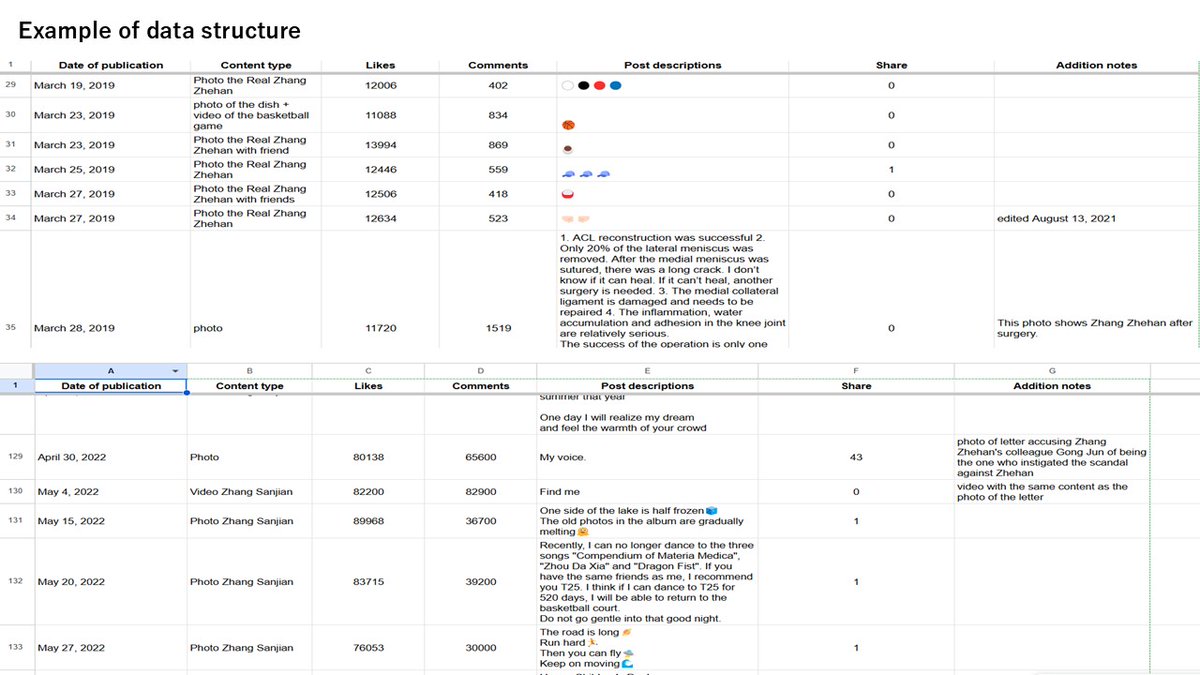
Well, I think it’s time to clarify the myth of the "verified Instagram account." Over the past few weeks, I’ve collected data for analysis. All of the data was gathered manually, and an example of its structure is shown in P1. For this analysis, I selected 124 posts by Zhang Zhehan (ZZH) before August 2021 and 126 posts by Zhang Sanjian (ZSJ) after January 2022 (from when the account zhangzhehan_super3 became active again). Let’s break it down step by step.
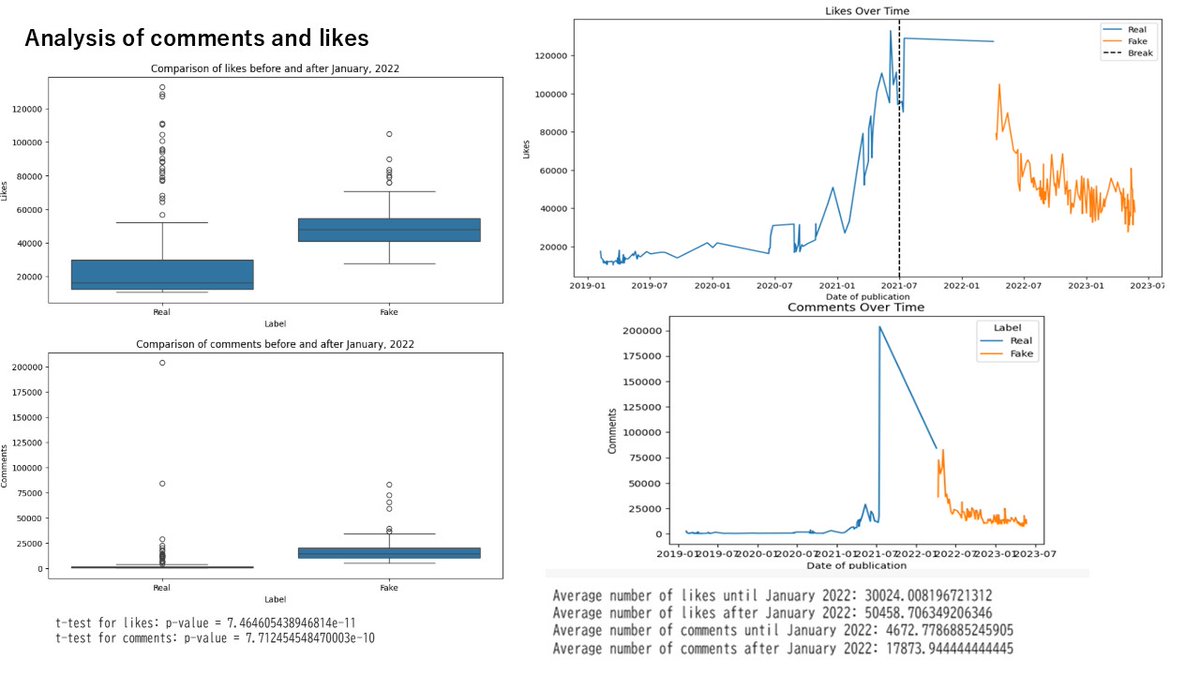
First, let’s examine the change in the number of likes and comments. The graphs in P2 show a technical analysis of likes and comments from February 2019 to May 2023. What do the graphs tell us?
1. ZZH’s likes show fluctuations from low to sudden spikes, which align with his rise in popularity and the subsequent scandal.
2. ZSJ’s average likes are higher, but the range is narrow, which strongly suggests bot activity.
3. ZZH’s posts generally have low comment counts, with a few posts showing unusually high peaks.
4. ZSJ’s posts consistently receive high numbers of comments, which is unnatural and indicates bot engagement.
5. The graphs show a rise in likes and comments from 2020 to mid-2021, corresponding to ZZH’s growing popularity. After mid-2021, the data stops as the account was inactive for some time.
6. In early 2022, after the account super_3 became active again, engagement was high but gradually declined, possibly due to loss of audience trust.
7. The p-value for likes and comments is low (less than 0.05), indicating statistically significant differences between the two groups. This confirms that the account’s behavior changed after January 2022.
In any research project, it is important to know when to stop. I lack that skill. First, I ran an experiment on a small sample. Then, I wanted to run standard statistical tests. That didn't feel like enough, so I decided to run a wider variety of tests. Then I wanted to verify everything manually, and after that, write a validation script. Then I thought evaluating based on a single feature wasn't ideal, so I increased the sample size ninetyfold (bless API keys). Then I had to run all the algorithms and tests all over again. Then it seemed like one of the algorithms wasn't working quite right, leading to days of debugging. I don’t even know what comes next. At this point, I just need an emergency brake before the project disappears entirely into the rabbit hole.
I’m writing an article for academic journal. And do you know how much it costs to publish it as Open Access? $3,500.
What the hell?
A year of tuition at my university costs less than that, and I study at one of the best universities in the country. That’s an average monthly salary. At this point, academic publishing feels less like a service and more like legalized robbery.
@Quichie6 It's also called Cosmic Orange. I didn't have a chance. Honestly, I only bought it because of the color. I've associated this model with jzp since its release 🧡
Getting the physics right is much trickier even for AI.
That's exactly what caught my attention when I analyzed some images last spring. Today I came across a very interesting article that discusses exactly this issue – the physics of an image and the geometry of a scene. Here's a brief summary.
The history of photo manipulation is as old as photography itself. A famous portrait of Abraham Lincoln actually shows Lincoln's head superimposed onto the body of politician John Calhoun. Stalin famously airbrushed political opponents out of photographs. And two girls from Yorkshire convinced countless people – including Arthur Conan Doyle – that their photographs of fairies were genuine.
But how can we tell whether a digital image is actually real?
Digital forensics expert Hany Farid realized that whenever a computer creates new pixels by extrapolating from existing ones, it leaves behind detectable traces – statistical correlations between pixels. The challenge, therefore, was not to "prove" that an image was authentic, but to identify the traces left by different types of manipulation. Eventually, he concluded that the answer lies in physics.
Today, billions of people have access to AI systems capable of producing photorealistic images from almost any prompt within seconds. Early AI-generated images were often easy to spot because they lacked subtle statistical signatures present in real photographs, such as sensor noise or lens artifacts. However, modern image generators have become remarkably good at learning and reproducing these patterns, even adding realistic imperfections to mimic camera-generated images.
Physics, however, is a different story.
When analyzing an image, it's always worth asking a simple question: Does this scene obey the laws of the real world?
For example, in a genuine photograph, lines that are parallel in reality should converge toward the same vanishing point. Likewise, lines connecting points on an object with the corresponding points in its mirror reflection should also converge consistently according to the rules of perspective.
Shadows can also reveal inconsistencies. Because the Sun is so far away, its rays are effectively parallel when they reach the Earth's surface, which places strict constraints on the direction and behavior of shadows.
"Generative AI doesn't know about physics, doesn't know about geometry, and it does all kinds of crazy shit."
Source (Science): https://t.co/Kt5jJcufpm