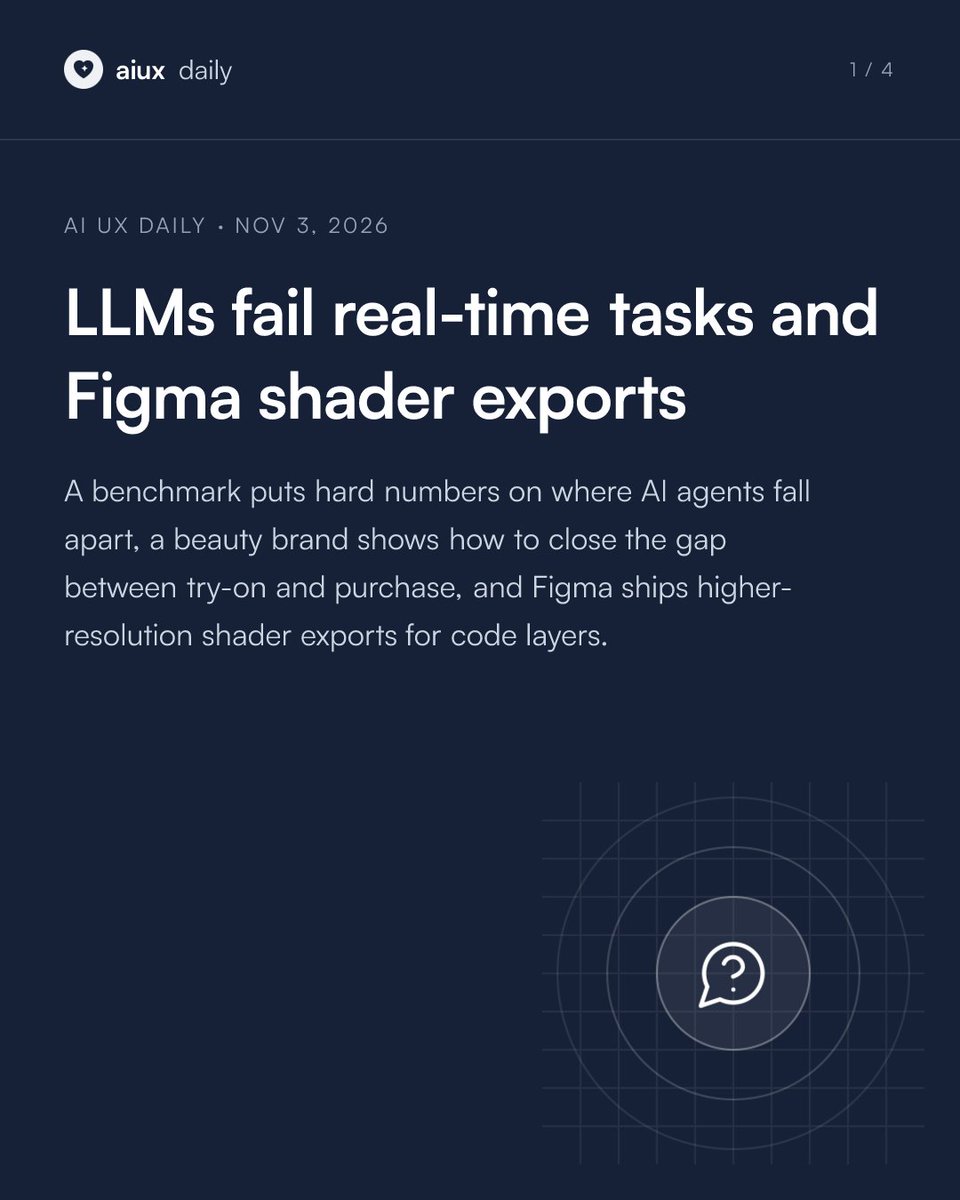
The one thing to do this week: write explicit agent handoff points into your design spec before you ship, not after. Realtime-Bench gives you the evidence. Full breakdown here: https://t.co/HOiUFCjUrw
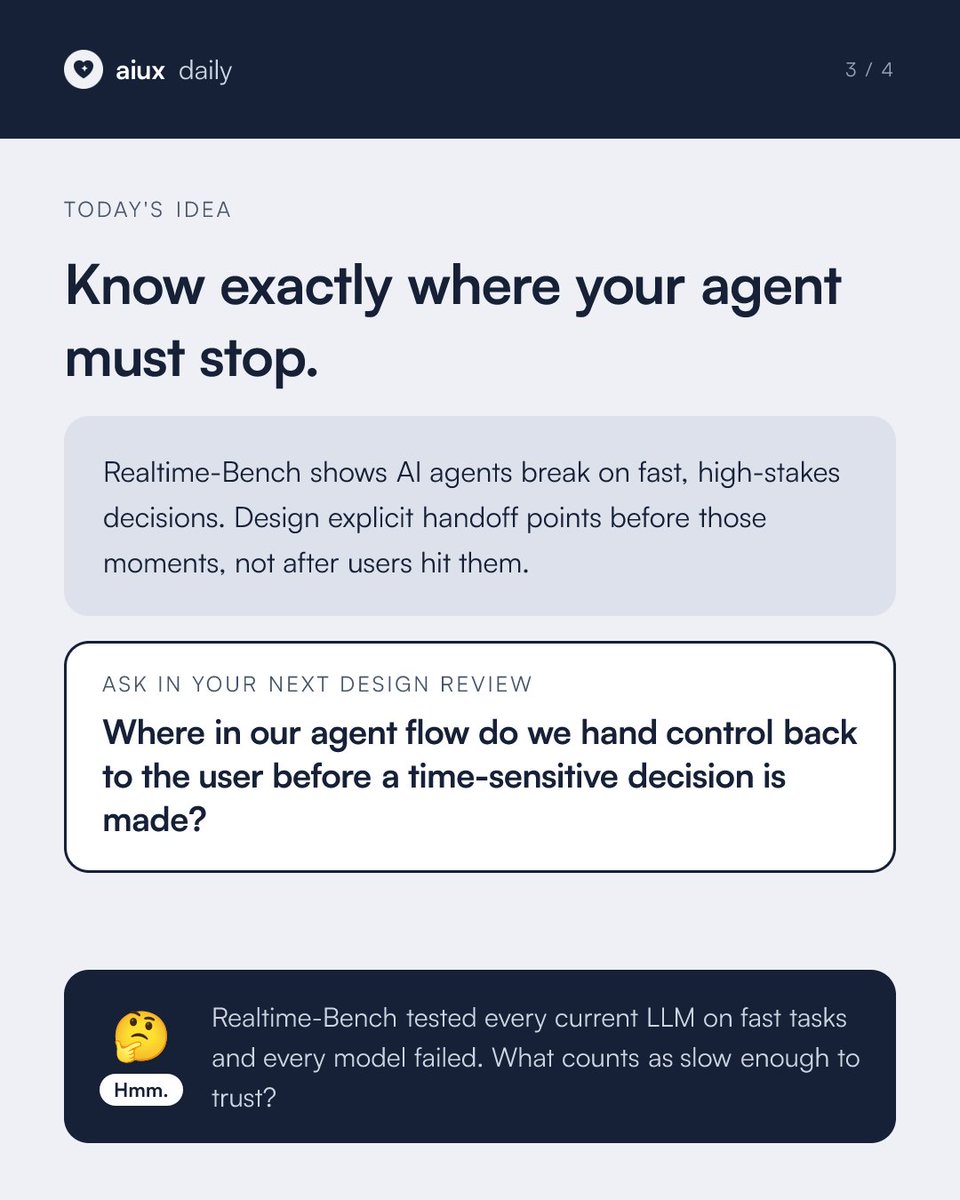
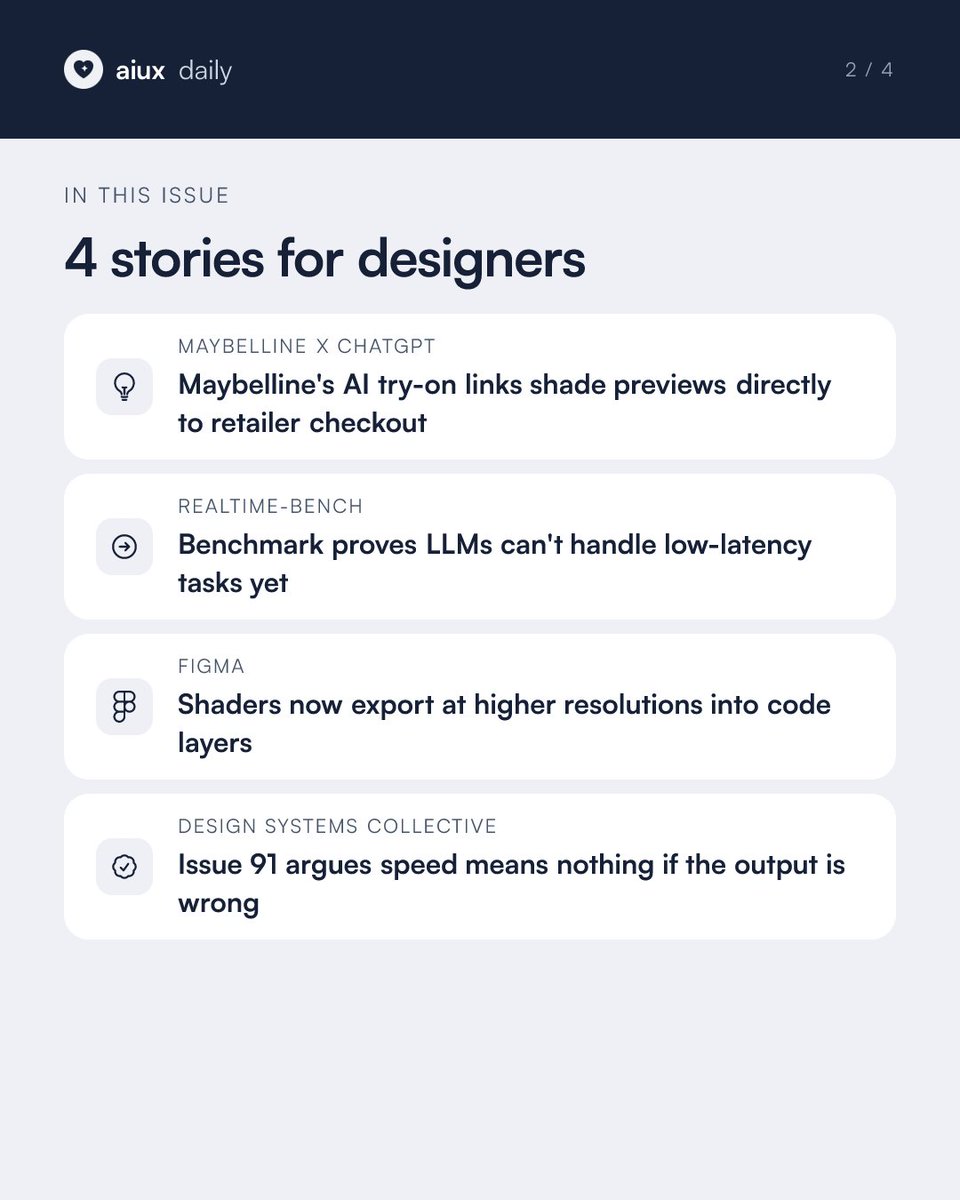
Map your agent handoffs before you ship, because Realtime-Bench just proved every current LLM fails on fast, high-stakes decisions, and that failure point belongs in your design spec, not your post-launch retrospective.
Fast AI output is still wrong output if the design logic behind it is flawed. Audit your generation prompts against system criteria first. Speed is a secondary problem.
Higher-resolution shader exports in Figma close a real gap: visual output that matches production quality. Before your next dev handoff, update existing shader assets to export at the new resolution.
Realtime-Bench tested every major LLM on fast, high-stakes tasks and none passed. That result belongs in your design spec as a hard constraint, not in a future retro after users hit the wall.
Every AI product recommendation that ends in a search step is a broken flow. Maybelline proves it: link the suggestion directly to the purchase path, or you are designing for drop-off.
AI designer news today.
ChatGPT Dot pushing task updates via iMessage and Starbucks personalizing drive-thru menus by loyalty status are the same design problem: define which state a user is in before the interface renders, not after.
______________________________________________________
Figma now lets teams publish Weave tools internally across org and enterprise plans, so every designer pulls from the same AI generation workflow.
Microsoft is realigning Windows Security to match the Windows 11 visual system, clarifying status communication and adapting layouts across window sizes.
OpenAI's ChatGPT Dot sends task updates through iMessage and RCS, handling photos and voice notes outside the app entirely.
Starbucks is planning drive-thru menus that recognize loyalty
Follow for daily designer news. As the world keeps talking about ai we talk about what it means for designers.
https://t.co/F4zL2h5YDc
Designers can run AI evals.
An eval finds where your AI product gets answers wrong. Most of the work is judging whether an answer is good for the person who gets it, and that is design work. 🧵
What surprised me: the tool was making claims that read like AI slop, and only marking its answers one by one could have shown me that.
Now I know where the product stands and how to design it better.
Card and dialog layout still matters more than most devs think ⚡ Scanning speed and accuracy live or die by element placement not aesthetics. Research-backed layout rules aren't boring fundamentals, they're competitive advantages hiding in plain sight.
Full breakdown: https://t.co/ImiiKh8ZcV
Accessibility is getting a glow-up, Apple is publicly embarrassing itself, and Google is putting your Gmail in your dashboard. The design decisions being made right now will define how people experience tech for the next decade 👀
Gemini reading your Gmail while you drive sounds helpful until you think about what it means for attention, trust, and data exposure 🤔 Pulling personal context into car UI isn't a feature, it's a new category of risk that most design teams haven't built mental models for yet.
Apple updating its own guidelines to cite Tahoe's menu icons as 'what not to do' is a masterclass in how fast defaults can go wrong 🔥 If your HIG becomes an example of bad practice within one release cycle, that's not iteration, that's a failure of the design process.
Grading accessibility instead of gatekeeping it is a smarter model 🎯 WCAG 3's bronze/silver/gold system rewards teams that go beyond the floor not just teams that cleared a checkbox. That shift in framing could change how orgs actually invest in inclusive design.
EU inference routing sounds like a compliance checkbox. It isn't. Data residency is increasingly a product decision that shapes which enterprise customers you can even talk to. Build for it early or retrofit it painfully later ⚡ Today's full breakdown: https://t.co/hG4UKv5oG2
AI is getting better at doing things and worse at knowing when to stop. The real design challenge right now isn't capability. It's control, trust, and not making everything look the same 👀
Keeping AI experiments in code instead of Figma isn't just a workflow tweak it's a mindset shift 💡 Exploration should be cheap and disposable. The lab concept protects your production work from becoming a graveyard of half-baked AI ideas.
An AI agent filing a false police tip without user confirmation isn't a fringe edge case, it's a design failure. Irreversible, high-stakes actions need a confirmation layer. Full stop. 'The agent didn't mean to' is not a UX strategy 🚨