🌊THE DEEP MAIN COLLECTION MINT DETAILS;
We are excited to share our mint information. We are about to reach our next stop in journey of Deep.
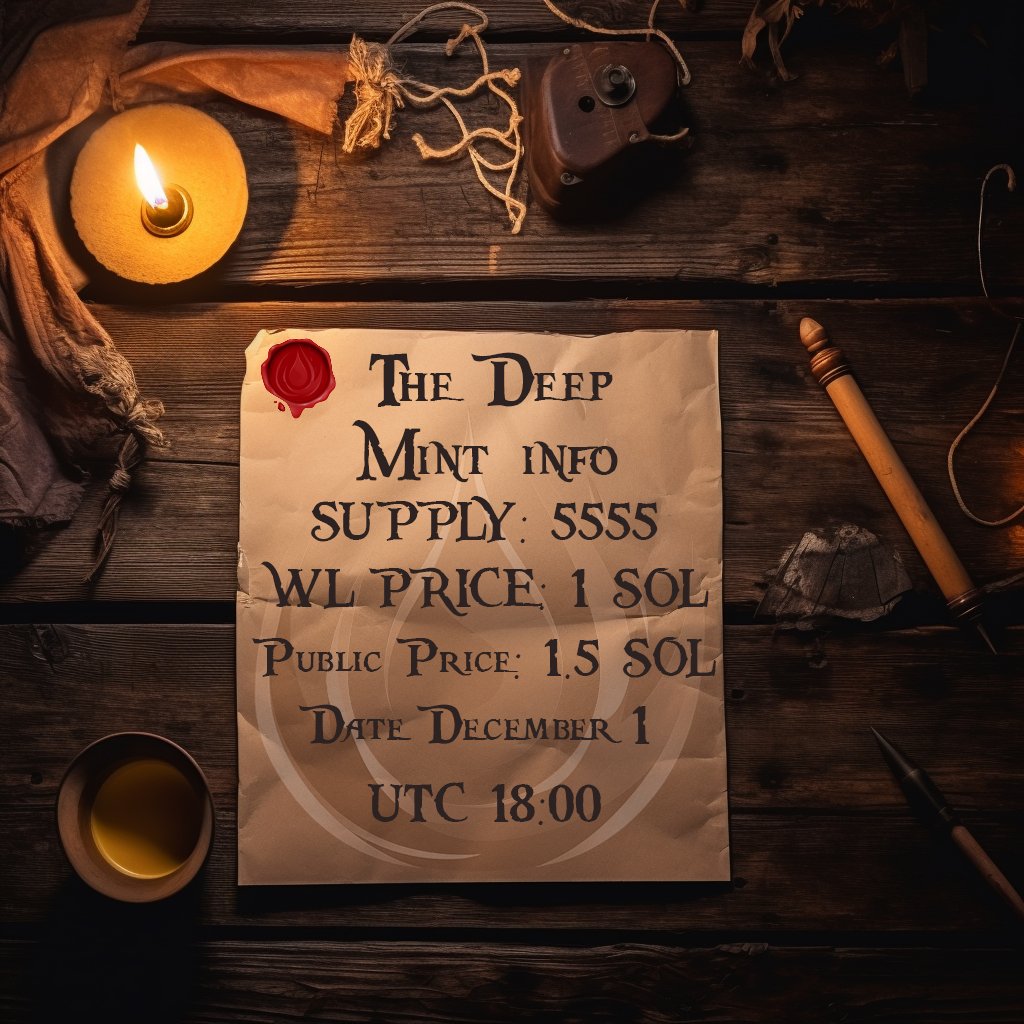
Here are The Deep Main Collection Mint Details:
Supply: 5555
WL Price: 1 SOL
Public Price: 1.5 SOL
Date: December 1 - 6pm UTC
🚨Keep your notifications open for more details.
Wanted to highlight a project I have liked and hold a significant amount for a while - @ClearCollectNFT
Before I talk about what they do, here is my latest win from their bubble shop. Won a @MadLadsNFT from the bubbles I earned by staking the NFTs which are 0.4 SOL each!!!!!
The Airdrop form is now re opened!!
You’ve got just 90mins to get in 🤡🤡
Form: https://t.co/0ZpFMWiAQO
make sure you’re following, retweet the pinned tweet and tag your friends
#Solana#SOL#SolanaAirdrop#Airdrops#Memecoin $clown
Such a beauty!
I'm dedicating this thread to all my naked @ClearCollectNFT!
With 'common' rarity, they seem to be undervalued. But I do appreciate FULL ART so it's a must-buy for me.
What's your favorite skin? Show me your naked CC below. 👇
1/🧵
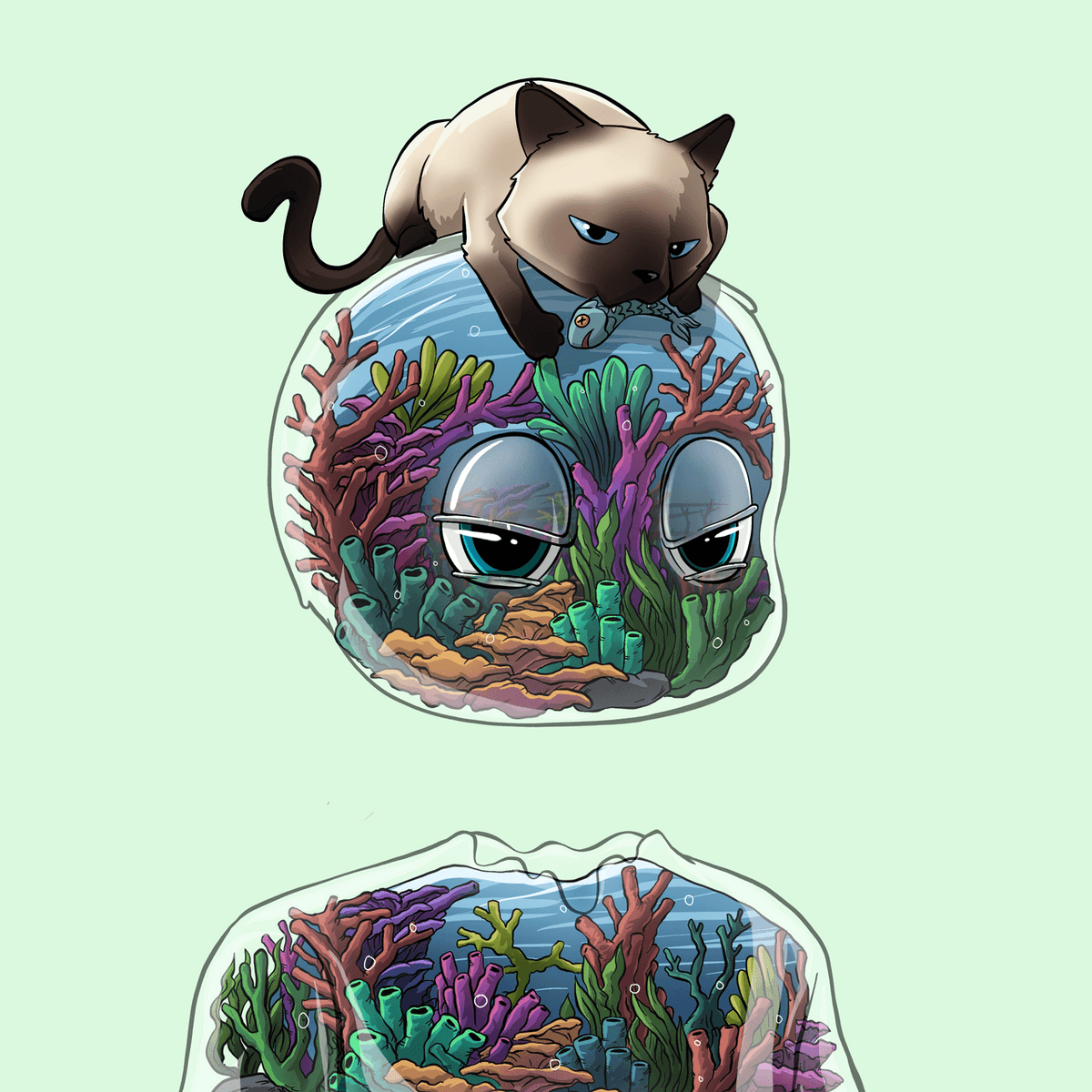
Skin: Reef
Hello world...
Good morning..
Have a Great Sunday..
Come and vibe with us.
@ClearCollectNFT family..The community is super active and the boys/girls there are super cool..
#NFTs
Check out thise nft
You definitely need to fill your bag with clear collection.
They are really cheap at the moment but hurry up.
Great builder and awesome community
@ClearCollectNFT
Pioneer Legends ART contest is now LIVE 🎨
⚠️ How to participate?
- Choose a base art from any of the factions.
- Develop an art based on the The Sat Man lore - https://t.co/0Uzx8mSeWV
- Reply with your version of the art on this thread with #SatManforPL
What makes Solana an engineering marvel and miles apart from other chains?
I have seen a lot of people excited to learn about Solana and how it works, while others calling Solana community intellectually bankrupt. Yet, just as one doesn't need to understand every car detail to drive it, users can enjoy Solana's swift and economical functionality without diving deep into its mechanics. However, SOL holders, as stakeholders, might benefit from a deeper understanding. I have tried to explain the inner workings in a language that is more digestible for an average SOL holder.
Be mindful that this is a simplistic overview and not technically exhaustive. In case of any oversights or errors, please let me know in the comments.
1. Solana - Overview
On a high level, Solana is a Proof-of-stake network, where validators check your transactions, order them correctly and include them in the chain while making the necessary changes to the data in the state. But there are quite a few technological innovations that make this chain as fast and secure as it is, while being extremely decentralized.
Vitalik has coined the term blockchain trilemma, which brings this idea that Security, Decentralization and Scalability cannot coexist in harmony, which has been widely used since. Solana is proof that this trilemma is not real, and distributed systems can be highly secure, highly decentralized and extremely scalable without sacrificing one of the other legs.
2. Transaction flow - Mempools; the old stuff
Now, let us look at the how this system operates and what happens when you hit send on a transaction in your favorite wallet.
Your wallet is connected to an RPC server which sends this transaction to a node that forwards it to a validator. In a blockchain like Ethereum, all these pending transactions sit in a waiting room called a mempool, each requiring different levels of computing and each offering different payments (tips above base fee) for doing that computation. The leader validator (block proposer) for the next block, selected at random, picks the ones that give them the best profit and include in a block. This block is “attested” by a group of randomly chosen validator committee, and is included in the chain.
However, in a high throughput system with targeted sub-second finality, mempools are a burden as they need to propagate via the gossip network. You need to process the transactions as they come without delays. Here comes the first issue, as there is no centralized agreed upon source of time in a distributed system to decide what came when.
3. Solana - Proof of History; It's time
Solana solves this problem by using an innovative creation called Proof of History, which allows these “timestamps” to be built into the blockchain itself. PoH is nothing but basically SHA256 loops executed as fast as possible. SHA256 is a one-way hash function which takes in any size of information and outputs a fixed-size string, which cannot be reverse calculated.
You take the output of the previous state and inserted messages and use it to generate the next hash. Modern day chips are optimized for these hash functions and even a significantly customized ASIC cannot have a significant variation in the amount of time taken to generate these hashes, which gives a consistent source of time. Understand that this is not a human scale of time but a consistent machine clock. A fixed period of hashes representing around 400ms is grouped together and called a slot.
PoH effectively acts as a decentralized clock for the Solana network, ensuring that all participants have a consistent view of time and event order. With a verifiable passage of time provided by PoH, Solana's consensus mechanism can achieve consensus more efficiently. Validators can be sure of the order of transactions without needing extensive communication with each other. Due to the properties of cryptographic hashing, it's computationally infeasible to produce the same hash sequence without having the same input data in the same order and spending a similar amount of computational time. This means that anyone can verify the sequence by recomputing a few hashes and ensuring they match the expected results.
Read: https://t.co/e3v6pxIcs7 if you are interested in learning Ethereum transaction flow and consensus mechanism.
Read more about PoH - https://t.co/lT1l3L682x
4. Block Production & Leader Selection
Let me discuss a bit about how Solana’s blocks are created before I talk about the consensus algorithm that keeps Solana secure. In Solana, a slot is fixed duration of 400ms (currently) during which a validator can produce a block.
Each slot is assigned a specific leader validator, which can be predicted in an earlier slot. The leader is responsible for creating a new block with transactions in their slot. Once this block is proposed, other validators in the network vote on its validity, confirming the block and including it in the chain.
5. Consensus - Tower BFT
The way the validators vote and provide consensus brings us to the next key innovation, which is Tower BFT. Before diving into Tower BFT, it's essential to understand the concept of Byzantine Fault Tolerance. In distributed systems, BFT refers to the ability of the system to function correctly even when some nodes act maliciously or unpredictably. The goal is for the system to reach consensus on the state of the network despite these adversarial conditions.
In Tower BFT, votes are cast for forks, not for individual blocks. Since ledger works as a reliable network clock, traditional BFT can be implemented using that. Without going into too much technicalities, Tower BFT builds validator commitment like a tower. When a validator votes for a fork, he commits to it for some time and cannot vote for any other fork that is not building on the one he voted for. Each time he votes, the commitment doubles. As more time builds, he is locked out from voting for competing forks in an exponentially growing period.
For example, a validator has voted 25 times in the past 10 seconds. The vote 10 seconds ago now has a timeout of 225 slots, or roughly 155 days, while a vote 12 seconds ago has a timeout of 54 years, during which he cannot vote for a competing fork. Once ⅔ of validators have voted on some PoH hash, that PoH hash is finalized.
6. Turbine - Blocks go brrrrrr
After understanding how validators vote and finalize blocks, let us understand how these blocks are created and propagated on the network. Enter Turbine, Solana’s block propagation protocol.
In blockchain networks, when a new block is produced, it needs to be propagated to all nodes in the network. As the size of the block or the number of transactions increases, broadcasting can become a bottleneck, leading to delays in block propagation and potential network congestion.
Turbine addresses this problem by breaking the data in the blocks into smaller packets. Instead of sending the entire block to all nodes, these smaller packets are sent to a subset of nodes, which then are responsible to sending to the next neighborhood. This heavily borrows from BitTorrent’s packet model and would be able to easily relate to if you ever used a torrent client to download a movie or a game.
The interesting thing about this is that if you look at them as levels, with leader at the top, 200 nodes in level 2 and 200 for each in level 3, a block can be propagated to 40,000 validators in 2 hops, or 200 milliseconds, making it extremely scalable.
I will not go into erasure codes which enhance the security which are basically arbitrary number of parity packets to recreate the whole block even with a significant loss in transmitted packets.
7. Gulf Stream - No more mempools
One of the innovations that enable Solana to be highly performant is Gulf Stream, Solana’s Mempool-less Transaction Forwarding Protocol
Mempools in Ethereum and Bitcoin are propagated between random nodes in peer-to-peer fashion using a gossip protocol. At tens of thousands of transactions per second, protocols get overwhelmed, and costs become prohibitively high.
Instead of having transactions wait in a centralized mempool, Gulf Stream pushes the responsibility of caching transactions to the edge of the network. This means validators (the nodes in the Solana network responsible for processing transactions) cache the transactions.
Validators predict which future blocks and leaders will be responsible for processing and confirming a transaction. They then forward those transactions directly to the expected leaders. This proactive approach ensures that by the time a leader is chosen to produce a block, they already have a set of transactions ready to be processed.
Since leaders have transactions ahead of time, they can start the processing earlier. When combined with Solana's Proof of History (PoH), this means validators can reach consensus more quickly because they're already familiar with many of the transactions in the proposed block.
In the event of network congestion, validators can prioritize forwarding transactions based on various factors, such as transaction fees.
By forwarding transactions directly to expected block leaders, the time it takes for a transaction to be confirmed and included in a block is reduced. The protocol helps Solana achieve its high transaction throughput. Traditional mempools can become bottlenecks, especially in high-demand scenarios. By distributing this load to validators and predicting block leaders, Gulf Stream ensures the system remains efficient even under heavy loads. It reduces the redundancy of transactions being broadcast to every node in the network. Instead, transactions are sent directly to where they are most likely to be processed.
8. One thread at a time? Stupid. Parallel is sexy.
EVM and other current popular VMs execute smart contracts sequentially on a single thread, meaning one contract at a time modifies the state. Sealevel, Solana’s parallel smart contracts runtime, allows for concurrent processing of non-overlapping transactions, maximizing the computational capacity of the network.
At its core, Sealevel is designed to identify and execute non-overlapping transactions simultaneously. This means that if two transactions aren't dependent on each other and don't interfere with each other's state changes, they can be processed at the same time.
Sealevel inspects the incoming batch of transactions to determine dependencies between them. It groups transactions that can run in parallel without affecting each other.
The reason why Solana is able to process transactions in parallel is that Solana transactions describe all the states a transaction will read or write while executing. This not only allows for non-overlapping transactions to execute concurrently, but also for transactions that are only reading the same state to execute concurrently as well.
Once transactions are grouped, they're handed off to the underlying hardware, which can be multi-core or multi-threaded, to execute these groups concurrently.
Solana's runtime can offload certain transaction processing tasks to GPUs. Sealevel is designed to leverage this capability, allowing certain parallelizable tasks to be processed even faster using GPU cores.
Sealevel's design means that as hardware evolves and offers even more parallel processing capabilities, Solana can readily take advantage of those improvements.
9. CPUs are fun, we need TPUs for our large computer
To get to near instant confirmation times, it is not enough to have quick consensus. There needs to be a way to quickly validate the large number of transactions. Solana’s answer to this is Pipeline, a transaction processing unit.
The fundamental principle behind Pipeline is to break down the transaction processing into several stages. Each stage handles a specific part of the validation process. By structuring the process in stages, Solana ensures efficient and parallel processing.
The first stage involves fetching the input data required for transaction processing. This might include details about the transaction itself, account balances, smart contract code, or any other relevant data.
One of the most computationally intensive parts of transaction validation is verifying cryptographic signatures. Pipeline dedicates a specific stage to this task, ensuring it's handled efficiently.
Once the signatures are verified, the transactions are passed to the banking stage. Here, the state changes associated with the transaction (like transferring tokens) are executed.
The final state changes, once validated and executed, are written to the Solana ledger.
The beauty of the Pipeline design is that while one transaction is in the banking stage, another can be in the signature verification stage, and yet another might be in the input fetching stage. This concurrent processing ensures maximum utilization of available computational resources.
Solana's Pipeline is designed to leverage the parallel processing capabilities of GPUs. Certain stages, especially signature verification, can be offloaded to GPUs, allowing a massive number of operations to be processed simultaneously.
10. How tf do you access all this data?
When scaling a blockchain without sharding, it is not enough to only scale computation. The memory that is used to keep track of accounts quickly becomes a bottleneck in both size and access speeds. LevelDB, the local database engine that many modern chains use, cannot support more than about 5,000 TPS on a single machine.
Cloudbreak is Solana’s horizontally scaled state architecture designed to answer this. You cannot maintain the global state in RAM because consumer machines cannot have that huge RAM. SSDs can hold the size but are much slower.
Solana tries to solve this by storing the actual accounts in memory-mapped files on disk, while storing the indexes to this in RAM. This enables much faster access to state because of sequential access instead of random operations. There’s a lot more that makes Cloudbreak very different and special, but I shall not go into more detail here as this is beyond the understanding capability of the average reader. You can dig this into this particular topic further by yourself if it interests you.
11. So, every validator needs to run a data center?!?! Hell no.
Last, but not least, we have Archivers, Solana’s distributed ledger store, its solution to the humongous amounts of it generates. At full capacity, network will generate 4 petabytes of data every year. If every node in the network is required to store all that data, it would limit network membership to a centralized few that maintain that kind of storage capacity.
That's where Archivers come in. The entire history of the Solana blockchain is divided into segments. Each Archiver node takes responsibility for storing a specific segment or segments of data.
To ensure data reliability and availability, each segment isn't stored on just one Archiver. Instead, multiple Archivers store replicas of the same segment. This redundancy ensures data isn't lost if an Archiver goes offline or faces issues.
Archivers must periodically prove they're still storing their designated data segments. They do this through a challenge-response protocol where they provide cryptographic proofs that they have the data they're supposed to store.
Solana's unique Proof of History (PoH) is integrated into the Archiver system. Each piece of data has a timestamp from PoH, ensuring data integrity and allowing for efficient data retrieval.
When nodes or clients need historical data, they can request it from the Archivers storing the relevant segment. The PoH timestamp ensures that the correct data is retrieved.
12. Is Solana God? Can it go beyond?
So, there we have it. All the building blocks of Solana, working together to create the extremely efficient and secure network, that we all use and love.
What I love more here is how beautifully it leverages the best software practices and cryptographic techniques, coupled with the maximum and efficient utilization of hardware. It was built in a way that it can always take advantage of both advances in cryptography and hardware, and become even faster and efficient.
A few things are already in the works – Jump’s firedancer optimizes a lot of processes that Solana uses even further, much to the level of low level functions to take it to the extreme levels of efficiency.
A few things in the works such as multiple leaders in a single slot, will increase the throughput much further enabling concurrent blocks in a single slot.
As bandwidth becomes cheaper each year and hardware becomes faster, Solana’s throughput is only limited by how fast information can travel and how fast newer hardware can process. So, any advances on these fronts automatically result in pushing Solana even further.
I have fallen in love with Solana’s architecture ever since I first got in touch, and my passion for this only grows stronger each day.
6 COOL ANIMES THAT MAKE METAMENFT EVEN COOLER!🧵
As someone who loves anime and Japanese culture, @metamenft reminds me of those I've watched in so many ways. Some can even be found in games or manga/comics.
⬇️⬇️⬇️⬇️⬇️⬇️
Can you identify them without finishing the thread?
1/8
1/
The first social tasks go live on the Clearverse today.
Here’s how you can earn “active” bubbles just for supporting and contributing to our ecosystem.
Stack those 🫧
1/ Today, we are unveiling the Clearverse, our take on community building, digital asset ownership, and collector utility.
This is going to be a game-changer, so let’s dive into Season 1 of the Clearverse!
🧵🔽