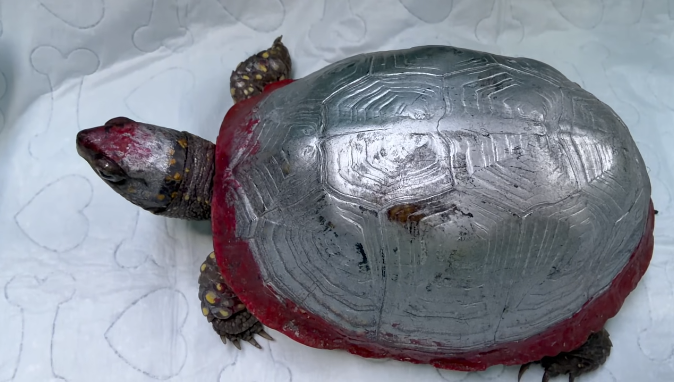
A turtle came into Wild At Heart Rescue in Mississippi last week painted from head to toe in silver and red. People keep doing this and it has to stop.
A turtle's shell is living tissue full of blood vessels that absorbs sunlight to produce vitamin D, helps the turtle regulate body temperature, and in many aquatic species participates in the animal's breathing system.
When a turtle is painted, all of that gets blocked. The turtle is no longer able to synthesize vitamin D where it's been painted and can develop metabolic bone disease as a result. (soft bones, deformed shell, slow death).
The painted shell loses its camouflage too, making the turtle visible to every hawk and raccoon in the area.
Removing the paint isn't a quick wash with a sponge. It involves multiple veterinary sessions, often with sedation, and many turtles arrive too damaged to ever recover.
If you see a turtle with paint on its shell, do not try to clean it yourself. Call a licensed wildlife rehabilitator right away.
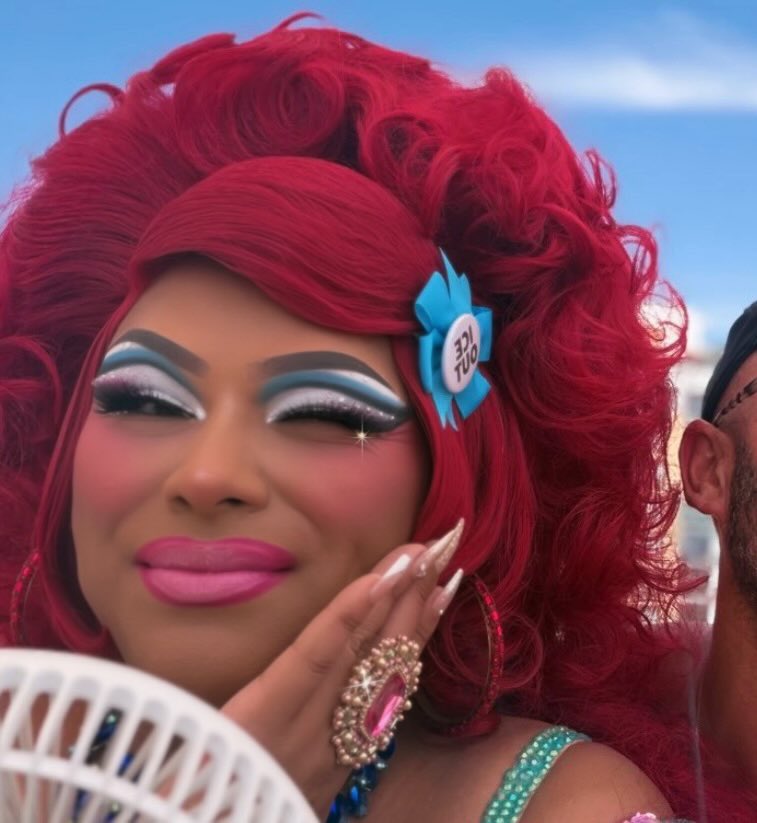
I’M IN PUERTO VALLARTA, MEXICO AND I WOULD LIKE TO SAY DEFUND ICE IN THE UNITED STATES. DEFUND THIS PRESIDENCY. DEFUND CORRUPTION. DEFUND BIGOTRY. #ICEOUT
🚨 NEW ACTION 🚨
Congress is trying—again—to strip Gray Wolves of federal protections. A poison pill in the Interior Appropriations bill would force a federal delisting rule and block court challenges, ignoring science.
Tell your Rep. to oppose Sec. 125: https://t.co/4Wy6SWqWF0
We're building a movement. 🐺
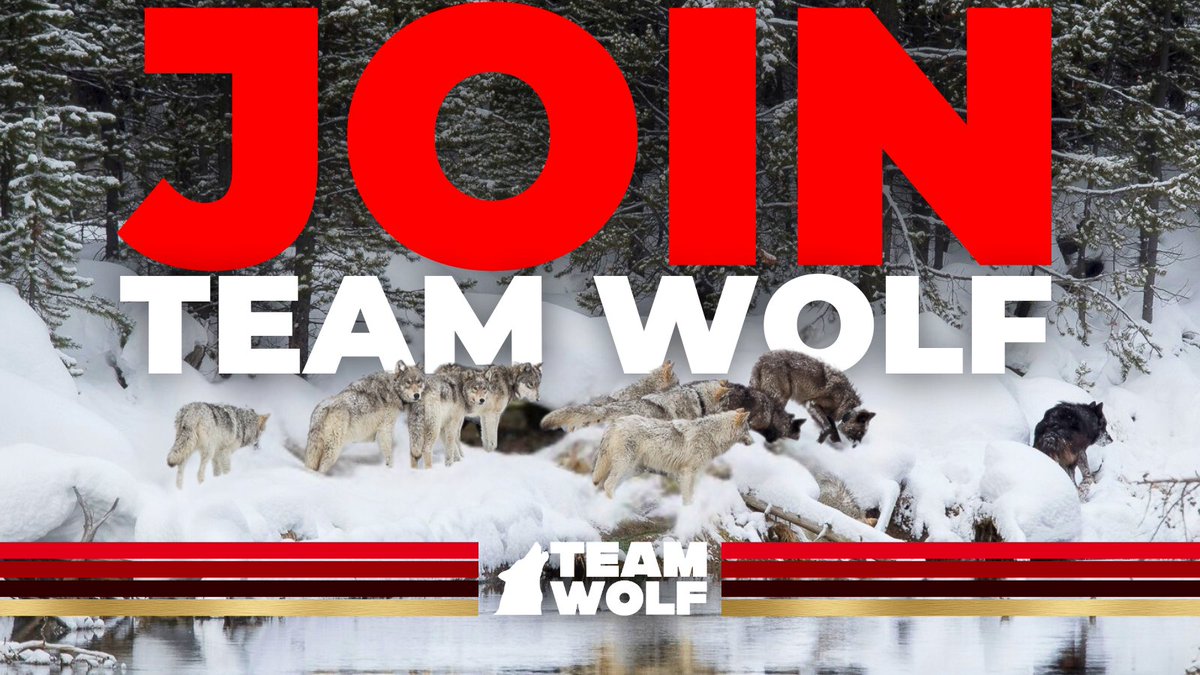
Wolves are worth fighting for, and all it takes is your voice. Join the largest pack of wolf supporters in the world!
Join us at https://t.co/4Wy6SWqWF0!
Image courtesy of Jake Davis
Wyoming is cutting its regulated wolf hunt in half after disease drove wolf numbers to a 20-year low—exposing how fragile “recovery” is when wolves are kept at bare minimum numbers.
Real recovery means resilience, not survival on the brink.
Take action: https://t.co/4Wy6SWqWF0
Norway just made a decision that will be remembered for years.
The country has officially ended fur farming nationwide. No more mink or foxes will be bred, kept in cages, and killed for clothing. An industry built on animal suffering is now gone.
This took years. Investigations exposed what life in fur farms looked like. Animals lived in small wire cages. They could not run, dig, or behave naturally. Many showed clear signs of stress. People saw the reality and spoke up.
Public pressure grew. Animal welfare groups kept pushing. More citizens questioned whether fashion could justify that cruelty. Lawmakers responded and passed a ban. Farmers received time to transition and shut down their operations. That process is now complete.
This matters. Thousands of animals will not be born into cages. Fewer lives will be treated like products. Norway chose compassion over tradition and profit.
The impact also reaches beyond Norway. Decisions like this show other countries that change is possible. They push others to look at their own systems and ask if they still make sense.
Consumers are driving this shift too. More people choose alternatives. More brands stop using fur. Demand is changing, and industries are forced to follow.
This is what progress looks like. It builds over time through awareness, pressure, and action. Then one day, what once seemed normal is no longer accepted.
Norway has drawn that line.
Sources:
- Euro Group for Animals: Fur farming ends in Norway as remaining farms close doors
- Dyrevern: Breaking News: Norway bans fur farming
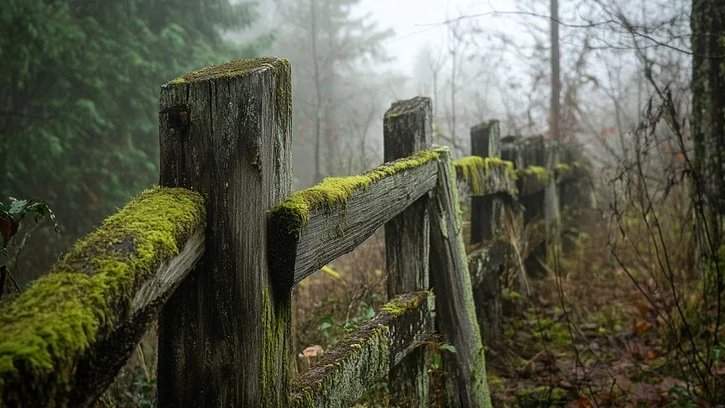
That little patch of moss on your fence or shady spot is doing work on a planetary scale.
Moss stores 6 billion tons of carbon globally. It pulls carbon out of the air, holds moisture, and supports tiny ecosystems.
So maybe stop spraying it with chemicals and power-washing it off.
Your moss is on the job, let it stick around.
In 77% of the cases where a wolf pack is dissolved, the dissolution was preceded by the death of a breeder wolf. Packs rely on the mother wolf to survive. Join the fight— become a part of #TeamWolf today at https://t.co/4Wy6SWqWF0 !
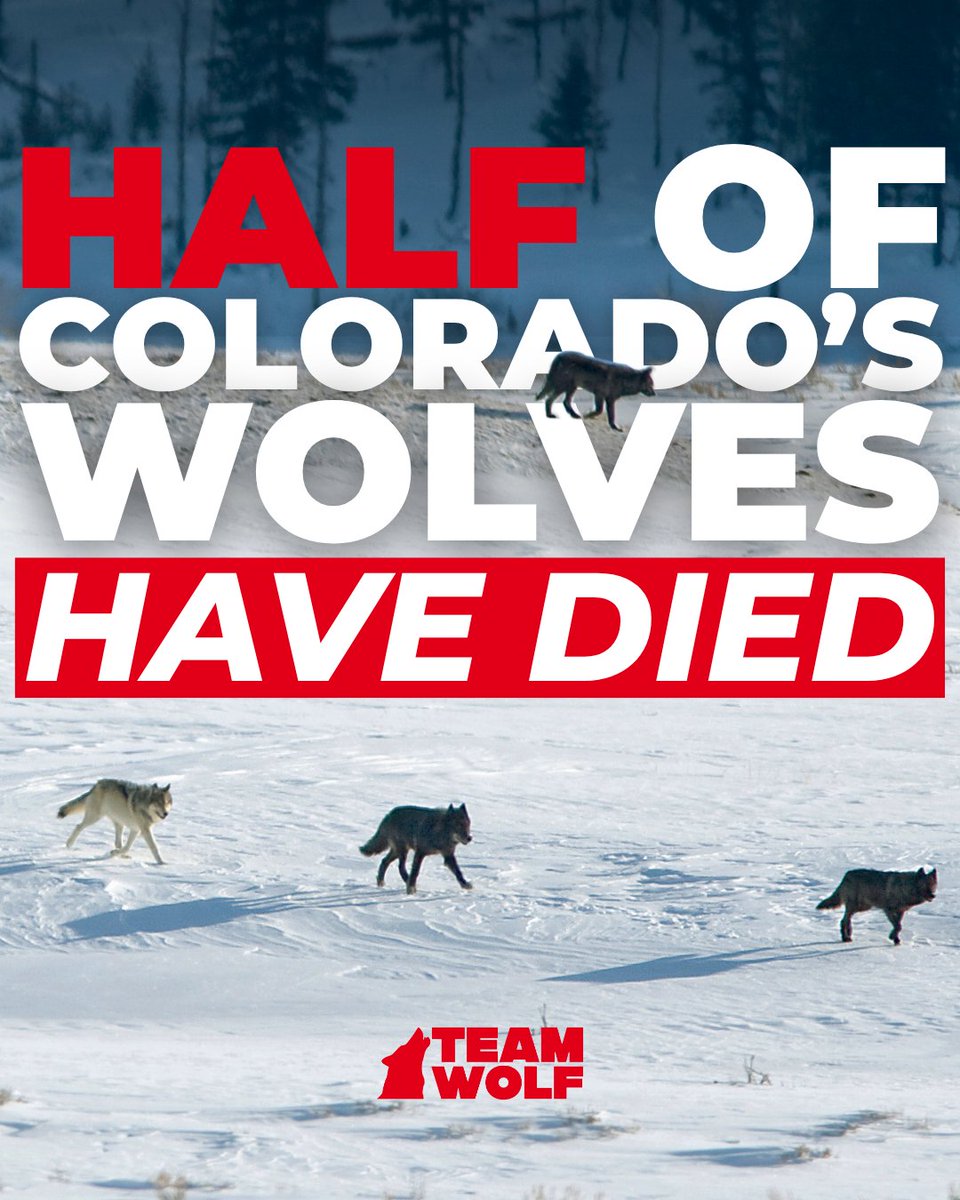
More than 1/2 of CO's reintroduced wolves are dead.
Early losses can occur, but the program’s future remains uncertain without a confirmed source for more wolves.
We need your voice to support CO wolves during USFWS Public Comment period.
Add your name: https://t.co/4Wy6SWqWF0
Colorado just opened the biggest wildlife overpass in North America.
Before it opened in December, the 18-mile stretch of I-25 between Castle Rock and Monument averaged one wildlife collision per day in migration season.
Elk, pronghorn, mule deer, black bears, mountain lions, all trying to cross six lanes of traffic to reach the 39,000 acres of habitat on the other side.
The new overpass is almost an acre wide, covered in dirt, and seeded with native plants. It connects to five underpasses and a fencing system that funnels animals toward safe crossings instead of the interstate.
Wildlife crossings work. Banff has documented 220,000 crossings on its system over 25 years. Korea has built 120 of them. The Netherlands runs the densest network on Earth.
The U.S. has roughly 50 wildlife crossings for 4 million miles of road. Every state with significant wildlife collisions could be building these, but most aren't.
Wildlife collisions cost the U.S. over $8 billion a year in vehicle damage, injuries, and lives. A single overpass pays for itself within a decade.
If your state hasn't built one, ask why.
In 2016, 5,712 Native women and girls were reported missing in a single year. Only 116 of those cases were entered into federal databases. Behind every number that was never counted is a name that deserves to be spoken.
In the 1980s, monarch butterflies filled the skies of North America in numbers so vast they could dim the sun. Over a billion strong, their migration was one of the greatest wildlife spectacles on Earth orange and black wings carrying them thousands of miles from Canada to Mexico.
And then, slowly, they disappeared.
Pesticides wiped out the milkweed they depend on. Roads and development fractured their ancient routes. Climate change disrupted the timing they had followed for millions of years. Quietly, almost invisibly, this natural wonder collapsed.
Today, some populations have declined by 99.9%. Billions have become thousands. The skies that once burned orange in autumn now fall mostly empty.
The monarch didn’t vanish because it was weak. It vanished because we weren’t paying attention.
And that’s the hardest part not that it happened, but that it happened while we were distracted.
Protect what takes your breath away, before it exists only in photographs.