Uber's price window closed. The businesses that thrived were the ones that built during it.
AI's window is open right now.
Are you building dependency — or capability?
One will age well.
https://t.co/4DsvgisrLP
You don't need an engineering team for this.
Audit your AI spend. Classify each workflow into 3 layers. Ask vendors where pricing is going. Pick one thing to build and own.
78% of IT leaders report surprise AI charges. Don't be the statistic.
https://t.co/4DsvgisrLP
Routing simple tasks to lighter models cut AI costs 39% and improved latency 32–38%.
Open-source models now hit 85–90% of frontier quality on routine tasks.
Not every task needs the smartest AI in the room.
https://t.co/4DsvgisrLP
Two ways to use AI:
Consumption: ask, use, repeat. Bill recurs forever.
Production: use AI to build something you own and run. Pay once.
Ask this about every workflow: "Is the output something I keep — or something I repeat?"
https://t.co/4DsvgisrLP
Three layers every business needs for AI:
1. Build & own — generate code you keep
2. Route & right-size — cheapest capable model wins
3. Invest in frontier — only where quality differentiates
Most operators haven't sorted their workloads this way.
https://t.co/4DsvgisrLP
AI API costs dropped 300x since 2023. Enterprise AI spend rose 36% in one year.
Both are true. And Microsoft already raised M365 prices 13–17% citing AI.
The floor drops faster than the ceiling.
https://t.co/4DsvgisrLP
In 2014, Uber lost money on every ride.
$1.50 trips. $4 to deliver. Not transportation — dependency.
AI is your $1.50 ride right now. What are you building on top of it?
https://t.co/4DsvgisrLP
All of it — canonical fields, semantic layers, access controls — serves one goal:
A room that trusts the numbers.
Trust breaks in one meeting. Rebuilding it takes months.
https://t.co/1xH4AGX8vT
BigQuery, Snowflake, Redshift Serverless all charge by data scanned.
An analyst who doesn't know this can take your bill from $400 to $4,000 in a month.
Nobody told them.
https://t.co/1xH4AGX8vT
Two ways data access fails. Both are damaging.
Over-access: compliance risk.
Over-restriction: analysts can't work.
The second causes more business damage. Quietly. Over months.
https://t.co/1xH4AGX8vT
Looker. Tableau. Power BI.
None of them fix your data problem.
They're mirrors. If your semantic layer is a mess, they'll show the mess clearly.
Fix what's underneath first.
https://t.co/1xH4AGX8vT
The fix most teams skip: canonical fields.
A formally designated version of each metric, enforced in the semantic layer.
The tools exist. The organizational agreement doesn't.
https://t.co/1xH4AGX8vT
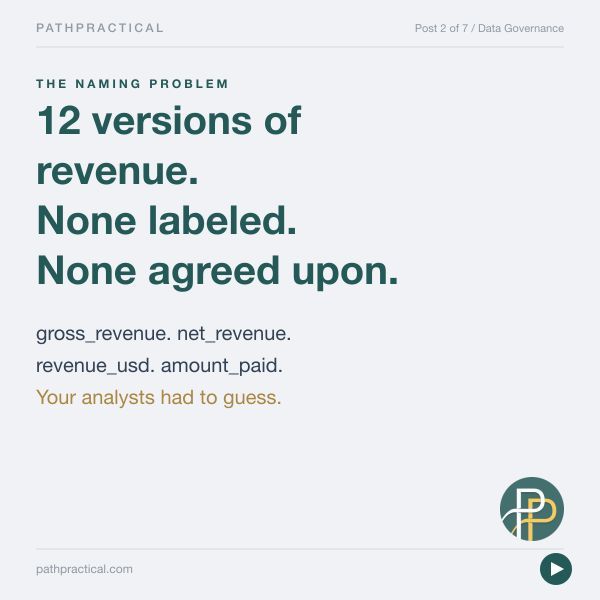
Your warehouse has 8–15 versions of revenue.
gross_revenue. net_revenue. revenue_usd. amount_paid.
Not one is labeled "use this one." Your analysts have to guess.
https://t.co/1xH4AGX8vT
Three analysts. Same warehouse. Three different revenue numbers.
Nobody made a mistake. The system failed them.
Five things breaking your data governance — and how to fix each one.
https://t.co/1xH4AGX8vT
AI isn't following your instructions. It's reflecting your judgment.
Custom skills built around your methodology. Output formats that enforce your standards automatically. A system that knows what "good" looks like.
→ Full breakdown of all 7 levels: https://t.co/1oaQ6NsWTp
At some point, you stop prompting AI and start running processes.
Build workflows where structured data flows in, AI works on it, and a finished output comes out — without you touching it in the middle.
→ Full breakdown of all 7 levels: https://t.co/1oaQ6NsWTp
The problem with Levels 1–3: every session is a performance.
You're improvising. Every time. Your output quality depends on how much time you have. How sharp you are that day.
That's not a system. That's luck.
→ Full breakdown of all 7 levels: https://t.co/1oaQ6NsWTp
The AI that knows your project is a different thing entirely.
At Levels 1–2, every session starts cold. You re-explain who you are, what you're working on, and what you need. Every time.
→ Full breakdown of all 7 levels: https://t.co/1oaQ6NsWTp
How many versions of “revenue” are in your data warehouse?
If you have a data warehouse the honest answer is: probably a lot.
gross_revenue. net_revenue. total_revenue. revenue_usd. amount_paid.
None of them have a label that says “the official one.”
https://t.co/OU7nq4Ig2s
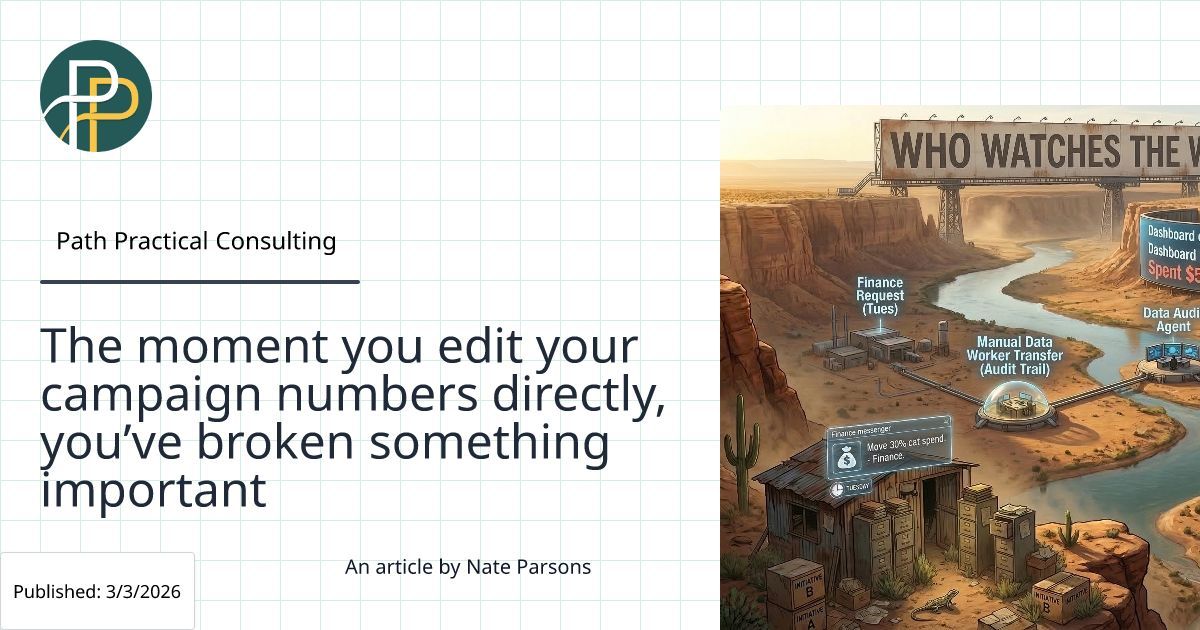
The moment you edit the numbers directly, you’ve broken something important.
Finance asks you to move 30% of last quarter’s campaign spend from one category to another. You open the reporting system and adjust.. But you've just broken your data.
https://t.co/OU7nq4Ig2s