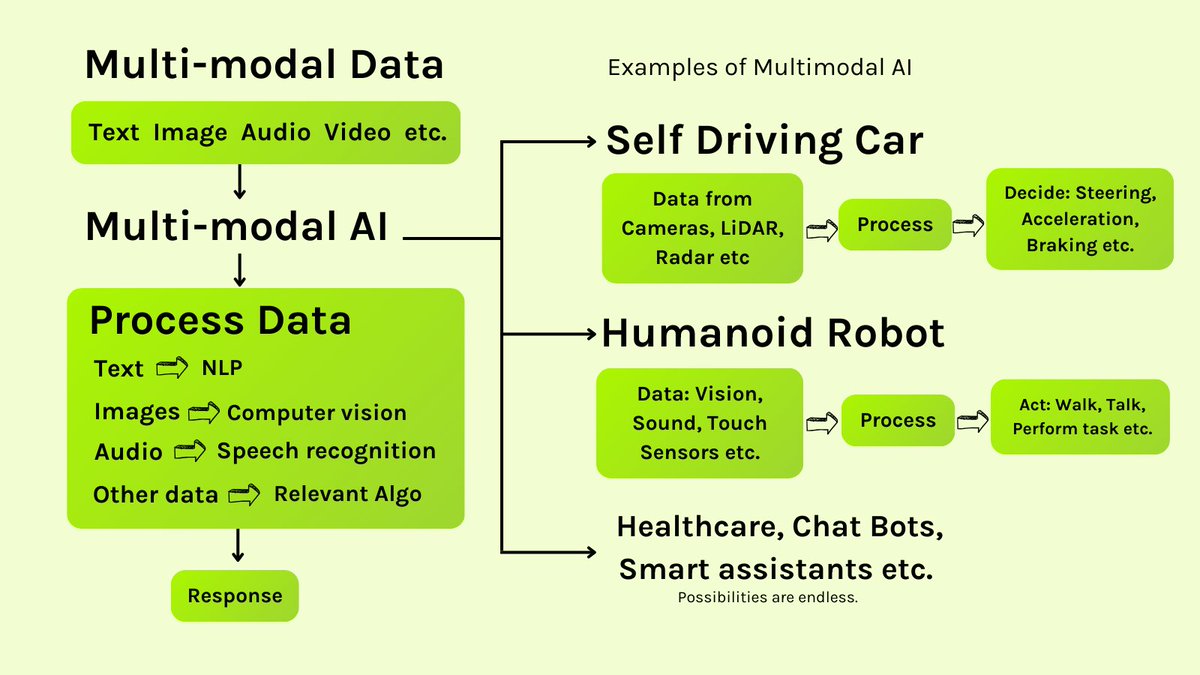
The vast amount of data in the world isn't textual. Data exists in the form of text and images, audio, video and more. To be able to fully understand the world, AI needs to be able to understand and process ALL of these different forms of multimodal data.
Multimodal AI systems are capable of processing different data types using specialized algorithms. It works in parallel, processing text through Natural language processing algorithms, audio through speech recognition algorithms, images through computer vision algorithms, and etc. Once all these different data are processed, AI combines them to form a more comprehensive output.
To compare it with us, we see, hear, visualize and combine all of them. For example, when you talk with your friend, you listen to what they say, notice their expression and act accordingly. This is similar to how multimodal AI work, it can process multiple data to generate output comprehensive output. What’s Interesting about multimodal AI is, if one modality is unreliable or unavailable, it can rely on other modalities to get a response instead of hallucinating.
Example:
- Self driving car takes input from sensors like radar, LiDAR, cameras, and ultrasonic sensors etc to navigate safely.
- Humanoid robots also takes input from like vision, audio, touch sensors etc. to act and perform task.
- In healthcare, it can combine different reports like CT-scans, X-rays, ECG etc. for diagnosis. etc.
The possibilities are endless.
TL;DR Our world is made up of diverse data like: audio, visual, text, and more. By combining and processing this data, we can develop more reliable AI models for real-world applications like self-driving cars, medical diagnostics, humanoid robots and many more!
Internal requests for building training datasets + our crawling index are 500-1000x this, depending on the day. The goal is for external LCR usage to eventually flip our internal usage.
A very important milestone for Grass, and one I’m particularly proud of.
There’s a much bigger story behind where this is going, but for now: huge credit to the team that built it.
My hot take is that it’ll probably take a while for personal agents to begin executing everyday purchases on behalf of people on a meaningful scale, and are more likely to act primarily as recommendation engines / price trackers for a while.
Main reason being many people love the act of shopping itself (actually you can probably safely argue that the majority of consumer use is scrolling social media & scrolling shopping websites, and consumers are addicted to both).
That said, if a major use case of “agents” for consumers ends up being shopping advice, what matters a lot less than the execution medium (whether the person or the agent clicks “buy”) is the fact that the agent is accurately reading the real-time state of each webpage. Nobody wants to use an agent for shopping if it’s recommending outdated prices or stock.
In other words, if agents suck at public web access, they will quickly become irrelevant for most consumer use cases. It turns out that the heaviest antibot occurs on e-commerce and travel websites, and will only show accurate data to consumer device fingerprints / IP addresses…
Grass DataCo Ltd., a wholly owned subsidiary of Grass Foundation, provides data infrastructure to leading AI labs training frontier models.
We're publishing an independent attestation of its revenue through Q2 2026, conducted by Regen Financial.
Full report: https://t.co/yvqFre8YZd
Imagine telling someone in 2024 that not over-relying on synthetic data is a good thing.
The reality is LLM outputs are biased towards the high-density regions of the training distribution.
Synthetic data is a lossy reconstruction of reality. That's great for augmentation and distillation. But if models increasingly train on the outputs of other models, we're effectively recompressing a compression. The first thing that disappears is the long tail (rare observations and genuinely novel information), and much of what we call intelligence is the ability to reason about those exact things.
The next GRASS Token Holder and Network Participant Call will take place on July 7. The call will provide an overview of Grass network progress, the development roadmap, business milestones, growth highlights, and more.
To promote equal access to information, the call will be open to the public. Questions may be submitted in advance for consideration during the session.
Further details, including the exact time and registration information, will be shared soon.
The network is more reliable than it's ever been as our success rates and core performance metrics have increased across the board.
This is a result of improvements to our detection and filtering capabilities that remove bots, bad actors, and low quality nodes from the network. Our efforts to prevent bad actors from gaming the system have led to stronger and more sustainable network performance.
Our goal has always been simple: reward real users who support the network with bandwidth that the network can actually use.
Real rewards for real users.
There's nothing quite like waking up to see new network points added on the dashboard overnight. Instead of big corporations quietly profiting off my unused bandwidth, it's now helping train AI models and I get rewarded for it.
win-win, especially as someone who's genuinely passionate about AI.
grass in 2025
> 3x’d node count
> launched the most performant multimodal data crawl in the world
> broke 3PB in daily scraped data
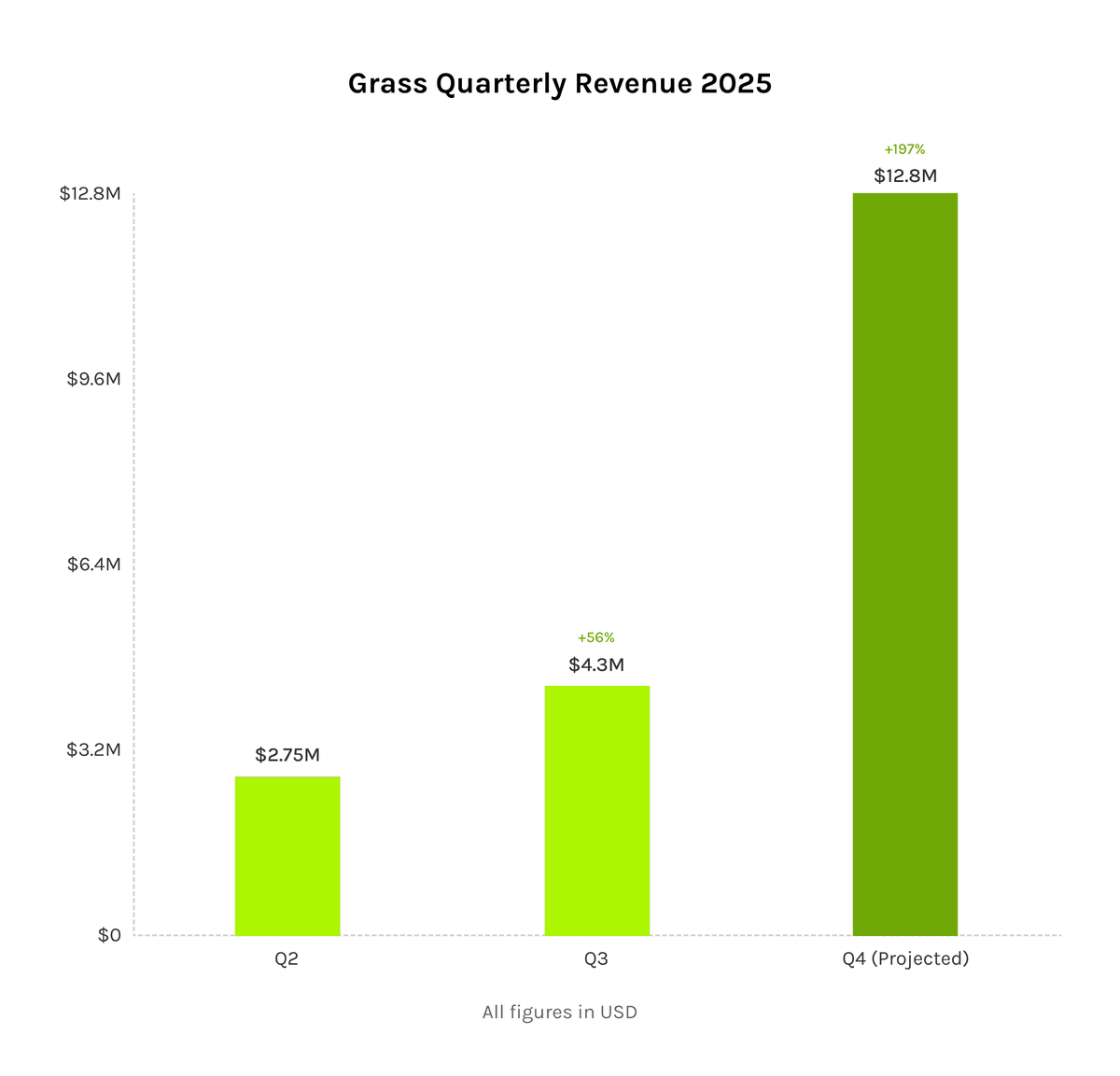
> scaled quarterly revenue from data sales to 8 figures
among other things, a big focus for 2026 will be expanding from training to inference data
we're growing quickly at Wynd Labs.
if you are highly technical, wanting to work with exabyte-scale data in a high performing and competitive environment alongside world class talent, send me a message.
Enterprise revenue flows directly to the Grass Foundation.
Wynd Labs is a service provider executing the network's mandate.
This structure ensures that as the business scales, value accrues to the ecosystem itself.
Andrej Radonjic breaks down the structure 👇
2025 has been a breakthrough year. Grass has evolved into one of the largest multimodal data providers, with accelerating commercial demand from AI labs and enterprise clients.
Every dollar generated is being reinvested to expand network capacity and support the Grass ecosystem.