Honestly, I don't think I'm qualified to talk about this. Freedom is a word we've heard again and again since we were kids, and I still can't say exactly what it is. Maybe this question never has an answer.
But if freedom is personal, it gets much clearer when I look at my own life. To make it even simpler, let me start from the opposite side.
What is not freedom?
1. Playing games vs. getting lost in games all day.
2. Having the courage to talk to a girl vs. being driven by sex, with a different girlfriend every week.
3. Sleeping on a schedule vs. working all night just to prove to myself I'm working hard.
The answer is easy. For me, freedom is self-control. It has nothing to do with how much money I have, how busy I am, or whether I have a good girlfriend. The key is control.
I have to keep this in mind, because I lose my freedom often. I get hooked on anything that gives high dopamine. I can work for hours without leaving the keyboard, watch porn with no limits, and play games till morning.
So freedom isn't something I have. It's something I take back, one small choice at a time: closing the game, closing the tab, going to bed. https://t.co/lA2c9SstjC
Even the best traders lose, and losing is normal. What matters is never getting wiped out, and waiting for the right moment to bet big.
The chart shows it. Most of his trades are small and go nowhere, but when he wins, he wins big. I wanted to know how, so I went through his recent trades.
Here is what he did:
1. Around Aug 20, NEAR's volume jumped. He bought in, around $1.9, without knowing yet if it was a real trend or just noise.
2. The price went nowhere for two weeks. He admitted he was wrong and got out on Sep 2, at about breakeven.
3. A few days later the price broke above $2 on three times the volume. He bought back in at a higher price, about $2.30, and built a bigger position than before.
4. Then the news came out, and NEAR went past $5. He held through it.
His strategy is simple, but he did three things right:
1. When the market didn't confirm his bet, he left quickly, even if it cost a little.
2. When the chance came back, he came back too, without thinking "but I sold lower than this."
3. When the move finally came, he didn't rush to sell. He let it run.
愿赌服输. Own the bet.
More articles at https://t.co/t9ixBF3a7i
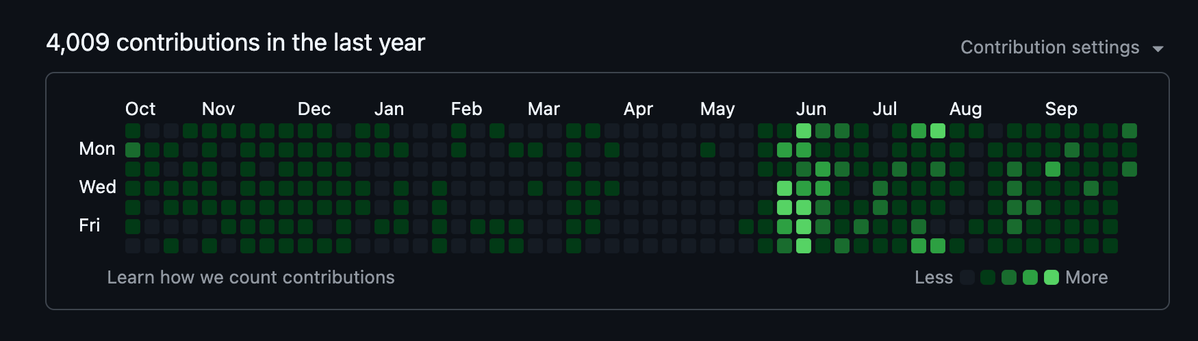
Saw 4K+ GitHub commits this year. Never aimed for it.
So I tried counting things from my heart instead: promises kept, thank-yous missed, excuses made, and how often I was too scared to say hi. https://t.co/ZLwQ6SOdib
@badlogicgames cool, i also implement this on iphone ^^ it is insane.
1) stable connection. better than codex.
2) customized behavior, e.g. i add proactive feature for agents, like muse/today
@philkellr Can not agree with you more. Before AI era, I can read academic paper for several hours. But now, I just want AI to summarize it. My attention becomes very very scattered
I wrote my first blog in English.
It's about how I live with AI day to day, as a phd student.
It contains work, life, and what I got wrong. ideas are tested.
https://t.co/GsO5XF8phH
@GarinZhang@pidotdev check pix
https://t.co/M2ffJcWQLH
this is a extension i maintained for myself.
feel free to your agents, to only deploy its enhanced image paste feature for you.
Eventually, there is a guy who share the same opinion with me...
why should we use 1-2 hour a day to let agent learn the up-to-date noise of the world?
Everyone's building a "second brain" now.
Obsidian, Notion, 400 notes, a connection graph that looks like a subway map.
And you still can't remember what you read yesterday, because you spent the whole day scrolling instead of thinking for even 10 minutes.
Why do you need a second brain when you barely use the first one?
@mateusz_palak also, in finance trading, there is a saying: 99% of infomartion are just noise.
especially in today's world, which is occupies by fake news.