@elonmusk What’s interesting is that this feels totally unimpressive to me … but it shouldn’t!
I think it’s the fact that in Arizona we have nonstop Waymos lining our roads.
Crazy that I’m so used to driverless cars that this advancement in technology feels “meh” to me
My mentor Bob Woodson has passed away, and though my heart is heavy, I take comfort knowing he is now at rest with Christ. His wisdom, courage, and faith shaped my life and work in ways I will carry always. I’m deeply grateful for his guidance, friendship, and enduring example.
The Woodson Center Mourns the Passing of Founder and President Robert L. Woodson, Sr. - A visionary leader whose life's work transformed communities from the inside out.
Read our full statement here: https://t.co/0rp3nhxynq
The Woodson Center Mourns the Passing of Founder and President Robert L. Woodson, Sr. - A visionary leader whose life's work transformed communities from the inside out.
Read the full statement here: https://t.co/qkCExpOiJh
Wait! I thought the Augsburg Confession said
“we are justified before God by our own mental gymnastics, when we labor strenuously, yea with sweat upon the brow, to think really, really, really hard about believing. For God is well-pleased not by the gift and promise of Christ alone, but chiefly by our furrowed brows, our clenched teeth, and the sheer velocity of our brainwaves”
@C2Antiquity The LCMS believes Anglicanism does not guard the doctrine of justification and the sacraments with the same clarity and certainty that the Lutheran Confessions demand
Unlike some reporters, I've met people in public housing and have seen what years of dependence on the government can do to a family.
Our mission is to grow people, not government, and get able-bodied, able-minded people to a life of self-sustainability.
The poor are not a monolith, per @WoodsonCenter.
1. Some are poor due to their decisions (only inside-out transformation helps, which is difficult but possible, per @BobWoodson).
2. Some are "poor" by gaming the system for Medicaid and benefits, choosing this over employment (we need less exploitable systems).
3. Some are poor temporarily and need help to restart.
4. Some are poor due to permanent mental or physical disabilities (we need better ways for families, churches, or communities to provide long-term care).
If by “attractive” you are collapsing some subjective mix of physical, financial and social strengths then I agree
Most of the research that focuses on physical attractiveness misses (don’t control for) that those attributes are often proxies for financial and social strengths
If financial and social are disconfirmed, the physical strengths are rarely enough.
The the Integrated Artificial Intelligence Professional (IAIP) certification is OFFICIALLY LIVE and open for enrollment. 📢
The gap between organizations with proper AI governance and those without grows wider daily, and now, more than ever, we need leaders. That's why we created the IAIP. It helps:
➡️ Position you as a leader in the rapidly evolving AI governance landscape
➡️ Give you access to the complete Integrated AI Framework
➡️ Make you part of an elite group of IAIP-certified professionals
➡️ Develop skills that position you as both an enabler of AI and protector of organizations
➡️ Build stakeholder confidence in your AI governance capabilities
➡️ Break down traditional silos between technical and governance teams
With IAIP, while others are still learning the basics of AI governance, the savviest GRC Professionals (pssst... that's YOU) will already be certified and leading the way.
OCEG's IAIP certification program includes:
✅ Comprehensive exam covering all aspects of integrated AI governance
✅ Access to the complete Integrated AI Framework
✅ All training materials and resources
✅ Certificate upon successful completion
The best part? Your Pro All Access Pass includes the entire certification, exam, framework, and all training materials for 𝗻𝗼 𝗮𝗱𝗱𝗶𝘁𝗶𝗼𝗻𝗮𝗹 𝗰𝗼𝘀𝘁.
🔗 Register for the official IAIP certification today: https://t.co/RhLUhFXvt8
#AIGovernance #GRC #GRCCertification #AI #AICertification #GRCTraining
World record: 1 million GB per sec internet speed achieved by Japan over 1,100 miles | Rupendra Brahambhatt, Interesting Engineering
Current data transfer speeds aren’t enough to support AI, VR, IoT, and various other emerging technologies. Here’s a mindblowing solution.
Imagine downloading 10,000 4K movies in just a second. A team of Japanese researchers has achieved such a mind-blowing internet speed using a specially designed optical fiber that’s no thicker than what we use today.
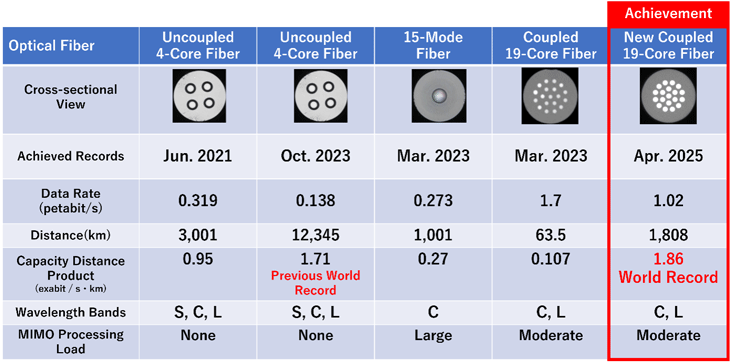
The researchers set a new world record, transmitting 1.02 petabits (1.02 x 106 GB) of data per second over a distance of 1,808 kilometers (~1,118 miles) using their special coupled 19-core optical fiber. However, this achievement isn’t just about faster internet.
In their new study, the researchers claim that their newly developed optical-fiber technology can help us prepare our networks for a future where data traffic will skyrocket, thanks to AI, 6G, the Internet of Things, and beyond.
The science of insane internet speed
For years, scientists have tried to increase the amount of data that can travel through optical fibers. While they’ve managed to send petabits per second before, they could only do it over short distances (less than 1,000 km or 621 miles).
Long-distance transmission has always been challenging. That’s because the signal weakens as it travels, and amplifying it across many fiber cores without creating interference is a major technical challenge. The study authors tackled the problem by designing a special type of optical fiber—a 19-core fiber.
Think of it like replacing a single-lane road with a 19-lane superhighway, all bundled into a fiber just 0.125 mm thick, the same size as those used in existing infrastructure. Each core carried data independently, and together they allowed a huge amount of information to move simultaneously.
The researchers also developed a smart amplification system. Optical signals lose strength as they move along the fiber, so amplifiers are used to boost them. However, there’s one catch: each core had to be amplified at the same time, and across two different bands of light (C-band and L-band).
The team built a system that used a combination of special amplifiers to do this in all 19 cores without mixing up the signals. They set up 19 recirculating loops, each using one core of the fiber, and passed the signals through them 21 times to simulate a total distance of 1,808 kilometers.
At the end of the journey, a 19-channel receiver caught the signals, and a multi-input multi-output (MIMO)-based digital processor cleaned them up, removing interference and calculating the data rate.
The result was astonishing. A total capacity of 1.02 petabits per second over 1,808 km was achieved, setting a new world record for optical fiber communication using standard-sized fibers. Even more impressive, the capacity-distance product, a key measure of fiber performance, reached 1.86 exabits per second-km, the highest ever recorded.
A powerful and practical fiber technology
This isn’t the first time a 19-core optical fiber has been put to the test. “The transmission over an earlier generation of 19-core coupled-core fiber was limited to 1.7 petabits per second over a relatively short distance of 63.5 km,” the study authors added.
However, this is indeed the first time that this revolutionary technology has broken the distance limits by carrying data over 1,800 km. This success could completely reshape how we build the internet of tomorrow.
As the world moves into the post-5G era, with self-driving cars, AI assistants, real-time VR, and billions of connected devices, we’ll need massive data highways to keep everything running.
“In the post-5G society, the volume of data traffic is expected to increase explosively due to new communication services, and the realization of advanced information and communication infrastructure is required,” the study authors added.
This research shows that it’s possible to build ultra-high-speed, long-distance fiber networks without changing the size of existing infrastructure, which makes real-world deployment much easier. However, when this new optical fiber technology will actually roll out remains to be seen.
Read more:
https://t.co/kmhybbVsGE
My grandfather would buy lottery tickets once the pot reached certain thresholds.
And the $2 provided more than a 1 in a zillion chance of being rich.
It afforded
1. Leisure time with his grandchild in the car and at the gas station where he purchased the ticket.
2. Entertainment around betting on his lucky numbers (birthdays of family members)
3. Jokes with friends and family about surly winning the lottery “this time” … and “I’m not sharing…”
4. Conversation re “what would you buy if…”
5. And more
Terrible strategy to actually get rich. Potentially legit strategy for other social wants/needs.