@NoahRevoy I wonder if any of this is innate, I find myself thinking about ways to simplify my life and a desire to sell a lot of my things as of late.
@GuruAnaerobic At least you can still start a motorcycle with a dead battery and no kick start by giving it a push down a slope, hopping on and slowly letting out the clutch with it in 3rd or 4th gear.
Same with a car -- if it's a stick shift.
Automatics? Good luck.
The only constraint on the table isn’t computational efficiency. First, there are additional technical constraints in gaming, like the requirement for very low latency in response to human input, limited by the speed of light and server-side predictive abilities. But secondly, and more critically, another constraint is also distribution of control, and freedom in computing. Stadia and similar deeply misunderstood this, which is why they didn’t pan out.
Economic value is dictated not merely by resource efficiency, but by efficiency in producing what individuals find valuable. Thus, there is substantial counter pressure to centralized gaming servers, and that’s a very good thing.
Beyond this, centralization is not even necessarily the most computationally efficient architecture. Distributed problems are much better solved by distributed systems in principle, because you want to eliminate synchronization & contention.
Central planning enjoyers do not seem to understand this. On top of bringing computations closest to the user (physically & thus in time, minimizing latency floor etc.), free, personal, user-owned computing distributes a highly sophisticated computational problem (what to run & how) to every home (or pocket), with zero synchronization overhead.
Comparing 120fps to 30fps on a laptop is disingenuous at best.
Maybe for console users and low end gaming PCs it could make sense, but it's a long way from replacing a high end rig with 240hz monitors, let alone 300 or 400+ hz displays and associated high end hardware.
Click to pixel end to end is a decent measurement but misses how much a cloud provider can mess with the quality when you don't control the hardware or the streaming software, 4K 120 on a cloud provider may look very different, and even feel different with more felt latency than instantaneous measurements might lead one to believe.
On the bit of latency as well, I wish video game studios, and operating systems more broadly would push down the audio latency as much as possible, the hardware is largely capable already, but the software stands in the way.
In other words, if a student uses a prompt with a bullet point list to generate an essay, and a professor uses an LLM to extract a bullet point list from an essay, the actual information content (lossily) transmitted was the bullet point list. The rest was waste. Nobody actually cared about it.
It’s even worse than that, though. The more significant societal function of university is *not* really personal educational development, but rather acting as a social signaling mechanism for conscientiousness and being above a minimum bar of intelligence. If students are simply writing prompts, the conscientiousness and intelligence requirements are effectively gone, meaning universities (if they function primarily electronically) now signal ~nothing of importance.
Citizens of @X, we would love to hear your feedback.
What features do you want to see in our trucks?
To avoid answer redundancy, check the photo below for existing committed architecture items.
@reoindustries@EagleZeroX@X I've worked on tons of vehicles over the years, everything he listed above is absolutely on-point.
I'd add also, access panel for heater core and/or AC evaporator.
Electronic AC compressor is also a good one, means you can get away with a less complex belt system too.
@reoindustries@X Limited slip (torsen style preferred) or locking rear diff at a minimum. Absolutely under-rated feature I miss in any truck/SUV without it.
Ability to turn off ABS without pulling a fuse. Anyone who's dealt with snow and ice knows how bad even the best systems are.
There is no demand for huge quantities of slop. More commits / LOC / PRs does not equate to more valuable productivity. Users want fewer, but better, programs.
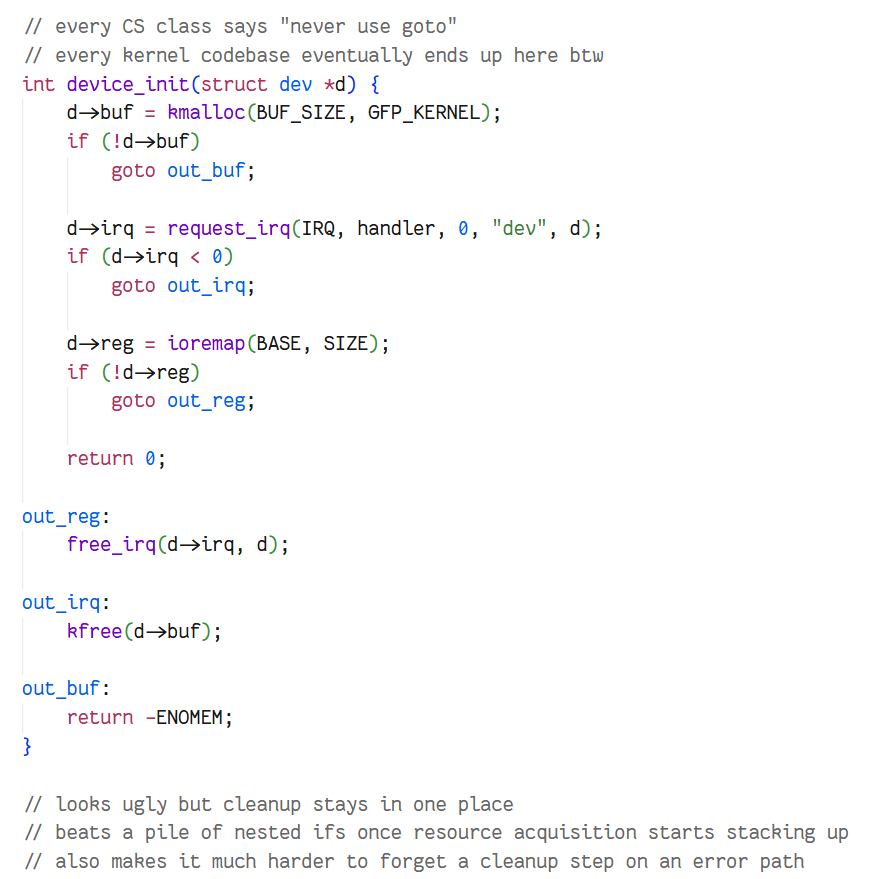
Non-local goto isn't great, sure. C has that as `setjmp` and `longjmp`. But that's not your pedestrian `goto` people so often complain about without any understanding.
Dijkstra called goto harmful in 1968
the Linux kernel contains tens of thousands of goto statements
the label out alone appears thousands of times
Linus's response on LKML in 1997: "there's nothing wrong with gotos, especially for handling error cases"
@awesomekling I dislike almost all of the UI toolkits on Linux. Qt is probably the only sane choice at the moment for new development, but it still has all sorts of oddities. I just assume I'm going to have an annoying hodgepodge of different UI toolkits on Linux, forever.
Modern “AI” is prediction using a statistical model based on a huge dataset of preexisting human work. This, by definition, considers ~mean quality output as successful output. That isn’t a bad thing, nor is it useless, but that’s what it is.
Software has sucked for a long time. A small number of people really cared to make it great. They are statistical outliers.