"A person who does not know the history of the last 3,000 years wanders in the darkness of ignorance, unable to make sense of the reality around him."
— Johann Wolfgang Goethe
@exhale603156241 @nu_ya_nikto “And Peleus the aged was telling his own son, Achilleus, to be always best in battle and pre-eminent beyond all others.”
-Iliad 11.783–784
Napoleon did an insane amount of reading when exiled on the island of St. Helena.
He brought 588 volumes from France, and his captors sent him another 1,200 paperbacks.
What did he read? His librarian wrote:
"The Emperor was infinitely fond of reading. The Greek and Roman historians were often in his hands, especially Plutarch. He could appreciate this excellent author more than anyone else. Therefore The Lives of Illustrious Men always appeared on the shelves of his campaign libraries. He often read Rollin. The history of the middle ages, modern history, and particular histories occupied him only casually. The only religious book which he had was the Bible. He liked to read over in it the chapters which he had heard read in the ruins of the ancient cities of Syria. They painted for him the customs of those countries and the patriarchal life of the desert. It was, he said, a faithful picture of what he had seen with his own eyes. Every time that he read Homer it was with a new admiration. No one, in his view, had known what was truly beautiful and great better than this author; consequently he often took him up again and read him from the first page to the last. The drama had great charms for the Emperor. Corneille, Racine, Voltaire, often had one or two acts of their pieces read aloud. He preferred Corneille to the others, in spite of his imperfections; he always chose what was as lofty as he himself, Napoleon. Sometimes he would ask for some comedy which he had seen played, and from time to time a piece of poetry, for instance, ‘Vert-Vert’ [by Gresset]. He also took pleasure in reading some parts of Voltaire’s Essai sur les moeurs et l’esprit des nations, as well as some articles from the Dictionnaire Philosophique of the same author. Novels helped him to relax and broke the seriousness of his habitual occupations. Gil Blas, Don Quixote and a small number of others would be read by him. Those of Mesdames de Staël, Genlis, Cottin, Souza, etc. he read over sometimes, but the novels which he could not bear were those of Pigault Lebrun. He could not endure this author, although he had almost all his works; he never thought of asking for a volume of them, and would have refused one if it had been offered to him. He had nearly always under his eyes all the works relative to the military art and the campaigns of the great captains. One author, Polybius, which he had desired for a long time, he received only during his last days, when he had almost given up work. It was only by chance that he took up a scientific work; books of this sort were only occasional."
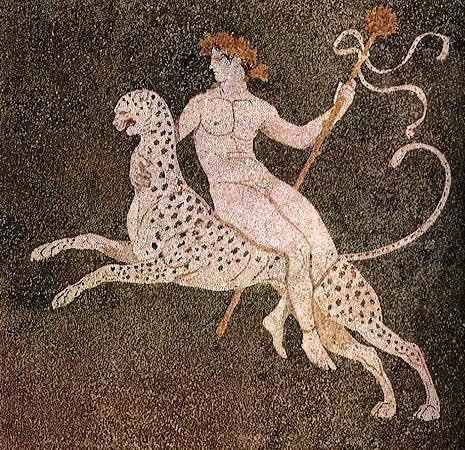
Büyük İskender Hindistan'ı fethettiğinde askerleri "biz Dionysos'un peşinden gidiyoruz" demiştir. Mitolojide Zeus'un emri ile Dionysos'un Hindistan'ı fethi yer alır!
Dionysos orada LEOPAR üzerinde resmedilir. Karahantepede'ki gibi!
The presence of dreams proves the existence of Kant's Transcendental Apperception (we might call it a Universal Constructor) because it's that synthetic process of memory & imagination which constitutes dreamwork, and this happens independently of conscious awareness.
Every early Polis had its own god or gods, who were understood to compete with those of other cities. They were not passive divinities but active civic protectors, expected to secure victory in war & safeguard the city. When they failed, citizens could regard them almost as soldiers who had deserted their post, having neglected their sacred civic duty.
The cult-like worship of certain females, especially by European young men, seems to be a deep archetype of "Minnedienst", "Love-service" in their ethnic memory.
It's not about really being with the woman. It's about praising her beauty and going to battle for her (this part is missing, unfortunately, today; this means posting).
It is the “High Minne” of German Minnesang: the woman is placed socially and symbolically above the man. The singer serves, courts, and suffers. And it is Dantes Dolce Stil Novo.
The unattainability of the woman is necessary. She is celebrated not as a concrete individual but as a perfect ideal. The real person disappears behind that archetype. She must not age or change. Gio becomes like Dante's Beatrice.
Like in older times, this desire must be publicly performed. The point is not to “get the her,” but to appear and perform as her great admirer and lover.
But the troubadour is not only suffering. He gains something from his Minnedienst and unfulfilled desire: it is personal refinement, inspiration, and, before everything, a romantic poetic identity. This also creates a sense of community with other Troubadours - the digital Fedeli di Amore.
Interesting Analogy.