The claim that Israel is an apartheid state is one of the most preposterous of all the claims made against Israel.
Hitler and Goebbels always said, “If you say something ludicrous but false long enough and loudly enough, over time, it will seed itself in the collective subconscious, and people will start to believe it.��
Israel is a country of 10 million people, 21% of whom are Arabs, 17% of whom are Arab Muslims, and they have the exact same civil, commercial, and political rights as their Jewish neighbors.
They can open a restaurant, become dentists, lawyers, and doctors. There is a Supreme Court justice sitting on the court, Supreme Court of Israel, who is an Arab Muslim, and by the way, almost always has been. There are Muslim judges all throughout the court system.
If you see the rate of matriculation and graduation at some of the most elite universities in all of Israel, the engines of socioeconomic mobility, you'll see that Muslim Arabs comprise sometimes almost 50% of the graduates in dentistry schools and nursing schools, even though they're only 20 or so percent of the population.
That’s the very opposite of an apartheid state.
But there is apartheid being practiced every single day all across the Middle East, but it's not in Israel. It's in the Arab states that are pushing the apartheid claim against Israel.
Think about whether there would ever be a Jewish or Christian Supreme Court justice on the Supreme Court of Tehran. Would there ever be a Jewish or Christian general in Damascus, or a Jewish and Christian head of a hospital in Ramallah or Gaza City? Those are obviously preposterous things even to conceive of, but the opposite happens every single day in Israel.
What does the state of New Mexico, the city of Louisville, Kentucky, and Birmingham, Alabama, have in common?
Each of them has more Jews in them than there are living in the entire Arab world. 22 countries with hundreds of millions of Arabs have fewer Jews living in them than live in the city of Birmingham, Alabama, or the state of New Mexico. There is apartheid all over the Middle East, it's just not happening in Israel.
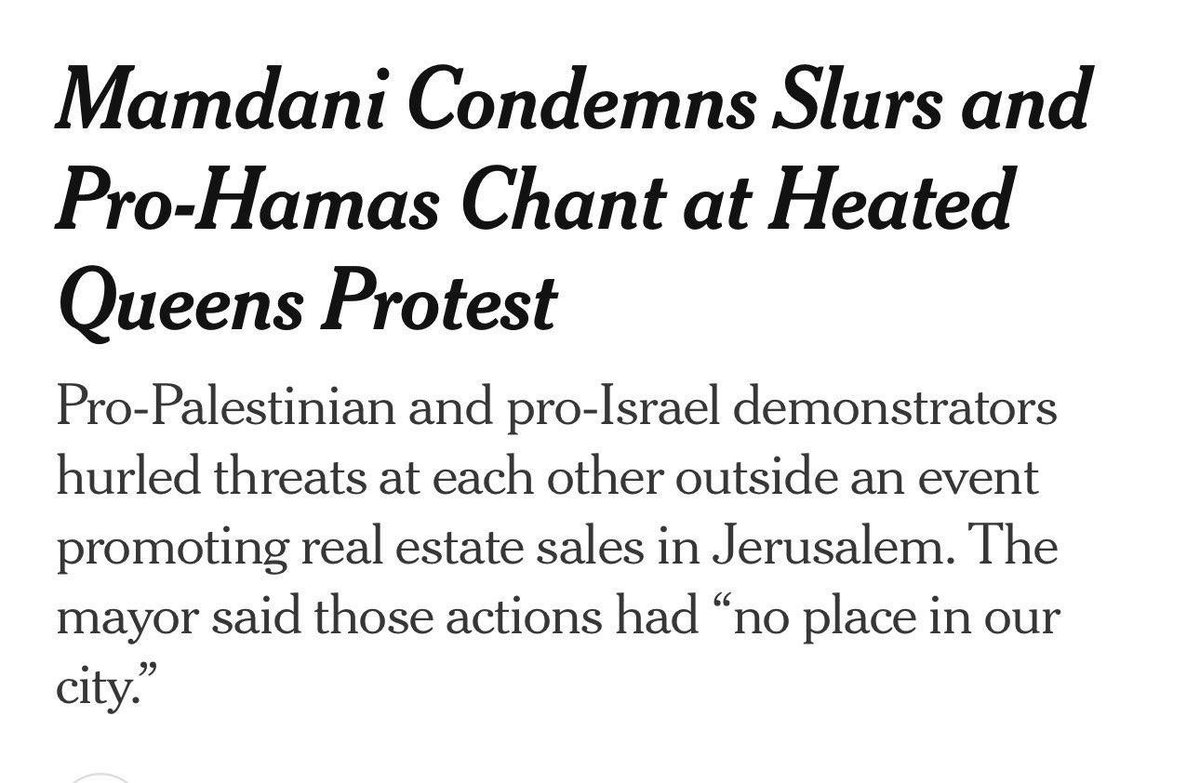
As I said earlier today, chants in support of a terrorist organization have no place in our city. We will continue to ensure New Yorkers’ safety entering and exiting houses of worship as well as the constitutional right to protest.
🚨 GRAPHIC CONTENT, BUT A REALITY CHECK
This is what Hamas does, not just to Israelis, but to their own people.
These are the same people the world calls “freedom fighters.���
Watch this video and remember every single person who marched through your city chanting “Free, free Palestine”, refusing to call Hamas what they are: terrorists.
This is their “resistance.”
Share this. Tag your officials.
Show the world what the mainstream media refuses to show.
🇮🇱 Stay connected, follow @MOSSADil.
Israel can enhance its defense by blending startup creativity and agility with the production capacity, expertise, and global reach of established contractors, creating a more competitive and responsive capability.
https://t.co/JxYgu9SWmH
Let’s normalize the 15 min founder / investor intro Zoom:
- 1 min pleasantries
- 1 min overview on our fund
- 5 min overview by the founder
- 5 min QA
- 2 min demo
- 1 min next steps
It’s plenty of time actually 🚀🚀🚀
NEW YORK'S MORTGAGE RECORDING TAX: STATE-SANCTIONED ROBBERY DESTROYING AFFORDABILITY WHILE THE MTA PICKS YOUR POCKET WITH THEIR 0.3% EXTORTION RACKET
Let's address one of the most predatory, disgusting scams driving New York's already obscene housing prices into the stratosphere: the Mortgage Recording Tax (MRT) – a legalized theft operation masquerading as bureaucracy.
When you dare to pursue homeownership in New York, the state violates your wallet for the audacity of "recording" your mortgage. Don't be fooled into thinking this is some legitimate clerical expense. In functioning states, this would be a modest administrative fee. In New York's legalized racketeering scheme, they calculate this robbery as a percentage of your entire loan, and it bleeds you dry by design.
In New York City, this shameless shakedown reaches an unconscionable 1.925% of your mortgage amount. Let that sink in:
A $500,000 home with a $400,000 mortgage? You're forced to surrender $7,700 just for some bureaucrat to push a few buttons.
A $1.5M home with a $1.2M mortgage? That's a staggering $23,100 stolen from you before you've paid a single cent in legal, broker, or title fees.
This percentage-based extortion is indefensible. It's literally identical paperwork whether you're borrowing $200K or $2M. You're not paying for additional work—you're being punished and plundered for attempting to put down roots in a market already crushing people under its weight.
And here's where this scam becomes truly vile: 0.3% of this government-sanctioned theft operation is funneled directly to the MTA—as if breathing New York air near a decrepit, crime-infested subway entitles them to raid your savings.
The most infuriating part?
🔻 The MTA's 0.3% skim operation alone exceeds—or nearly matches—the entire mortgage tax in virtually every other state.
✅ Florida, the next highest, demands a 0.35% mortgage tax—total.
⚠️ Meanwhile, New York's parasitic system gouges you for up to 1.925%, with massive portions having absolutely nothing to do with actual recording services.
Let's call this what it is: If this tax genuinely covered recording costs, why does it scale with property value? Why should someone buying a $1.5M home be forced to pay three times more in "recording fees" than a $500K homebuyer when the paperwork is identical?
This isn't policy—it's systematic pillaging. It's not a filing fee; it's a deliberately hidden affordability-killing money grab—one that adds tens of thousands to closing costs, crushes homeownership dreams, and disproportionately victimizes buyers in a state already suffocating under astronomical real estate costs.
New York's MRT isn't just among the highest in the country—it's among the most deceitful and corrupt. If the state wants to extract more cash from its residents, they're certainly not shy about it—but they should stop pretending this outrageous fee has anything to do with administrative costs. It's daylight robbery dressed in bureaucratic clothing.
Just another chapter in New York's hypocritical playbook: loudly proclaiming support for affordable housing—while systematically bleeding homebuyers dry.
Bow Bridge, Central Park
1968
Did you know that bridge, completed in 1862, was built with cast iron while most of the other archways in the park were built with stone? It's the second oldest cast iron bridge in America.
The Bronx foundry that built the bridge also constructed the dome of the US Capitol building.
A common misconception: the value of investments increases consistently (even exponentially) over time, so GPs should always hold to maturity.
This idea has played a significant part in slowing down the use of secondary transactions. It's not really true.
Investments often don't increase in value. Quite often, they fail outright. Failure rate does reduce over time (39% at seed, 13% at series D), but it remains significant throughout.
(source: "Analyst Note: VC Returns by Series: Part IV")
To quote the brilliant thread by @robgo:
"Typically, you think of a series A startup as less risky than a seed startup, and a series D startup as less risky than a series A startup. This is often true, but because VC dollars both add and remove risk, the move down the risk curve is less linear."
This is especially true for 'the biggest winners' who are often absorbing huge amounts of capital from the 'venture banks':
"But in recent years, this picture has been skewed even more, especially if the capital raised comes from a mega VC fund. At each funding round, there is a significant re-risking of the startup, to the point that you are not moving meaningfully down the risk curve for a long long time. And even at a late stage, a mega funding round can bring you right back up to the point of maximum risk."
These rounds are also often highly dilutive; particularly with the proclivity of large firms to ignore pro-rata and cram-down early investors.
So, in an absolute sense, there is a sustained risk of failure which slowly concentrates portfolio returns into fewer companies over time, which will decelerate TVPI growth (or even turn it negative).
On top of that, there are often terms included in later rounds which mean that shares held by early investors become relatively overvalued. Particularly, IPO ratchet clauses and automatic conversion vetos.
Thus, even if the theoretical TVPI of a seed fund remains flat, in reality it may be falling:
"In November 2015, Square went public at $9 per share with a pre-IPO value of $2.66 billion, substantially less than its $6 billion post–money valuation in October 2014. The Series E preferred shareholders were given $93 million worth of extra shares because of their IPO ratchet clause. This reinforces the idea that these shares were much more valuable than common shares and that Square was highly overvalued."
(source: "Squaring venture capital valuations with reality")
Looking at @AngelList data, the best time for a fund to sell (on an IRR basis, and ignoring the clauses above) would be year 8 — with value concentrating (but not really net expanding) in years 9 through 12.
(source: "What to Know About TVPI")
That means the typical investment (assuming a 3 year deployment period) would be best positioned for a (partial) sale in years 5-7.
Considering this, it's difficult to make the case that GPs should be holding 100% for the ultimate outcome, every time. If they do, they are concentrating their risk without necessarily improving the portfolio outcome.
To take this a step further, we could assume in a more rational market, less dominated by hype (more secondary activity driving more pricing tension, fewer bullshit markups), the illustrated TVPI would flatten out more gradually — so less of an obvious time to sell.
In short, the story here is not about opportunistic secondaries to drive better IRR. The real case to be made is for a comprehensive secondaries strategy, and opportunistic holding.
For too long, there has been ideological friction around secondaries which has held back venture performance and enabled some very bad habits. It's time to change that.
Agrarian Manhattan
1970s
Battery Park City
Did you know that Battery Park City reclamation project was created using excavated material from the original World Trade Center construction and other sources in Lower Manhattan during the 1970s?