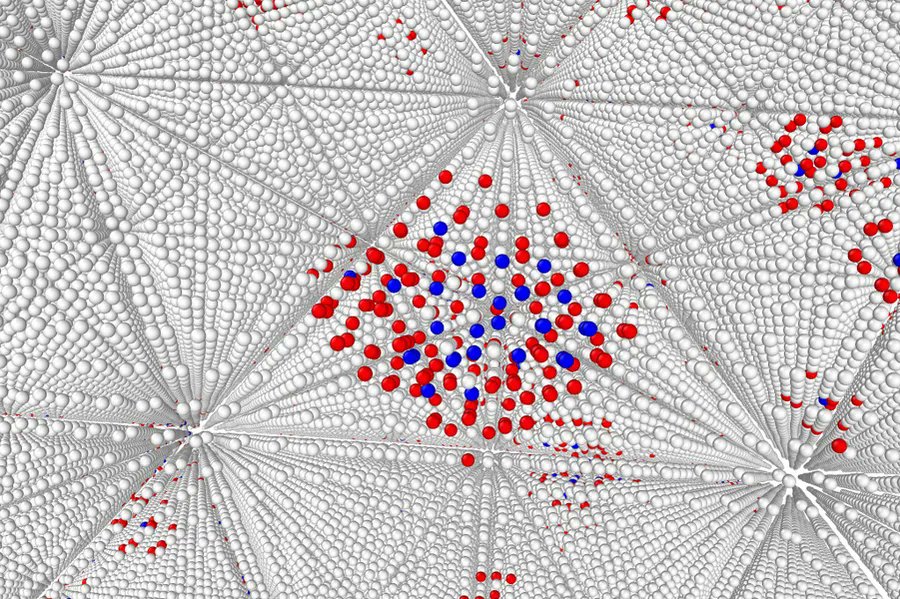
Physicists discover a new switch for superconductivity. The results could help turn up unconventional superconducting materials. https://t.co/bYx6f6gstA
Team uses 3D printing to strengthen a key material in aerospace, energy-generation applications. The approach could improve the performance of many other materials as well.
https://t.co/COKaGMsTFs
Toward more flexible and rapid prototyping of electronic devices. FlexBoard is a flexible breadboard that enables rapid prototyping of objects with interactive sensors, actuators, and displays on curved and deformable surfaces.
https://t.co/NLGO5z1Zit
Drawing inspiration from butterfly wings, reflective fibers woven into clothing could reshape textile sorting and recycling. Read more: https://t.co/mmVHZwB64v
https://t.co/CeyEE1eCkd
MIT scientists have shown that two previously separate fields in condensed matter physics can be combined to yield new, exotic phenomena. Work could have applications in future computers. Read more https://t.co/v5M8XCUWbz
Mining will play an important role in the world’s transition from fossil fuels to renewable forms of energy. How will the world meet that increasing demand while minimizing environmental and social impacts? Read more...https://t.co/9zAsSR2vSe
https://t.co/iIS7KyZSJp
MIT team reports giant response of semiconductors to light and explains atomic origins of phenomenon. Read more https://t.co/verbHFvUbg
https://t.co/305RGWO115
Team IDs simple way to significantly increase lifetimes of fuel cells and other key devices by changing the “pH” of the system. Read More https://t.co/9QOW09fYej
https://t.co/vephHU9guj
Teachers make Frankensteel during Materials Camp, a self-healing material inspired by the villain in the Terminator 2 movie Read more https://t.co/eANKO8D8sb
https://t.co/MF6HvVDoQW
How cool is this? An MIT Materials Camp for high-school science teachers where they made....Frankensteel. And they can recreate the experience for their students back home. @mitmrl https://t.co/OzXATfTV5F
A lot of damage inside nuclear reactors is so small it’s difficult to detect. Now @MIT researchers Michael Short, Scott Kemp, and DMSE’s Ju Li can measure the damage, potentially extending the lifetimes of nuclear power plants. @mit_nse@MITEngineering https://t.co/6qBsL5HUWm