DPH 25%
Daň z vyšš. príjmu 40%
Podniková daň 22%
Daň pri kúpe inv. bytu jak 🐖
Platy 4x viac ako my
To je 🇩🇰
Podľa klamstiev našej pravice a médií je v takej krajine komunizmus a totálna apokalypsa. Lenže sa tam super žije, ľudia sú milí, krajina prosperuje a firmy investujú.
Zamestnanci majú vysoké platy.
Dôchodcovia vysoké dôchodky.
Ľudia v núdzi vysoké dávky.
Len milionári a biznis, ktorí sa topia v zlate strašne trpia.
Tak vyzerá svet podľa liberálnej propagandy v prémiovej žurnalistike. Každý deň.
Mikloš rozdáva rozumy bez oponenta:
- Taliansko má primárny prebytok rozpočtu a aj tak má problémy. Ako ešte viac ozdraviť financie než mať 0,8% primárny prebytok?
- Grécko nevyriešili trhy, ale štáty. Grécku nebol povolený trhový mechanizmus (bankrot), ale boli mu mocensky nanútené pôžičky, aby nemeckí bankári nemuseli niesť dôsledky za svoje zlé finančné rozhodnutia.
- Riešenie vplyvu starnutia na verejné financie vidí len v uťahovaní opaskov, a teda krátení dôchodkov. Sú samozrejme aj iné spôsoby (daň z majetku, z dedičstva, z predaja nehnuteľností a podobne), ale to nepovie ani on, ani nikto, s kým je v diskusii.
Ak by Mikloš vedel, že mu niekto bude v diskusii tie jeho hlúposti vyvraciať, tak do tej diskusie nejde. Lebo guru slovenskej opozície je pokrytec a zbabelec.
@ZzMatuSs Hovoríš, že firmy neplatia dane, lebo im štát nič nedáva. Tak sa pýtam prečo neplatí dane Bezos? Vari majú v USA taky nefunkčný hnoj ako Slovensko?
Sledujem obľubu ukazovať na boomerov ako tých, ktorí sú vinní za všetko.
Nemáte kde bývať?
Platíte veľké dane?
Máte nízky plat?
Na vine sú boomeri!
Ľahká korisť. A liberálom na túto propagandu krásne skončili aj mnohí s ľavicovým myslením. A miliardári sa spokojne usmievajú.
V USA nie sú protesty proti chudobe. Ľudia sú zvyknutí buď sa modliť, alebo umrieť. Pekný dôkaz, že neregulovaný kapitalizmus má najbližšie k feudalizmu a otrokárstvu.
@ZzMatuSs Platenie daní ako súvisí s lacnými energiami? Takže Bezos platí dane z plného príjmu, hej? Alebo chceš povedať, že USA je teda hnoj ako Slovensko, keď ich neplatí?
🇫🇷 FLASH - Édouard Philippe dévoile son programme pour la présidentielle de 2027. Voici les principales mesures qu’il propose :
- Repousser progressivement l’âge de départ à la retraite à 65 ans, avec 45 années de cotisation, en moins de 10 ans, pour ceux qui le peuvent.
- Supprimer 250.000 postes de fonctionnaires en ne remplaçant pas un départ sur trois.
- Réduire à 12 mois maximum les allocations chômage pour les moins de 50 ans.
- Imposer 3 jours de carence en cas d’arrêt maladie, aussi bien dans le public que dans le privé.
- Expulser immédiatement les étrangers ayant commis des délits.
- Mettre fin à l’accord franco-algérien de 1968.
- Suspendre le droit du sol à Mayotte pendant plusieurs années.
- Geler toute immigration à Mayotte pendant 5 ans, y compris dans le cadre du regroupement familial.
- Rétablir la double peine pour les étrangers délinquants.
- Prélever directement les amendes impayées sur les prestations sociales.
- Rendre possibles de courtes peines de prison dès la première infraction.
- Rétablir les peines planchers et supprimer le juge de l’application des peines.
- Instaurer un état d’urgence contre le narcotrafic dans les territoires les plus touchés.
- Utiliser la vidéosurveillance et l’intelligence artificielle pour identifier les casseurs et les criminels.
- Verser 350€ d’allocations familiales par mois dès le premier enfant.
- Exonérer les classes moyennes d’impôt sur le revenu pendant les 3 premières années de leur enfant.
- Augmenter de 20% en moyenne les salaires des enseignants sur 5 ans.
- Permettre aux parents de travailler à 80% tout en conservant 100% de leur salaire pendant 2 mois.
- Instaurer un service militaire volontaire pour 50.000 jeunes chaque année.
- Fixer des quotas pour encadrer l’immigration professionnelle.
- Créer des centres à l’étranger pour organiser le retour des personnes devant quitter la France.
- Ne créer aucun nouvel impôt pendant le quinquennat.
- Réduire de 50 milliards d’euros les impôts de production, en contrepartie d’une baisse équivalente des aides aux entreprises.
- Inscrire une règle d’équilibre budgétaire dans la Constitution après un référendum.
- Former 100.000 ingénieurs en intelligence artificielle chaque année.
- Maintenir un soutien total à l’Ukraine.
(site officiel du candidat)
Mentálna gymnastika odborníka na bezpečnosť z PS:
1) Vymyslíme si o niekom, že je to špión. Úplne na sedláka, bez dôkazov.
2) Dotyčný človek/inštitúcia to poprie.
3) Bátorov víťazný comeback: ČO INÉ BY SME AJ ČAKALI!
4) Americké úrady potvrdia, že nemajú žiadne dôkazy o tom, že je tá osoba špiónom. Bátor je ticho jak voš pod chrastou.
Some companies use your personal data, like browsing history, to serve different prices to different costumers. It’s called surveillance pricing, and we just banned it in New York City.
This tweet will say the same thing in incognito mode, don’t worry.
Jared Kushner is right (never thought I'd say that) – the EU is behaving absurdly.
In 2024 EU national leaders chose Kaja Kallas to be the union's voice on foreign policy (even though some in Western Europe had concerns she was too bombastic on Russia).
It is an obvious choice to have the EU's foreign minister conduct talks on foreign policy. But now Kallas is being blocked from doing so on the Ukraine War because some think she's too anti-Russian. But if that's the case, then why did they choose her to be the EU's foreign minister in 2024?
Here's the truth: the national capitals simply don't want to cede any authority to the EU confederal level on foreign policy. So they continually hobble and handicap the person they've tasked to represent them. And in the end, the EU ends up with no seat at the table because the national capitals can't get over this short-term-thinking destructive instinct.
Europe's problem doesn't come from Brussels. It comes from Paris, Rome, Berlin, Warsaw etc. The short-termism and lack of vision of our national leaders castrates the EU on the world stage.
This is the subject of my new book, Europe's Lost Decades, coming out next year.
https://t.co/ub9rKEs2UF
This is absolutely brilliant, by legendary Australian investor John Hempton, who explains the core financial paradox at the heart of the AI story (and which also, to some extent, may explain the Jensen Huang story).
The numbers say that about $7 trillion in AI compute is set to be built by 2030. For the industry to earn that back, given those chips have a roughly 5-year lifespan and cost a lot to run, they need to generate about $2 trillion of AI revenue a year.
Hempton says the only way you can get to these sorts of numbers is by selling AI as a productivity tool to businesses, meaning replacing workers.
And since, for reasons he explains in the video, no company fires people to save just 10% in costs, the savings have to be about double what businesses pay for the AI: roughly $4 trillion in savings on wages a year.
What does firing $4 trillion worth of workers mean concretely? Hempton calculated this equates to roughly 10% of the OECD’s total wage bill of about $40 trillion: one in every ten dollars paid to workers across the OECD’s 38 member countries.
Which, naturally, when you suddenly take that much income out of people’s pockets, would trigger a massive global recession.
And here's the paradox: in a massive global recession, there's no way businesses will pay $2 trillion a year for AI, so the return disappears anyway.
In other words, AI's only possible path to success given the numbers requires destroying the very economy that is supposed to pay for it.
HOWEVER - and here's where the Nvidia/Jensen Huang story might come into play (and, to be clear, this is now me speaking and not Hempton given this interview is prior to the whole Nvidia saga) - this all rests on a core assumption: that compute stays super expensive. Which in practice means Nvidia keeping its pricing power, with a 75% gross margin on its chips.
Break Nvidia's pricing power, and the $7 trillion bill, the $2 trillion in revenue and the 10% of jobs all shrink with it.
This would also put the whole China story in a different light. Maybe it's not so much a "we don't want the Chinese to be competitive with similar chips to us" story as it is a "we don't want Chinese demand to drive up chip prices" one. Or probably both.
And, as such, you could actually think about the US export controls not as a national security measure but as a good old subsidy for US AI players (together with a handicap for their Chinese competitors), a way to limit the price of chips.
This holds even with China itself blocking Nvidia imports, since Chinese firms simply rent the chips abroad instead, in places like Southeast Asia, which is precisely what this whole Alice Huang/Megaspeed story is about.
The main obstacle for all this was, of course... Jensen. Obviously, the guy wanted the exact opposite: as many buyers as possible, Chinese players included, to keep chip prices and Nvidia’s margins sky-high. He was also the one man with the clout to make that happen.
All hard to prove, of course, but I can imagine that quite a few corks popped this week in Anthropic's offices: nothing like the news that the man keeping your biggest cost sky-high is out when you're a week away from a $1.2 trillion IPO.
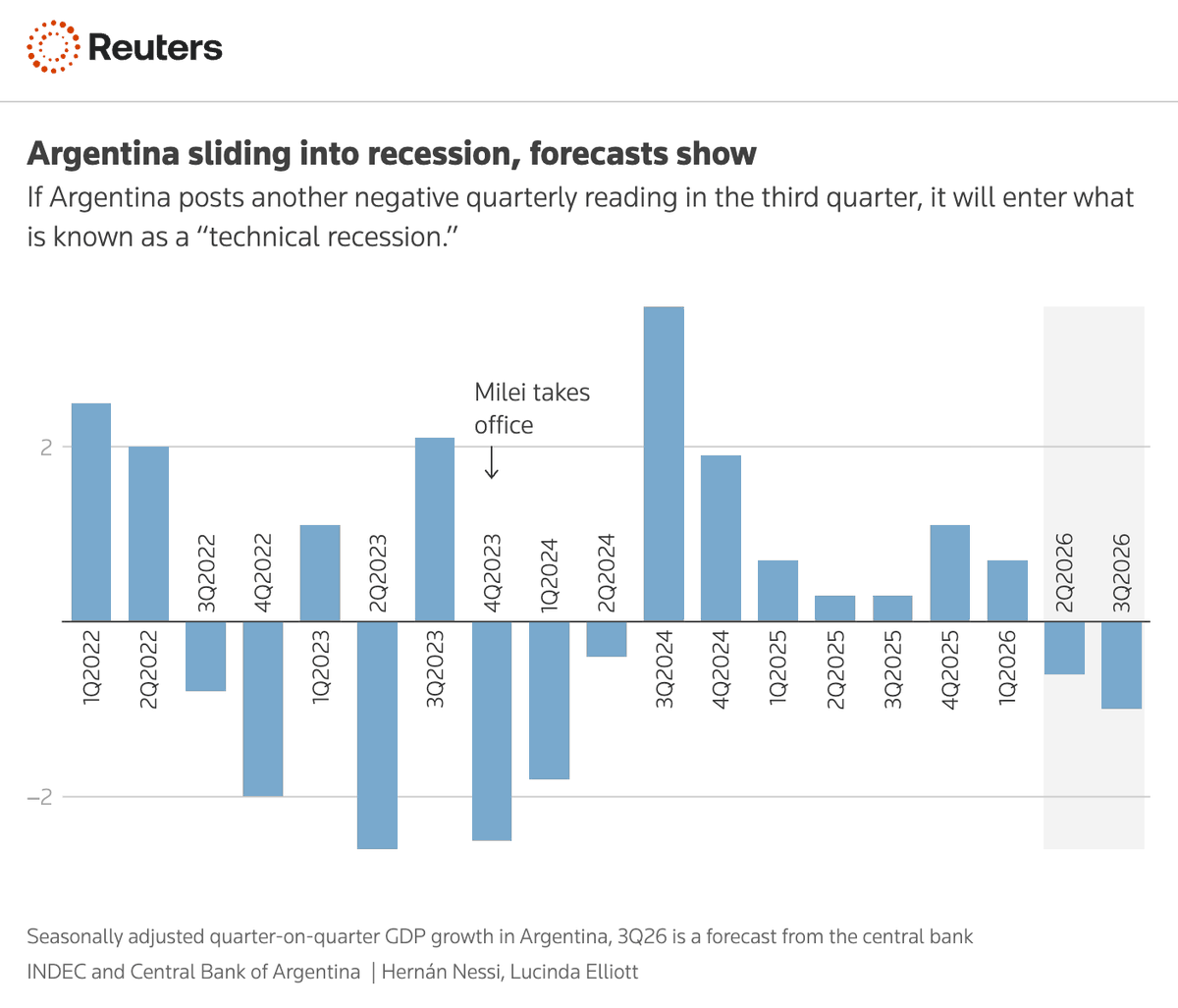
Argentina is officially in recession. The free market dream is over.
Under Milei:
- 32,300 businesses closed
- Industry, construction & retail wiped out
- Only growth sectors are financial speculation & sale of natural resources
- 1/3 people in poverty
https://t.co/IzKcZwAV2T
Tupé škrty a likvidace veřejného sektoru nepřinesly 🇦🇷 prosperitu, ale naopak recesi. Ekonomika pod podivínským libertariánem Javierem Mileiem, kterému se mezi lidmi přezdívá El Kalousek, klesá už druhý kvartál v řadě. Třetina populace žije v chudobě, do voleb zbývá necelý rok.