🇪🇺 As EU co-legislators advance in their respective position on the EU #GridsPackage, with the Permitting Directive expected to be voted in the @Europarl_EN next week, UFE, together with its European counterpart @bdew_ev, @EDSO_eu, @PKEE_Brussels and @Synergrid call for a framework that ensures a secure, affordable and technically robust energy transition. Europe's decarbonisation pathway requires planning tools grounded in operational realities, governance built on system expertise, and regulatory mechanisms that protects consumers while enabling investment.
Tacit approval for grid connection requests should be rejected. Introducing a "silence equals approval" mechanism when DSOs do not reply within the deadlines would create operational, legal and safety risks, whereas every request requires a technical assessment to ensure system stability and grid security. In several Member States, DSOs are already legally obliged to issue a connection offer unless it would endanger the network. The proposed preferential treatment for certain applicants also calls for clarification in light of the non-discrimination principle: the aim must be adequate, scalable and workable rules, not special provisions or parallel connection regimes.
Grid visibility for small-scale installations below 100 kW must likewise be preserved. While their individual impact may be limited, their cumulative effect can significantly affect both distribution and transmission networks. We therefore support maintaining a grid connection application procedure and preserving mandatory notification to DSOs, to ensure the observability of electric flows. Speeding up permitting must not come at the expense of system integrity or the ability of DSOs and TSOs to manage a growing volume of distributed resources.
We stand ready to work with policymakers towards a final agreement that is ambitious, realistic and aligned with system needs.
Find our Joint Statement on Permitting Directive 🔎 https://t.co/q0McklOiS0
Od 9:00 oglądaj debatę: Czas ukończyć w pełni zintegrowany jednolity rynek.
Rok po opublikowaniu raportu Mario Draghiego nt. konkurencyjności UE, PE przedyskutuje z przedstawicielami Rady i Komisji, jak doprowadzić do całkowitego zintegrowania jednolitego rynku i rozwinąć go ⤵️
Important @Bruegel_org paper: #Poland GDP at risk in the low-carbon transition is 43,1% - nearly 3 times higher than #EU average (16,2%). This is exactly why any post-2030 climate target needs an Impact Assessment with granular results on a country level⤵️
https://t.co/uysYudB9Mx
Szereg organizacji i stowarzyszeń (@ZPPnetpl, @Konf_Lewiatan, @PracodawcyRP, @Federacja_PL, @_PKEE_, @fundacjainstrat i wiele innych) – także tych związanych z przemysłem ciężkim – oraz @pse_pl z apelem o podpis prezydenta pod ustawą odblokowującą potencjał lądowych elektrowni wiatrowych. To ważna i potrzebna zmiana 🤝
@On58Greg Gdy pracowałem w branży wiatrowej widoczna była duża chęć dzierżawienia działek pod FW z uwagi na zyski i duża niechęć sąsiadów bazująca na podejściu ,,czemu sąsiad ma zarobić, a ja nie". Proponowane rozwiązanie zatem bardzo na plus. Oby podpisał prezydent.
Did you know that electricity is often taxed more than fossil fuels in the EU?
It’s a policy choice that makes electrification less competitive.
Our @RegAssistProj report explores how taxes and levies shape this imbalance and what can be done.
https://t.co/BNsZbHfLcD
DG ENER Report: Investment needs of European energy infrastructure to enable a decarbonised economy - Final report
https://t.co/ByZX1YsXMH
https://t.co/rBdIRTLLm6
🇵🇱 Krzysztof Bolesta also warns that if the Commission hopes to push through an enhanced climate target for 2040, it must present an ambitious Clean Industry Pact for business as a counterweight.
2/2
@chrisbulski w @xyz_oficjalnie: 🇩🇪 mają 253 organizacje/firmy,zabiegające w Brukseli o ich interesy gospodarcze w #UE, 🇨🇵 151,a Polska... 10. Tym większy zaszczyt móc kierować @PKEE_Brussels i organizować imprezy takie,jak #EnergyDay2024 9XII. Działamy!👍💪https://t.co/4oAZlo2LNT
13 November I The path to the climate neutrality of district heating systems - Solutions, regulations, technologies
Join this Hybrid Conference to discuss the road to net-zero of district heating systems.
Register here: https://t.co/TPy6O185eU
More info: https://t.co/WvDyfnmRYi
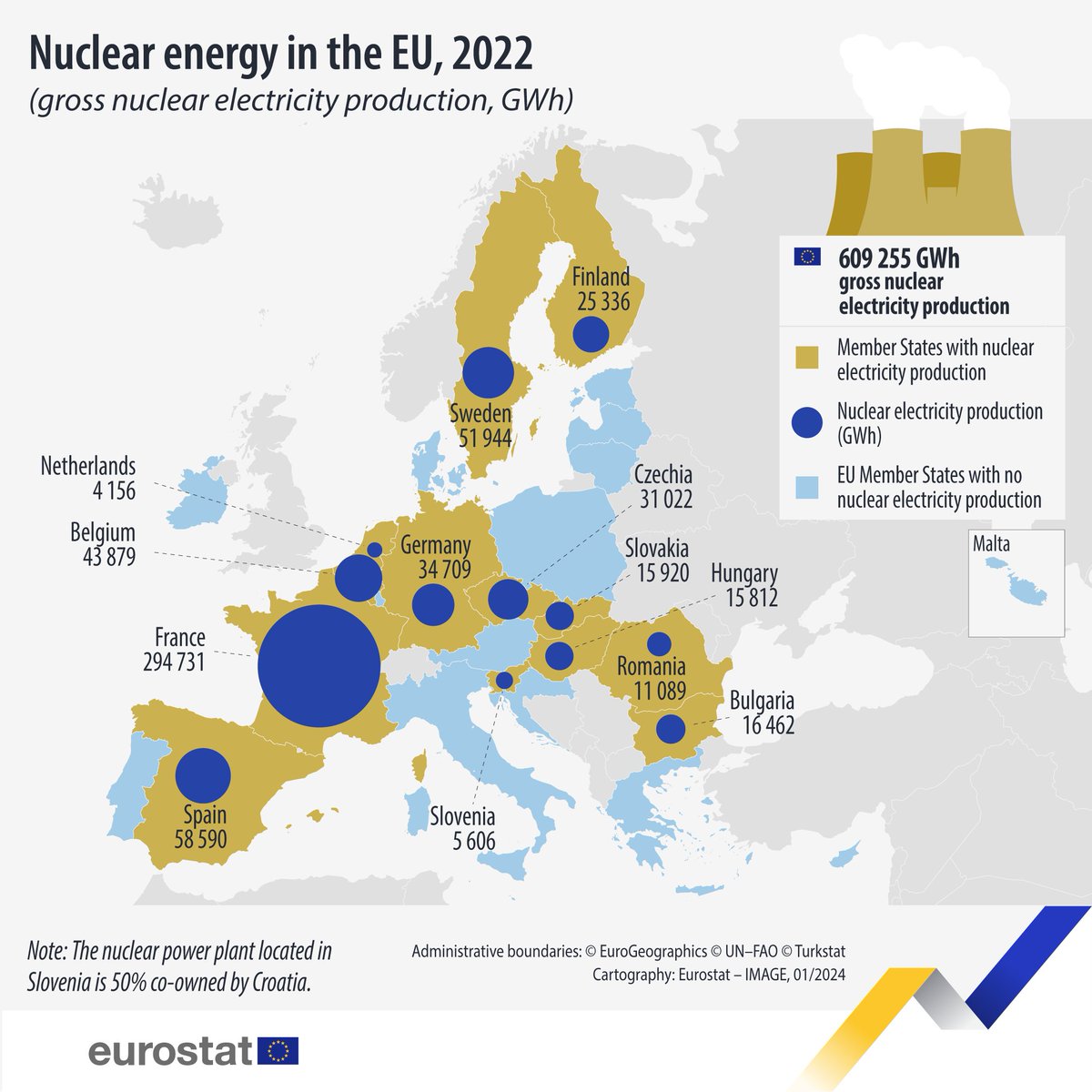
The EU's approach to the nuclear energy is changing on its favor, but... nuclear electricity production in the EU is decreasing (the peak was in 2004).
⚡Drop in #nuclear power production
In 2022, 13 EU countries generated 609 255 gigawatt hours of nuclear electricity (-16.7% compared to 2021)
Highest in:
🇫🇷France (48.4%; 294 731 GWh)
🇪🇸Spain (9.6%; 58 590 GWh)
🇸🇪Sweden (8.5%; 51 944 GWh)
More info➡️https://t.co/rqMhp0y85m