Everything you need to master in 2026 to get rich:
• Using Fable 5 for planning, Codex for execution
• Hermes agent
• Coding loops
• Running Codex/Claude Code side by side
• /goal
• Running local models
• Karpathy's Autoresearch
• Building an X audience
• Creating videos
• How machine learning works
• How databases work (been using Convex)
• Using API's
• Training your own LoRAs
• Elimination of doom scrolling
• Most importantly: focus
anthropic just published the official playbook for getting the most out of Fable 5.
it's a long technical doc, but I pulled out the best prompting techniques you can actually use here:
1. tell it why you're asking. fable 5 works better when it knows what the task is for. instead of "write me X," say "i'm building X for Y, they need Z, so write me X." that context helps it pick the right approach instead of guessing what you wanted.
2. stop writing long prompts. older models needed you to spell out every rule. fable 5 follows one short, clear instruction just as well as a 20-line list. anthropic's actual advice in the guide: go back into your old prompts and delete instructions. the long ones you wrote for older models now make fable 5's answers worse.
3. give it your hardest problem first. most people only test a new model on easy tasks, so they never find out what it can really do. it's like using a ferrari to drive to the mailbox. anthropic says the teams getting the most out of fable 5 are the ones handing it their biggest, messiest, still-unsolved problems.
4. make it check its own work before it reports back. on long tasks, models tend to say "done" when they're not actually done. the fix from the guide: tell it "before you tell me you finished something, show me the proof, and if you haven't verified a step, say so." in anthropic's testing this almost completely stopped the model from claiming work it hadn't done.
5. turn the effort up or down on purpose. fable 5 lets you set how hard it thinks, from low to max. even on its lowest setting it beats the best setting of the previous generation of models. use high effort for hard thinking, low effort for simple stuff you just want done fast.
6. tell it when to stop and ask you. on its own it'll either bug you too much or charge ahead and do too much. one line fixes it: "only stop and check with me before something you can't undo, a real change in scope, or anything only i can answer. otherwise keep going."
7. when you're just thinking out loud, tell it that. fable 5 has a habit of "fixing" things you were only describing. so say it directly: "i'm just thinking through this, don't change anything yet. give me your read on it and stop there."
8. give it a memory. fable 5 gets noticeably better when it can write down what it learned and read it back later. this can be as simple as one notes file: one lesson per line, plus why it mattered. it stops making the same mistake every time you start a new chat.
9. have it run several agents at once. fable 5 is much better than older models at managing helper agents. you can tell it to split a big job into parts and run a separate agent on each part at the same time, while the main one keeps working. one person directing a whole team of bots.
10. have a second agent check the first one's work. when a model reviews its own output, it misses its own mistakes. so use a fresh agent that hasn't seen the task and ask it to check the result against what you originally asked for. an outside checker catches what the original misses.
11. expect it to run for a long time. on hard tasks, one request can think for several minutes, and a fully autonomous run can go for hours. anthropic now tells teams to stop staring at the screen and just check back later, the way you'd check in on a coworker.
Karpathy just wrote the manual for Claude + Obsidian as a real second brain.
Most vaults die the same way. A year of saved articles and highlights. None of it linked. The graph rots while it still looks impressive.
So he moved the upkeep to the model. You curate sources and ask questions. Claude files, links, and reconciles. You keep judgment. It keeps the books.
raw belongs to you and never gets edited. wiki belongs to Claude. It isn't RAG. Your sources compile once into linked pages and compound from there.
9 rules. Start with 10 sources, not 10,000.
Most people hoard notes. This turns them into a brain that maintains itself.
This is actually wild. Hermes just let you merge any two AI models into one virtual model. 🤯
It is called Mixture of Agents. Here is how it works.
You pick any two models. GPT-5.5 and Claude Opus for example. One runs as the reference, one as the aggregator. Name the combo anything you want. It shows up as a single selectable model in your picker like any other.
Every task, both models run in parallel. The reference analyzes and responds.
The aggregator reads that, synthesizes everything, writes the final answer, and handles all tool calls. You see one clean output.
The results on hard agentic tasks:
→ 8% higher than Opus 4.8 alone
→ 11% higher than GPT-5.5 alone
Full Hermes features work untouched. Memory, tool use, skills, long sessions, cross-channel messaging. Nothing breaks.
The combo just performs better than either model on its own.
You can mix any providers too. OpenAI, Anthropic, OpenRouter, local models. Whatever you have access to.
MASSIVE Hermes Agent update over the last few days
Totally changes the way I use Hermes
Here's 8 new features you need to start using immediately:
1. Native iMessage support: This is by far the easiest way to message Hermes on the go. Totally free to set up. I now use iMessage for quick prompts on the go, Hermes Desktop at home
2. Background agents: Background agents are now on by default. Now you can give Hermes complex prompts and by default Hermes will spin up subagents and put them in the background. Instead of waiting a long time to follow up with your agent while it works, you can immediately message it while background agents work quietly
3. Updated Desktop App: Bunch of new quality of life features in the desktop app including:
• pop out chats in their own window
• model selector now at bottom
• live subagents pane
• built in terminal
4. Profile builder in the browser: profiles in Hermes are basically new Hermes agents that work side by side. You should have at least 2 profiles set up so if one goes down, the other can fix it. Never been easier to set up new profiles, type hermes dashboard in your terminal and go to profiles
5. Skills Hub: There's now a skills hub in Hermes dashboard as well. Makes it really easy to browse and install new and popular skills
6. Smarter memory edits: your agent will now self improve way more and with better improvements too. Your agent will constantly write and update new skills as you work
7. Unreal Engine 5.8 MCP: For the first time you can now use AI to build video games in the most popular and powerful engine on Earth: Unreal Engine. Install the MCP in Hermes and you can have your agent build super complex and in depth 3D games.
8. Better Telegram formatting: Hermes now takes advantage of complex formatting in telegram like tables and charts. I like to use Telegram when I'm doing deep work on the go and iMessage when I have quick prompts on the go
Excellent updates that have significantly improved the experience. Video showing how to use and set this all up shortly.
HOW TO MAKE $50K/MONTH SELLING MANAGED AI AGENTS (FULL COURSE)
The model: sell managed AI agents to businesses for $5K/month each. You handle the infrastructure, they get an employee that never sleeps.
10 clients puts you at $50K MRR with 85%+ margins, run entirely by you and a fleet of agents.
@nickvasiles is doing exactly this, and he came on the pod to walk through the whole playbook.
Here's what I learned:
1. The arbitrage is that nobody knows this is possible. 99% of business owners are still asking ChatGPT what the weather is. One working agent hooks them on the spot.
2. Sell abundance. Unlimited agents, unlimited infrastructure. They don't care what an MCP is, they care that their problem is gone.
3. Don't niche too early. Say yes to everyone and let the market pull you. You find the niche by doing reps, not guessing.
4. Paid audit into managed service. Charge $1K to map every automation opportunity, then credit it toward month one. Qualifies the lead, makes the upsell a no-brainer.
5. First call, don't sell. Record it, map the workflow tip to tail, find the automation with the most value and least effort. Start there.
6. The stack is Hermes + Composio + Orgo. Composio connects all their apps in one click. Orgo spins up a working Hermes agent in 26 seconds.
7. Productize with a golden snapshot. Build one perfect agent, clone it, and every copy comes over one for one with auth intact.
8. Turn client call transcripts into skills in 10 minutes. Feed the recording to Claude Code, write the skill, port it to the client's agent via Orgo MCP.
9. Watchdogs make you look elite. Get alerted before the client notices anything broke. "Already fixed it" is why they keep paying you.
10. You become their guy. You drive more outcomes than their own employees, they credit every win to you, and churn drops to almost nothing.
His 2 key takeaways:
1. Bet on cost going to zero. They launched unlimited tokens when it was barely profitable because they knew they'd capture the spread. Build for where the puck is going.
2. One client every six weeks gets you to $600K a year. The model isn't hard, it's just unevenly executed. That's the entire opportunity.
Nick is crushing this model and we had a blast diving deep on how you can do the same.
Go follow @nickvasiles
Full video below.
https://t.co/aeH4PeWwar
(Also available on the Build With AI podcast wherever you get your pods)
There is an old laptop in your closet.
Gathering dust. Dead battery. Slow processor. You keep it because you feel guilty throwing it away.
That laptop can replace every cloud subscription you pay for.
- Netflix
- Google
- Dropbox
- 1Password
That is $42 a month. $504 a year. To rent things you used to own.
The old laptop in your closet could do all of it.
Now meet CasaOS.
A free and open source system that turns any old laptop, Raspberry Pi, or mini PC into your own personal cloud.
You run one command. In 30 minutes, the laptop becomes a server. You open it from your phone, your TV, your work computer, anywhere in the world.
Then you pick the apps you want from a built-in store. One click each.
- Jellyfin to replace Netflix. Stream every movie and show you own.
- Immich to replace Google Photos. Faces and search included.
- Nextcloud to replace Dropbox. Sync every file across every device.
- Vaultwarden to replace 1Password. All your passwords, your keys.
- Syncthing to keep files in sync across every device, no cloud.
- Home Assistant to control every smart device in your home.
- AdGuard to block ads on every device on your wifi.
Setting up a home server the old way took an entire weekend. Install Linux. Learn Docker. Write config files. Set up storage. Fix errors. Look up every app one by one.
CasaOS does all of that for you. No code. No config files. No Linux skills. You see icons on a screen. You click them.
34,116 stars on GitHub. Apache 2.0. Free forever.
Built by a small team starting September 2021. Runs on Raspberry Pi, Intel NUC, old laptops, and most home servers. Over 100,000 Docker apps can be installed.
A new Raspberry Pi costs $50. The old laptop in your closet costs $0. It already works. It is already in your house.
Netflix charges every month. CasaOS doesn't.
Google charges every month. CasaOS doesn't.
Dropbox charges every month. CasaOS doesn't.
1Password charges every month. CasaOS doesn't.
Here is the wild part.
The laptop you forgot about is more powerful than the web server that ran most websites in 2008.
It is sitting in a drawer. It costs you nothing. It already works.
One command. Thirty minutes. Five hundred dollars a year back in your pocket.
Your files. Your photos. Your movies. Your home.
Your closet just became a data center.
GOOGLE CEO SUNDAR PICHAI: "IF YOU DON'T LEARN HOW TO ORCHESTRATE AGENTS NOW, YOU'LL SPEND 2027 CATCHING UP TO PEOPLE WHO STARTED TODAY."
30 minutes on why the best engineers stopped writing code line by line and started orchestrating agents instead.
Most people think building an agent requires an engineering degree.
It doesn't.
It requires one guide and one afternoon.
Watch the interview. Then save the exact setup below.
One guide. One afternoon. That's all it takes.
The gap between you and the engineers winning in 2027 closes this weekend.
I just vibe-coded a Google Maps Lead Gen Scraper in Claude Code that pulls hundreds of local business leads in minutes 🤯
Enter a keyword, city, & state → get back names, phone numbers, emails, websites, & reviews.
All inside Claude Code.
Perfect for agencies and lead gen operators who need a fresh prospecting list every week without burning $200/month on a scraper SaaS.
If you're still building lead lists by hand...
searching Google Maps,
clicking through listings one by one,
copy-pasting phone numbers into a spreadsheet for hours just to end up with a few hundred decent leads...
This scraper eliminates the entire loop:
→ Enter your keyword (plumber, dentist, realtor, etc.)
→ Pick your city and state
→ Set the number of results you want
→ Hit search and let Apify do the scraping
→ Save the leads you like to a bookmark list
No manual searching.
No copy-pasting into spreadsheets.
No $200/month lead gen tool.
What you get:
→ Full search results with complete business info
→ A bookmark feature to save your best leads
→ Search history to track every past scrape
→ Optional Replit hosting so your whole team can use it
Built 100% in Claude Code.
I recorded a full walkthrough showing exactly how I built this from scratch, plus all the prompts I used.
Want all the prompts so you can build it yourself?
> Like this post
> Comment "LEADS"
And I'll send it over (must be following so I can DM)
the US government literally just banned Fable 5 for non-Americans due to cybersecurity concerns...
but you're still being lazy with your digital security? lol
your bank accounts, photos, social media, and identity are more vulnerable than ever thanks to AI.
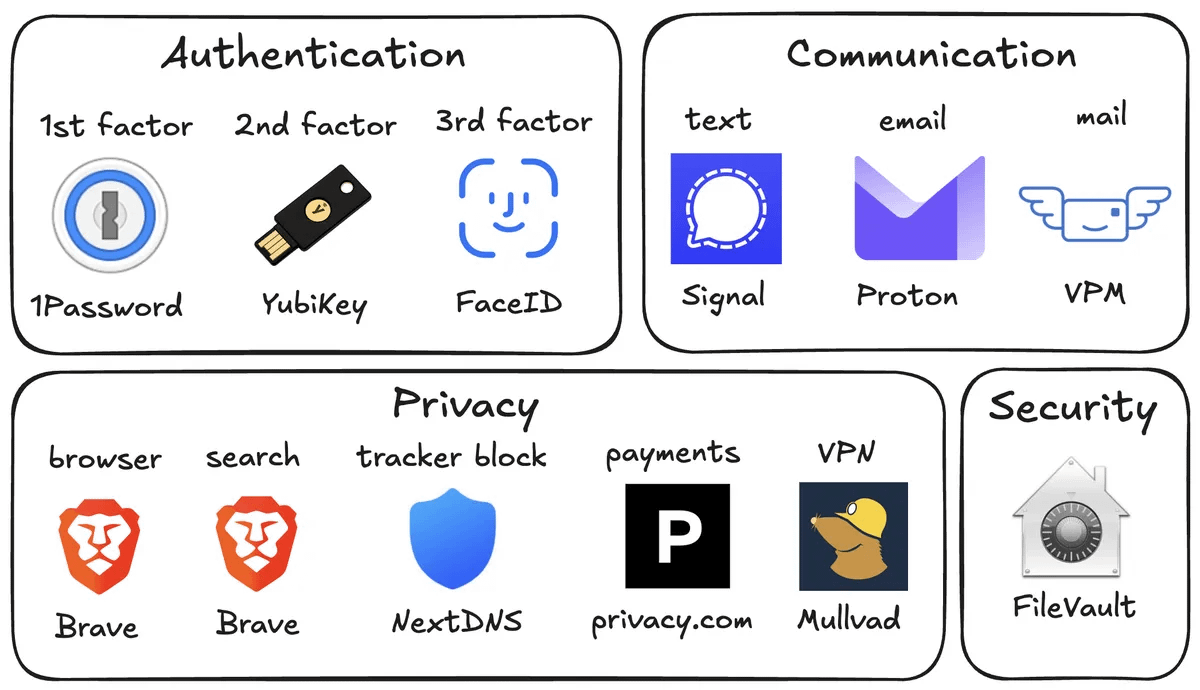
this is why Karpathy's digital hygiene guide is probably the most important thing you can read this week.
> use a password manager for every account
> set up physical security keys so attackers can't log in
> enable face id and fingerprint everywhere
> randomize your security question answers
> encrypt your hard drive
> get rid of unnecessary smart home devices
> switch to signal for private messaging
> use brave instead of chrome
> switch to brave search instead of google
> mint virtual credit cards for every purchase
> get a virtual mailing address
> never click links inside emails
> use a vpn on public wifi
> block ads and trackers at the dns level
> install a network monitor to see which apps are spying on you
full breakdown of each step below:
Europeans and American patriots!
Tomorrow, the courts of my country, France, may decide to send me to prison for daring to say on television that “the main danger to women in France is Black African and Arab immigrant men.”
Meanwhile, my own attacker, a Tunisian migrant, is still at large.
I need your help to generate media pressure and hope to be acquitted.
They cannot silence the truth!
Thank you for your support 💪🏻🇫🇷
ANTHROPIC JUST OPEN SOURCED THE ENTIRE WALL STREET WORKFLOW AND FIRMS ARE NOT GOING TO BE HAPPY ABOUT IT.
DCF models. LBO models. Equity research reports. Merger analysis. KYC checks.
All of it. Free. On GitHub.
Here is what just became available to anyone with a laptop.
Direct connections to Bloomberg, FactSet, S&P Global, Morningstar, and PitchBook.
Real Excel models with live formulas and sensitivity tables built automatically.
CIMs, IC memos, earnings reports, and buyer lists drafted on demand.
PE due diligence, GL reconciliation, and NAV tie-outs running as production agents.
This is not a chatbot wrapper that summarizes financial news.
These are production agents that own entire financial workflows end to end.
The kind that investment banks and private equity firms pay $50,000 to $500,000 per year in software licenses to run.
Now it is a one-line Claude Code plugin install.
19,800 GitHub stars.
Apache 2.0 license.
100% open source.
Think about what this actually means.
A junior analyst at a bulge bracket bank spends 80% of their 100-hour week running models, drafting memos, and compiling data across Bloomberg and FactSet.
That entire workflow just became a Claude Code agent.
The banks charging clients $500 an hour for analysis that this system produces in minutes are not going to tell you this exists.
The boutique advisory firms charging $50,000 retainers for due diligence work that these agents handle autonomously are not going to promote this repo.
But it is already live.
19,800 people have already starred it.
The window where knowing this gives you an edge over every analyst, associate, and advisor still doing this manually is open right now.
Star it. Fork it. Deploy it this weekend.
Bookmark this before your next financial model.
Follow @cyrilXBT for every open source release that disrupts an overpriced industry the moment it drops.