Energy and power are first-class resources in scaling AI compute.
https://t.co/uq5rWvY6jB builds open-source infrastructure for measuring, understanding, and optimizing the energy use of ML workloads.
Start here:
- https://t.co/dlMO31ZCLT
- https://t.co/51t3ymSyEX
Maxing out energy efficiency across training and inference lowers cost per token and increases revenue per megawatt.
Full‑stack optimizations include:
⚡Energy‑efficient MoE architectures
⚡Narrow‑precision formats like NVFP4
⚡Dynamic power allocation with real‑time telemetry
⚡Energy‑aware training that cuts idle GPU time
The result: more tokens per second per watt on fixed power budgets, allowing you to redirect saved energy from training to inference on the same infrastructure.
🔗 Learn more: https://t.co/MAHOkp0cWs
#ISC26
Maxing out energy efficiency across training and inference lowers cost per token and increases revenue per megawatt.
Full‑stack optimizations include:
⚡Energy‑efficient MoE architectures
⚡Narrow‑precision formats like NVFP4
⚡Dynamic power allocation with real‑time telemetry
⚡Energy‑aware training that cuts idle GPU time
The result: more tokens per second per watt on fixed power budgets, allowing you to redirect saved energy from training to inference on the same infrastructure.
🔗 Learn more: https://t.co/sdoCmjO3kk
#ISC26
Introducing Slingshots // THREE: 13 projects from the top researchers and top institutions in US and Canada. Alt architectures, world models, continual learning, hard sciences, HCI, and more. Let's meet the batch 🧵
ML ENERGY x NVIDIA blog post is live!
Power is a binding constraint for AI factories, and energy efficiency converts directly to revenue.
This collaborative blog post covers our works on providing energy observability and improving performance per watt:
- Understanding and optimizing inference energy consumption with the ML ENERGY Benchmark & Leaderboard
- Optimizing training energy consumption with Perseus & Kareus
Our works are open-source on GitHub, and we look forward to more collaborations with NVIDIA!
https://t.co/5WBSQGsr0b
@NVIDIAAI@NVIDIAAIInfra
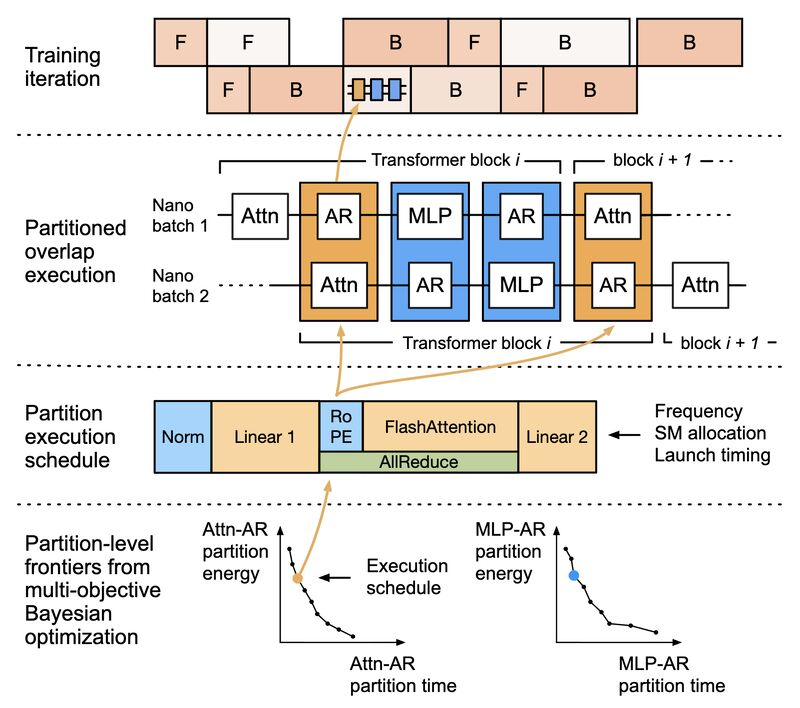
Kareus (OSDI ’26) is our latest advancement in large model training time & energy optimization.
Large-model training energy is shaped by both dynamic and static energy.
- Lowering GPU frequency can reduce dynamic energy.
- Improving kernel scheduling can reduce runtime and static energy.
But these two are not independent: GPU frequency and kernel scheduling interact.
Kareus jointly optimizes kernel scheduling and GPU frequency to push the time-energy frontier for large-model training.
Paper: https://t.co/hmXlAGnTJU
GPU energy measurement depends on more than the code being run.
- Temperature
- Warmup and cooldown (in the literal sense)
- Measurement duration
Getting these wrong can produce meaningfully different measurement results.
Read more in our blog post: https://t.co/ms5FapU0Ao
SKILL.md & Claude Code plugin for the https://t.co/NSitZ2VTDR Data Toolkit
Have a question about the https://t.co/NSitZ2VTDR Benchmark data? Install the data toolkit SKILL.md in your favorite coding agent and fire away natural language questions.
For Claude Code:
/plugin marketplace add ml-energy/data
/plugin install skill@ml-energy-data
Toolkit: https://t.co/s1ALOBS5v1
Programmatically analyze time & energy data with the https://t.co/NSitZ2VTDR Data Toolkit.
The web leaderboard (https://t.co/p9lkrxBtft) is nice for browsing, but not if you want to actually derive insights from data.
We released the https://t.co/NSitZ2VTDR Data Toolkit: a Python library for working with https://t.co/NSitZ2VTDR Benchmark data, including token latencies, power timelines, energy measurements, batch size, and more.
It is already used to build the leaderboard, support blog analyses, and power downstream use cases such as AI datacenter-grid simulation.
Try it out: https://t.co/s1ALOBS5v1
The https://t.co/uq5rWvYE99 Leaderboard v3.0
Energy, Power, Latency, and Throughput measurements for a vast set of LLMs and diffusion models on state-of-the-art AI computing stacks including B200 GPUs.
Leaderboard: https://t.co/utxHsLrqDP
Analysis: https://t.co/8v2wtIoRnV